
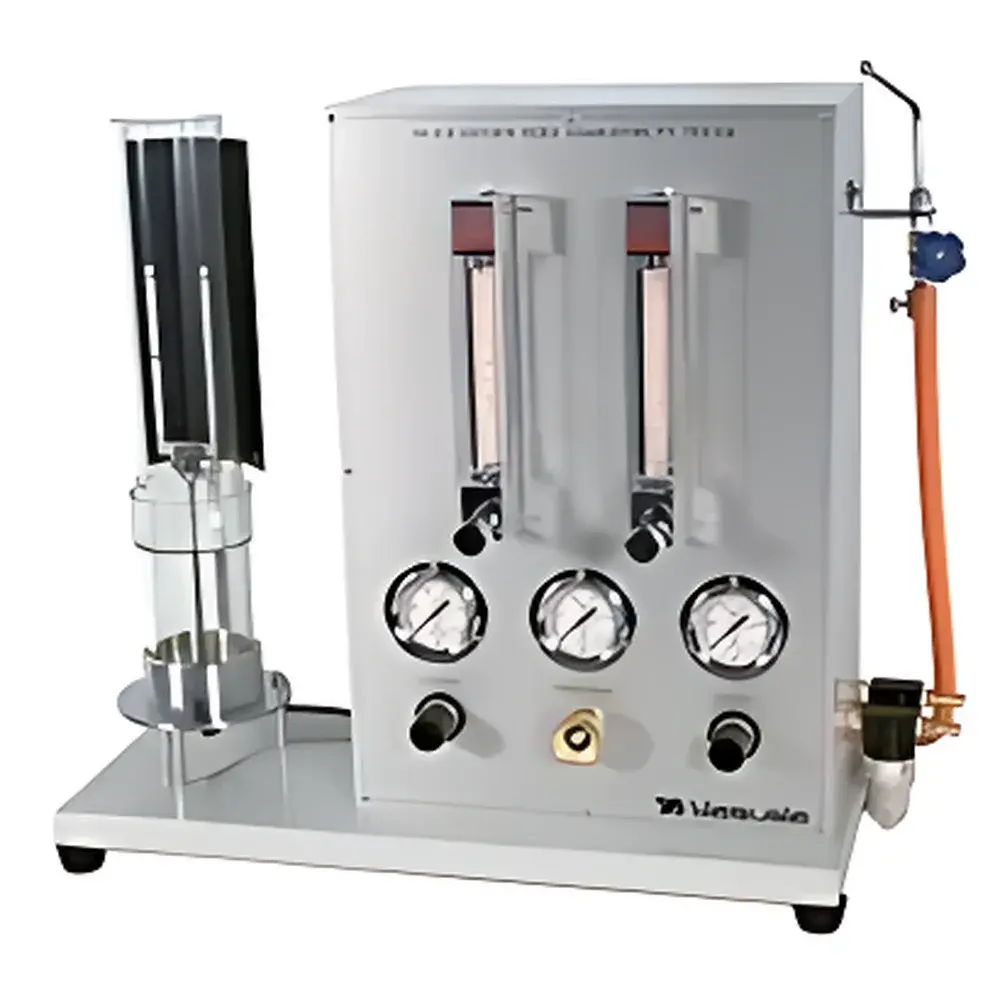
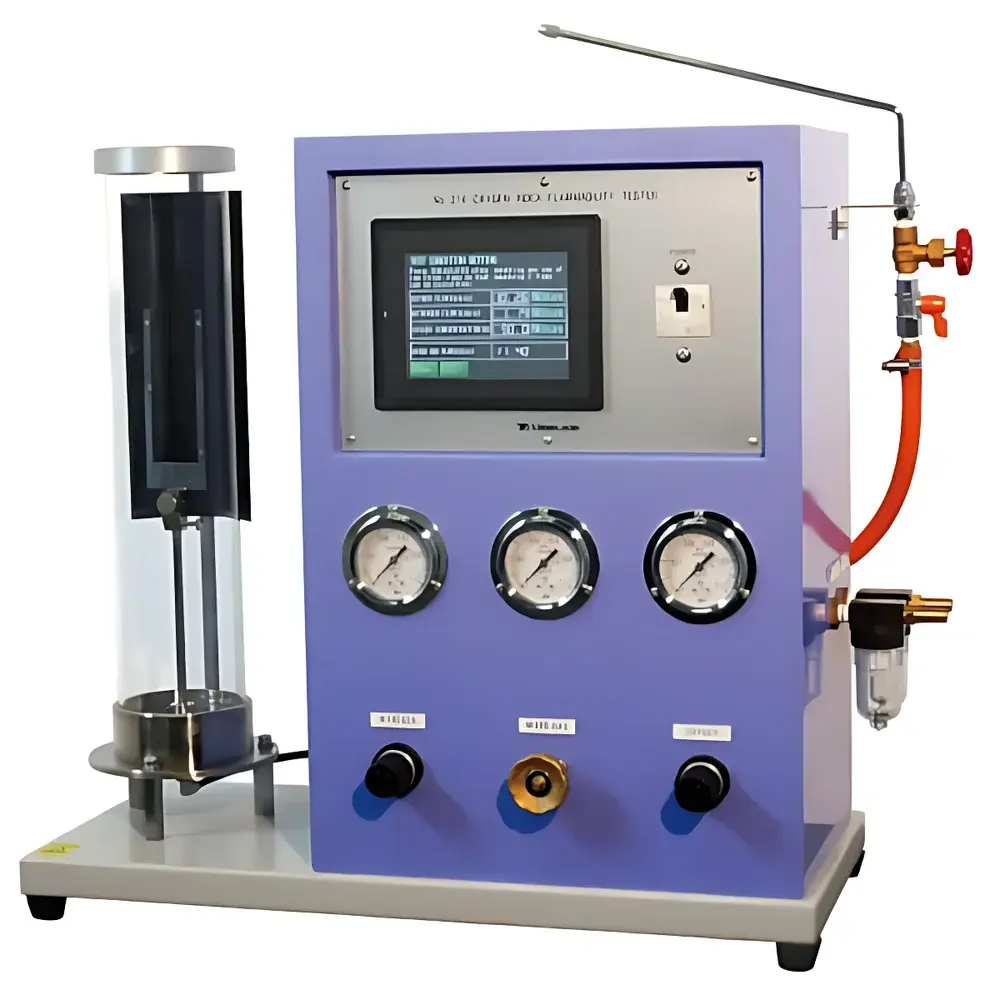
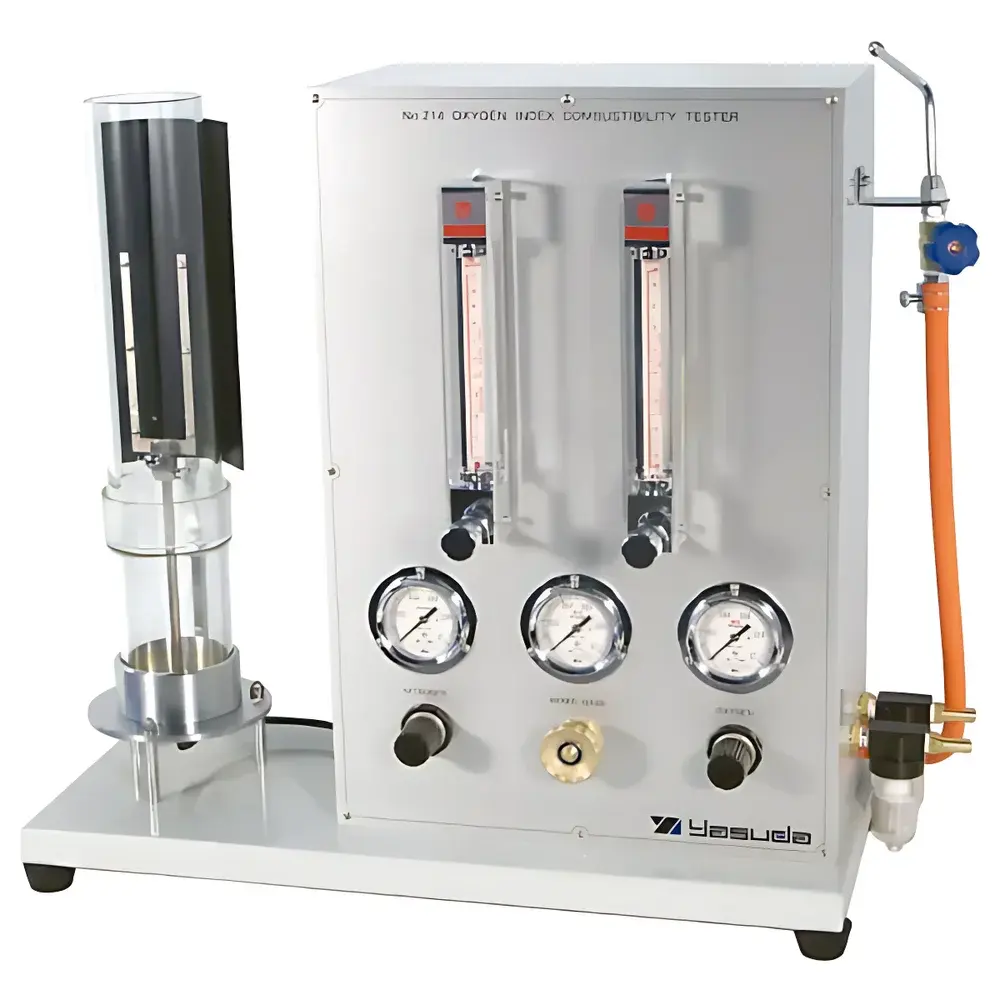
Yasuda No.214 Oxygen Index Tester
| Brand | Yasuda |
|---|---|
| Origin | Japan |
| Model | No.214 |
| Standards Compliance | JIS K6269, JIS K7201, ASTM D2863, ISO 4589-2 |
| Combustion Tube ID | Φ75±3 mm (No.214) / Φ95 mm (No.214-ISO), H: 450±5 mm |
| O₂ Flow Range | 0–8.6 L/min (±0.1 L/min) / 0–20 L/min (±0.1 L/min) |
| N₂ Flow Range | 0–11 L/min (±0.1 L/min) / 0–20 L/min (±0.1 L/min) |
| Pressure Range | 0–0.1 MPa (±0.002 MPa) for O₂, N₂, and mixed gas |
| Flame Height Adjustment | 6–25 mm |
| Specimen Holder | Adjustable vertical clamp with optional high-temperature (HT) configuration |
| Fuel | Methane (≥98% purity) or town gas |
| Dimensions (W×D×H) | ~600×300×580 mm (No.214) / ~600×270×580 mm (No.214-ISO) |
| Weight | ~35 kg (No.214) / ~25 kg (No.214-ISO) |
Overview
The Yasuda No.214 Oxygen Index Tester is a precision-engineered instrument designed for the quantitative determination of the limiting oxygen index (LOI) of polymeric materials—including thermoplastics, thermosets, elastomers, fibers, and composites—according to internationally recognized flammability test standards. Based on the principle of upward flame propagation in a vertically oriented specimen column under controlled oxygen–nitrogen atmospheres, the device measures the minimum volume fraction of oxygen in the mixture required to support candle-like combustion for at least 3 minutes or over a defined length (typically 50 mm). This LOI value serves as a critical comparative metric in fire safety evaluation, material selection for regulated environments (e.g., aerospace interiors, rail transport, building cladding), and R&D-driven flame-retardant formulation development. The system operates under laminar flow conditions within a calibrated combustion tube, ensuring reproducible gas mixing, uniform thermal environment, and stable ignition dynamics—essential for inter-laboratory comparability and regulatory acceptance.
Key Features
- Two configuration variants: Standard No.214 (combustion tube ID Φ75±3 mm) and ISO-compliant No.214-ISO (Φ95 mm), both with height tolerance ±5 mm (450 mm total), enabling alignment with JIS, ASTM, and ISO method requirements.
- Dual-range mass flow control: Independent, high-stability rotameters for oxygen (0–8.6 L/min or 0–20 L/min) and nitrogen (0–11 L/min or 0–20 L/min), each with ±0.1 L/min resolution and calibrated traceability to national standards.
- High-precision pressure monitoring: Digital pressure transducers (0–0.1 MPa, ±0.002 MPa accuracy) for O₂, N₂, and blended gas supply lines—critical for maintaining consistent total flow and stoichiometric ratio integrity during extended testing cycles.
- Adjustable Bunsen-type burner with fine-thread flame height control (6–25 mm), compatible with methane (≥98% purity) or municipal gas, ensuring repeatable ignition energy delivery per ASTM D2863 Annex A1.
- Modular specimen handling: Vertical adjustable clamp with optional high-temperature (HT) upgrade for elevated ambient testing; U-shaped specimen jig and glass bead filler included for dimensional standardization per ISO 4589-2 Clause 6.2.
- Robust mechanical architecture: Stainless steel frame, flame-resistant housing, and integrated ventilation porting compliant with laboratory fume hood interface protocols (EN 14175-3).
Sample Compatibility & Compliance
The No.214 accommodates rigid and semi-rigid specimens measuring 150 mm × 10 mm × (3–10) mm (thickness per JIS K6269), as well as flexible sheets, foams, and textile laminates when mounted using auxiliary supports. Testing is performed under ambient laboratory conditions (23±2°C, 50±5% RH) unless otherwise specified by HT option. All operational procedures conform to the mandatory procedural controls outlined in ISO/IEC 17025:2017 for testing laboratories—including documented calibration schedules for flowmeters and pressure sensors, operator competency verification, and environmental monitoring logs. The instrument’s design inherently satisfies the apparatus requirements of ASTM D2863 Section 6, ISO 4589-2 Clause 5, and JIS K7201 Annex B, supporting audit readiness for GLP, automotive OEM PPAP submissions, and EU Construction Products Regulation (CPR) Class B-s1,d0 classification dossiers.
Software & Data Management
While the No.214 is a manually operated benchtop system—optimized for method fidelity and minimal electronic interference—it integrates seamlessly into digital QA workflows. Optional data acquisition modules (sold separately) enable analog-to-digital conversion of flow and pressure signals, time-stamped logging via USB or RS-232, and export to CSV or LIMS-compatible formats. All recorded parameters—including O₂ concentration (% vol), burn time, char length, and extinction behavior—are structured to satisfy FDA 21 CFR Part 11 requirements when paired with validated third-party software featuring electronic signatures, audit trails, and role-based access control. Calibration certificates include uncertainty budgets per ISO/IEC 17025 Annex A, and traceability chains to JCSS (Japan) or NIST (USA) reference standards are provided upon request.
Applications
- Comparative LOI screening of halogen-free flame retardants (e.g., phosphinates, metal hydroxides) in polyolefin and engineering plastic compounds.
- Quality conformance testing for wire & cable jacketing (UL 758, IEC 60332-1), railway seat foam (EN 45545-2), and aircraft interior panels (SAE AS4687).
- Regulatory dossier preparation for CE marking (EU CPR), US CPSC 16 CFR Part 1632, and Japanese Fire Service Act Article 30 approvals.
- Root cause analysis of batch-to-batch flammability variation through correlation with TGA residue yield and cone calorimeter THR data.
- Educational use in polymer science and fire safety engineering curricula, emphasizing fundamental combustion kinetics and oxygen diffusion-limited burning regimes.
FAQ
What standards does the No.214 fully comply with?
It meets the apparatus specifications and procedural requirements of JIS K6269, JIS K7201, ASTM D2863, and ISO 4589-2—including combustion tube geometry, flowmeter accuracy, pressure tolerances, and specimen conditioning protocols.
Can the No.214 be used for testing foams or thin films?
Yes—foams require density-matched support trays and pre-conditioning per ISO 4589-2 Clause 7.3; thin films (<1 mm) must be stacked to ≥3 mm thickness and tested with edge-sealing to prevent curling-induced flame quenching.
Is methane the only acceptable fuel source?
Methane (≥98% purity) is recommended for highest repeatability; town gas may be used if its Wobbe index and combustion velocity are verified against reference methane runs per ASTM D2863 Annex A2.
Does the system include calibration documentation?
Each unit ships with a factory calibration report covering flowmeter linearity, pressure sensor zero/span drift, and combustion tube dimensional verification—traceable to JCSS-accredited laboratories.
What maintenance intervals are recommended?
Rotameter glass tubes and O-rings should be inspected quarterly; burner nozzles cleaned monthly with ultrasonic acetone bath; full recalibration recommended annually or after 500 test cycles.



