
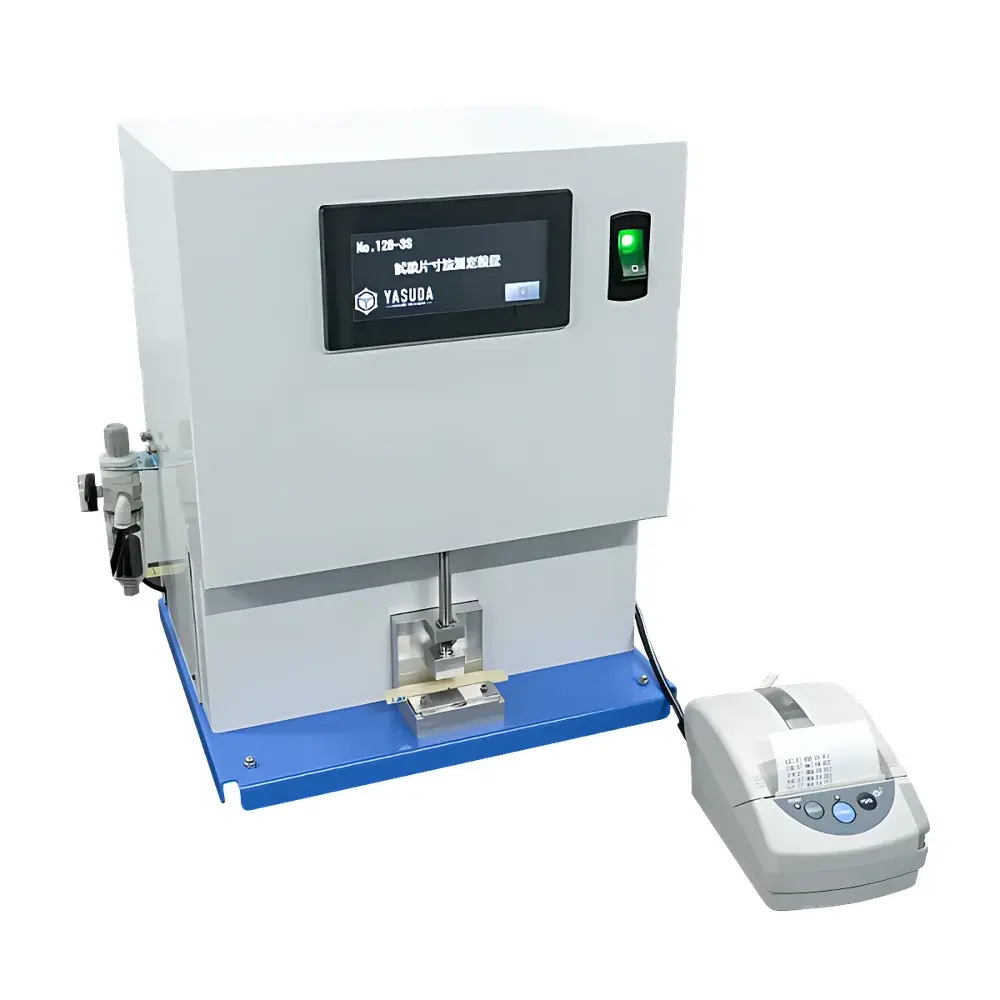
Yasuda No.128-3S Automatic Impact Specimen Dimension Measurement System
| Brand | Yasuda |
|---|---|
| Origin | Japan |
| Model | No.128-3S |
| Application | Automated dimensional verification of Charpy/Izod impact test specimens |
| Compatibility | Yasuda No.258-D and No.258-L digital impact testers |
| Measurement Modes | Notched specimen residual width & thickness |
| Data Interface | Bidirectional digital communication with host impact tester |
| Compliance | Designed for ISO 148-1, ASTM E23, and JIS Z 2202 conformance workflows |
| Calibration Support | Traceable to national metrology standards (JCSS-accredited procedures available) |
Overview
The Yasuda No.128-3S Automatic Impact Specimen Dimension Measurement System is an engineered metrology solution designed specifically for precision dimensional verification of standardized Charpy and Izod impact test specimens—primarily those conforming to ISO 148-1, ASTM E23, and JIS Z 2202 geometries. Unlike manual caliper or micrometer-based approaches, the No.128-3S employs a dual-axis contact-sensing architecture with motorized stage positioning and high-resolution linear encoders (±0.005 mm repeatability) to autonomously acquire critical dimensions: residual notch width (at the root), specimen thickness (both notched and unnotched), and overall height. The system operates on a deterministic measurement sequence: upon placement of the specimen on the precision-ground granite base plate and initiation via the integrated touch interface, the instrument executes synchronized lateral and vertical probe movements to locate and quantify geometric features without operator intervention. This eliminates subjectivity in notch root identification and ensures consistent pressure application during contact measurement—critical for minimizing elastic deformation errors in brittle or high-strength alloys.
Key Features
- Automated dual-dimension acquisition: Simultaneous measurement of residual notch width and specimen thickness in under 8 seconds per sample
- Modular probe configuration: Interchangeable contact tips enable rapid reconfiguration between notched-specimen mode (V-notch or U-notch geometry) and flat-thickness mode for unnotched reference bars
- Digital integration with Yasuda impact testers: Native RS-485 and optional Ethernet/IP interface supports automatic bidirectional data exchange with No.258-D (digital display impact tester) and No.258-L (low-temperature variant with cryogenic chamber)
- Traceable calibration framework: Supports JCSS-accredited calibration protocols; includes NIST-traceable reference artifacts for periodic verification of encoder linearity and probe hysteresis
- ISO/ASTM-compliant reporting: Generates timestamped, audit-ready dimension logs with embedded instrument ID, operator code, and environmental metadata (ambient temperature/humidity if externally sourced)
- Robust mechanical architecture: Granite base plate with vibration-damping feet; stainless-steel guideways; IP52-rated enclosure for laboratory environments
Sample Compatibility & Compliance
The No.128-3S is validated for standard Charpy specimens (10 mm × 10 mm × 55 mm, 7.5 mm × 7.5 mm × 55 mm, and 5 mm × 5 mm × 55 mm cross-sections) as defined in ISO 148-1:2016 and ASTM E23-22. It accommodates both machined V-notches (45° ± 1°, depth 2 mm ± 0.05 mm) and U-notches (1 mm radius ± 0.05 mm). Specimen alignment is assisted by kinematic V-groove positioning fixtures with ±0.1° angular tolerance. All measurement outputs are structured to feed directly into impact energy calculation algorithms per ISO 148-2 Annex A and ASTM E23 Section 11. The system’s firmware enforces dimensional acceptance criteria prior to test initiation—flagging out-of-tolerance specimens (e.g., thickness deviation > ±0.05 mm or notch width variation > ±0.02 mm) in accordance with GLP-aligned quality control workflows.
Software & Data Management
Embedded firmware v3.2 provides local measurement execution and real-time validation against configurable dimensional limits. Optional PC-based Yasuda DimensionLink™ software (Windows 10/11, 64-bit) extends functionality with batch reporting, statistical process control (SPC) charting (X̄-R charts for thickness uniformity), and export to CSV, PDF, or XML formats compatible with LIMS platforms. Audit trails record all user actions—including parameter changes, calibration events, and data exports—with immutable timestamps and operator authentication. When deployed in regulated environments, the system supports 21 CFR Part 11 compliance through role-based access control, electronic signatures, and encrypted database logging.
Applications
- Quality assurance laboratories performing routine impact testing on structural steels, aerospace aluminum alloys, and polymer composites
- Third-party testing facilities requiring ISO/IEC 17025 traceability for dimensional pre-checks prior to accredited impact certification
- R&D departments evaluating notch sensitivity across heat-treated batches or weld zones
- Manufacturing sites implementing automated test cell integration where impact data must be paired with verified specimen geometry for failure analysis correlation
- Calibration laboratories maintaining reference specimen sets for inter-laboratory proficiency testing
FAQ
Does the No.128-3S support non-Yasuda impact testers?
Yes—via custom protocol adaptation using Modbus RTU over RS-485; engineering support required for integration validation.
Can it measure specimens with non-standard notch geometries?
Only standard V- and U-notches per ISO 148-1 and ASTM E23 are factory-validated; custom notch profiles require firmware customization and metrological requalification.
Is temperature compensation included for thermal expansion effects?
No built-in thermal sensor; however, ambient temperature input fields allow manual correction factors per ISO 148-1 Clause 6.2 when reporting dimensional results.
What is the recommended recalibration interval?
Annual calibration is advised; more frequent verification (quarterly) is recommended in high-throughput environments or after mechanical shock events.
How is measurement uncertainty quantified?
Total expanded uncertainty (k=2) is ≤ ±0.012 mm for thickness and ≤ ±0.008 mm for residual notch width, as documented in the Type Approval Certificate (JCSS No. 128-3S-2024-001).



