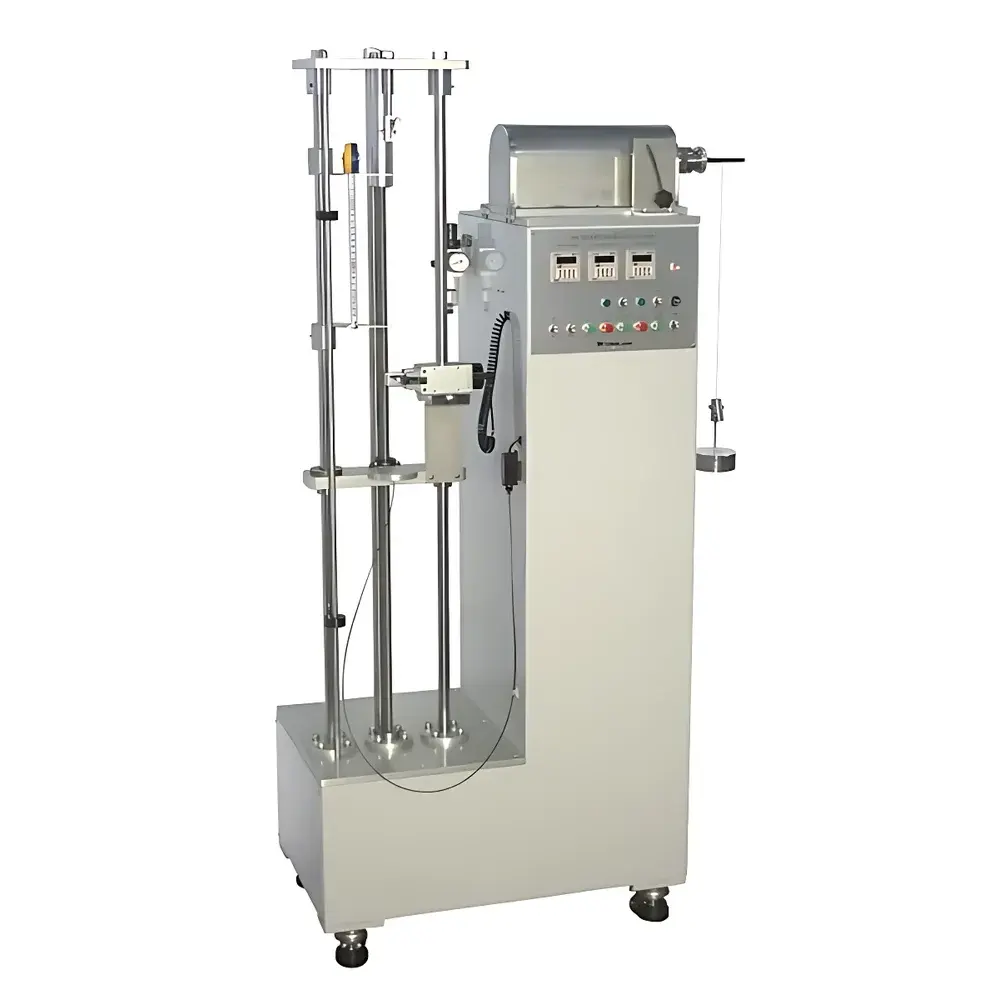
Yasuda No.161 Spring Elongation Tester for Enamel-Coated Wire
| Brand | Yasuda |
|---|---|
| Origin | Japan |
| Model | No.161 |
| Compliance Standards | JIS C 3003, IEC 60172, IEC 60851 |
| Test Principle | Gravimetric static elongation under controlled suspension time |
| Measurement Output | Dimensional change (mm) of wound coil after 1-minute load retention and 1-minute recovery |
| Operating Mode | Manual loading, gravity-driven extension, timed dwell |
Overview
The Yasuda No.161 Spring Elongation Tester is a precision mechanical instrument engineered specifically for evaluating the spring-like deformation behavior of enamel-coated magnet wire — a critical parameter directly correlated with wire stiffness, winding processability, and thermal-mechanical stability in motor, transformer, and inductor manufacturing. Unlike tensile testers that measure ultimate strength or yield point, this device implements a standardized static elongation methodology defined in JIS C 3003, IEC 60172, and IEC 60851. It quantifies the dimensional recovery lag of a precisely wound test coil subjected to a calibrated gravitational load over a fixed dwell period (60 seconds), followed by a 60-second unloaded recovery interval. The resulting permanent extension — expressed in millimeters — serves as an indirect but highly reproducible indicator of the wire’s elastic modulus, insulation adhesion integrity, and core conductor ductility under constrained bending conditions.
Key Features
- Fixed-axis coil winding fixture ensures consistent geometry across test specimens, minimizing inter-operator variability in coil diameter, turn count, and tension during preparation.
- Calibrated stainless-steel weight set (supplied per standard requirements) delivers traceable, repeatable loading force without dynamic impact or inertia effects.
- Dual-stage support platform enables precise positioning of the suspended coil and unambiguous initiation of the free-fall phase upon release.
- Integrated timing mechanism (mechanical or optional digital timer) enforces strict adherence to the 60-second loaded dwell and 60-second unloaded recovery intervals mandated by all referenced standards.
- Stainless-steel frame and hardened bearing surfaces provide long-term dimensional stability and resistance to environmental corrosion in QC laboratory or production floor environments.
- No electrical components or software dependencies — designed for operational robustness, minimal maintenance, and GLP-compliant manual data recording.
Sample Compatibility & Compliance
The No.161 accommodates enamel-coated copper or aluminum magnet wires with nominal diameters ranging from 0.05 mm to 0.50 mm, corresponding to AWG 44–24. Specimen preparation follows strict procedural requirements: 10-turn coils are wound on a mandrel of specified diameter (typically 2.5× wire diameter), with uniform tension applied during winding. The instrument is validated for conformance with JIS C 3003 (Testing methods for enamel-coated winding wires), IEC 60172 (Electrical insulation — Test methods for enamelled wires), and IEC 60851-4 (Methods of test for winding wires — Part 4: Mechanical properties). Its mechanical design supports audit-ready documentation under ISO/IEC 17025-accredited laboratories and satisfies traceability requirements for GMP-regulated electromagnetic component suppliers.
Software & Data Management
The Yasuda No.161 operates as a standalone mechanical tester with no embedded firmware or digital interface. All measurements are recorded manually using calibrated vernier calipers or optical comparators (not included), and documented on standardized test sheets compliant with internal QA procedures. Laboratories integrating the No.161 into electronic quality management systems (eQMS) may log results via LIMS-compatible templates. While the instrument itself does not generate electronic records, its protocol aligns with FDA 21 CFR Part 11 principles when paired with controlled documentation practices — including operator signature, date/time stamping, instrument ID logging, and revision-controlled test forms. Audit trails for calibration certificates (weights, calipers) and operator training records are maintained separately per ISO 9001 and IATF 16949 requirements.
Applications
- Quality control of enamel-coated wire batches prior to coil winding in automotive traction motors and industrial servo motors.
- Comparative evaluation of insulation resin formulations (polyester-imide, polyamide-imide) for elasticity retention after thermal aging.
- Process validation of wire drawing and enamel curing parameters affecting post-drawing resilience.
- Root cause analysis of winding machine jams or turn displacement attributed to excessive wire spring-back.
- Supplier qualification testing where spring elongation data supplements dielectric strength and thermal index reports.
- Technical support for wire manufacturers responding to OEM specification waivers requiring JIS/IEC-aligned mechanical verification.
FAQ
What wire diameters can be tested on the No.161?
The tester supports enamel-coated wires from 0.05 mm to 0.50 mm diameter, provided the test coil is wound according to JIS C 3003-specified mandrel ratios and turn counts.
Is calibration of the weights required?
Yes — the supplied weights must be certified traceable to national metrology institutes (e.g., NMIJ in Japan or NIST in the US) and recalibrated at least annually or per internal QA schedule.
Can the No.161 be used for round-trip hysteresis analysis?
No — it implements a single-cycle static elongation protocol per IEC 60851-4; cyclic loading/unloading requires dedicated dynamic mechanical analyzers.
Does the instrument include a coil winding jig?
A basic fixed-diameter mandrel is supplied; however, users must procure additional mandrels matching their specific wire gauge and standard requirements.
How is measurement repeatability ensured across operators?
Through strict adherence to JIS/IEC winding tension guidelines, use of standardized calipers with ≤0.01 mm resolution, and documented operator training verified every six months.