
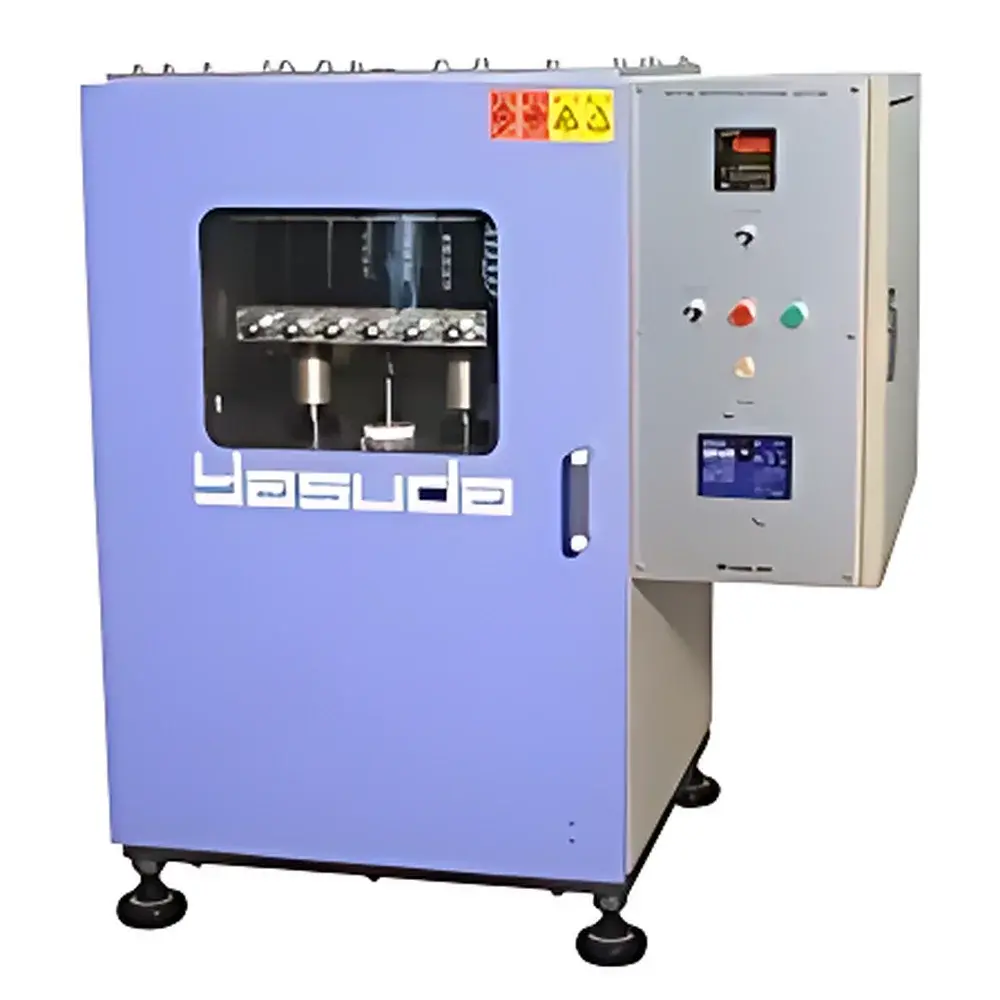
Yasuda No.119 De Mattia Flex-Cracking and Crack Growth Tester
| Brand | Yasuda |
|---|---|
| Origin | Japan |
| Model | No.119 |
| Standards Compliance | JIS K6260, ASTM D813, BS 903 Part A21, ISO 132 |
| Test Principle | Reciprocating bending deformation of vulcanized & thermoplastic elastomers under controlled amplitude and frequency |
| Configuration | Dual-plate parallel clamping system with horizontal reciprocating motion |
| Optional Variant | Low-Temperature L-Type configuration (compatible with external environmental chambers) |
Overview
The Yasuda No.119 De Mattia Flex-Cracking and Crack Growth Tester is an engineered precision instrument designed for the standardized evaluation of fatigue resistance in elastomeric materials under cyclic mechanical stress. Based on the classical De Mattia principle, the device subjects standardized test specimens to repeated in-plane bending deformation through synchronized reciprocating motion between two parallel clamping plates. This controlled flexing simulates service-induced strain states encountered in dynamic rubber components—such as tires, engine mounts, and vibration isolators—enabling quantitative assessment of both crack initiation (flex-cracking) and subsequent crack propagation (crack growth) over defined cycle counts. The tester operates in strict accordance with internationally recognized test protocols including JIS K6260, ASTM D813, BS 903 Part A21, and ISO 132, ensuring data comparability across global R&D, quality control, and regulatory submission environments.
Key Features
- Robust dual-plate clamping architecture with precision-machined stainless-steel platens for uniform specimen restraint and minimal edge slippage.
- Adjustable stroke amplitude (standard range: 0–5.0 mm, calibrated and traceable to national metrology standards) and programmable oscillation frequency (typically 100–300 cycles per minute), enabling method-specific test execution per standard requirements.
- Integrated digital counter with non-volatile memory, capable of recording up to 999,999 cycles with manual or automatic stop triggers based on pre-set thresholds (e.g., crack detection at N cycles).
- Modular mechanical design compliant with ISO 17025 laboratory infrastructure requirements—facilitates routine calibration verification using certified reference specimens and traceable displacement gauges.
- L-Type variant available for integration with externally controlled low-temperature environmental chambers (−70 °C to +100 °C), supporting cold-flex testing per ASTM D1053 or compound-specific low-temperature performance validation.
Sample Compatibility & Compliance
The No.119 accommodates standardized dumbbell-shaped or rectangular test pieces (per JIS K6260 and ASTM D813 dimensions: typically 25 mm × 12.5 mm × 2 mm thickness) cut from compression-molded or extruded elastomer sheets. Specimen mounting requires no adhesives or fixtures beyond mechanical clamping—eliminating interfacial variables that could bias crack nucleation behavior. All operational parameters—including platen alignment tolerance (±0.05 mm), parallelism deviation (<0.1°), and motion repeatability (±0.02 mm)—are documented in the manufacturer’s Declaration of Conformity and align with the mechanical accuracy requirements specified in ISO/IEC 17025 Clause 6.4 for physical property testing equipment. Routine use supports GLP-compliant test reporting when paired with validated documentation workflows.
Software & Data Management
While the base No.119 operates via electromechanical controls without embedded firmware, it is fully compatible with third-party data acquisition systems (e.g., National Instruments DAQmx or LabVIEW-based platforms) for time-synchronized logging of cycle count, elapsed time, and optional external sensor inputs (e.g., chamber temperature, ambient humidity). For laboratories requiring audit-ready records, the tester integrates seamlessly into electronic lab notebook (ELN) ecosystems via RS-232 or USB-to-serial interfaces. Cycle count logs may be exported in CSV format, supporting 21 CFR Part 11–compliant signature capture and version-controlled archiving when deployed with validated software layers.
Applications
- Quantitative ranking of natural rubber (NR), styrene-butadiene rubber (SBR), ethylene propylene diene monomer (EPDM), and thermoplastic elastomer (TPE) formulations for crack resistance in dynamic applications.
- Formulation screening during polymer development—correlating antioxidant package type/concentration with delay in crack onset (Ninit) and rate of crack extension (ΔL/ΔN).
- Quality assurance of production lots against release specifications defined in internal material specifications or customer technical agreements.
- Supporting failure analysis investigations where field cracking patterns are correlated with laboratory-accelerated flex-fatigue behavior.
- Pre-validation testing for automotive OEM component specifications requiring compliance with GMW15634, Ford CETP 00.00-L-467, or similar elastomer durability clauses.
FAQ
What standards does the Yasuda No.119 explicitly support?
JIS K6260, ASTM D813, BS 903 Part A21, and ISO 132 — all of which define specimen geometry, clamping configuration, stroke amplitude, and pass/fail criteria for flex-cracking evaluation.
Is calibration certification included with shipment?
Yes — each unit ships with a factory-issued calibration report traceable to JCSS (Japan Calibration Service System) standards, covering platen parallelism, stroke linearity, and cycle counter accuracy.
Can the No.119 be used for non-standard specimen geometries?
Custom夹具 can be fabricated per user-defined dimensions; however, deviation from standardized shapes invalidates direct comparison to published standard test results and must be declared in method validation documentation.
Does the L-Type variant include a built-in refrigeration system?
No — the L-Type configuration provides structural and interface compatibility with external low-temperature chambers (e.g., ESPEC or Angelantoni units); refrigeration is provided by the auxiliary chamber system.
How is crack detection performed during testing?
Visual inspection under 10× magnification at predetermined intervals (e.g., every 5,000 cycles), following the protocol defined in the applicable standard; automated optical crack detection systems may be integrated via external machine vision modules.



