
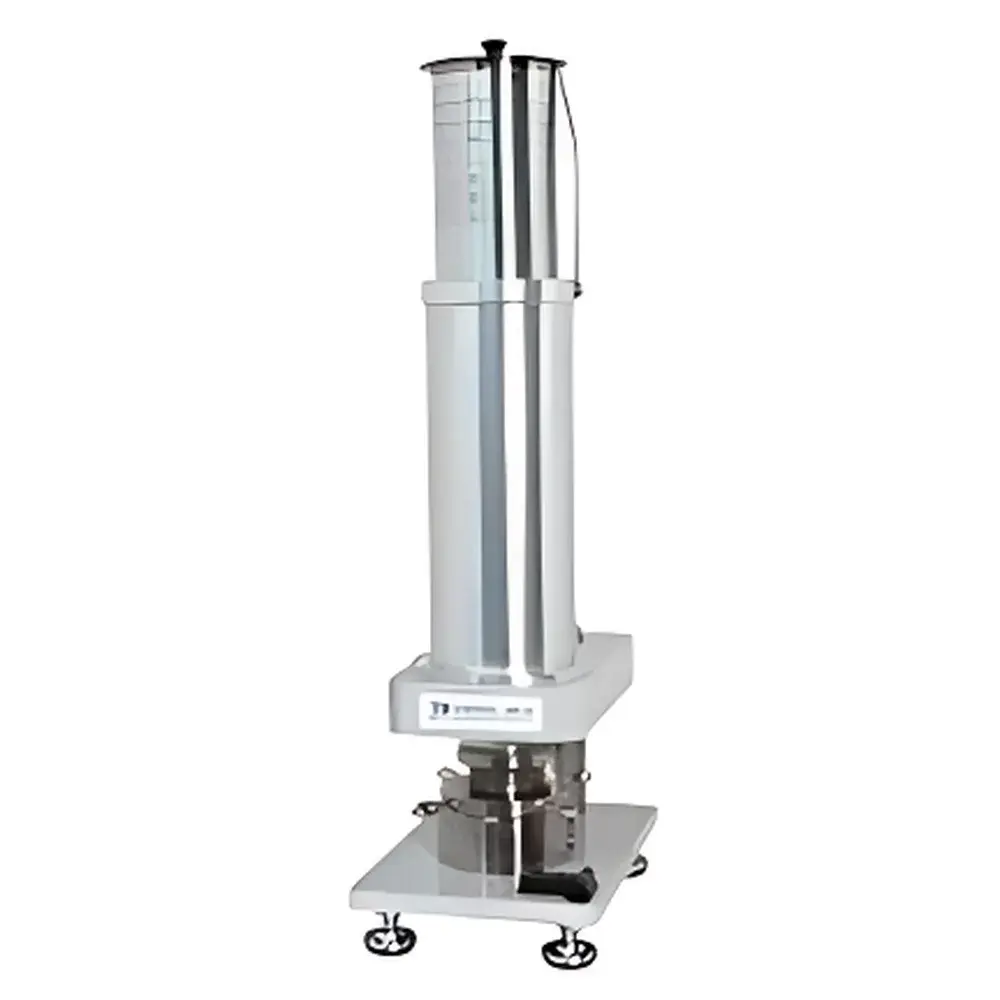
Yasuda No.323 Gurley-Type Air Permeability Tester
| Brand | Yasuda |
|---|---|
| Origin | Japan |
| Model | No.323 |
| Test Area | 642 mm² (φ28.6 ± 0.1 mm aperture) |
| Specimen Size | 50 × 50 mm |
| Inner Cylinder Mass | 567 ± 0.5 g |
| Inner Cylinder Dimensions | OD φ76.2 mm, ID φ74 mm, H 254 mm |
| Outer Cylinder Dimensions | ID φ82.6 mm, H 254 mm |
| Calibration Marks | 127 mm from base |
| Air Volume Scale | 0–100 mL (25 mL increments), 100–350 mL (50 mL increments) |
| Operating Mode | Manual stopwatch or automatic timing |
| Compliance | JIS L1096, ASTM D726, TAPPI T460, ISO 5636-5, P8117 |
| Optional Accessory | φ10 mm orifice connector kit |
| Power | None (gravity-driven mechanical system) |
| Dimensions (W×D×H) | ~150 × 230 × 420 mm |
| Weight | ~20 kg |
| Extended Height (raised cylinder) | 580 mm |
Overview
The Yasuda No.323 Gurley-Type Air Permeability Tester is a precision gravity-driven mechanical instrument engineered for the quantitative evaluation of air permeability in low-to-medium permeability sheet materials—primarily paper, paperboard, nonwovens, and fine-textured fabrics such as woolens. It operates on the fundamental principle of Gurley air resistance measurement: a fixed mass (567 ± 0.5 g) drives an inner cylinder downward within a sealed outer cylinder, compressing ambient air that is forced through a standardized test specimen clamped under controlled geometry. The time required for a defined volume of air (typically 100 mL) to pass through the specimen is recorded—this elapsed time (in seconds) constitutes the Gurley number, a widely accepted empirical metric for comparative permeability assessment in industrial quality control and R&D laboratories.
Unlike pressure-differential instruments requiring regulated gas supply or electronic flow sensors, the No.323 relies entirely on mechanical reproducibility and dimensional stability. Its design adheres strictly to the geometric tolerances specified in international standards—including the critical 642 mm² effective test area (achieved via a φ28.6 ± 0.1 mm circular orifice), precise inner/outer cylinder diameters (φ74/φ76.2 mm and φ82.6 mm respectively), and calibrated air volume graduations. This passive, analog architecture ensures long-term metrological stability without drift, calibration dependency, or software intervention—making it especially suitable for GLP-compliant environments where audit trails must be traceable to physical constants rather than firmware versions.
Key Features
- Gravity-actuated measurement mechanism with certified inner cylinder mass (567 ± 0.5 g), eliminating pneumatic or electrical dependencies
- Dual timing options: manual stopwatch interface with tactile stop switch or optional automatic timer integration for improved repeatability
- Standardized test fixture geometry compliant with JIS L1096 Type A, ASTM D726 Method A, TAPPI T460, and ISO 5636-5 requirements
- High-precision orifice plate (φ28.6 ± 0.1 mm) ensuring consistent 642 mm² active test area; interchangeable plates available for specialized configurations
- Mechanically robust cast-aluminum housing with corrosion-resistant surface treatment; stable base design minimizes vibration-induced timing error
- Graduated air volume scale with dual-range resolution: 25 mL increments (0–100 mL) and 50 mL increments (100–350 mL)
- Optional φ10 mm auxiliary orifice connector for method adaptation or custom protocol development
Sample Compatibility & Compliance
The No.323 accommodates flat, dimensionally stable specimens sized 50 × 50 mm, secured between parallel clamping plates. It is validated for use with paper grades ranging from dense kraft linerboard (Gurley values >10,000 s/100 mL) to lightweight tissue and filter papers (10–1000 s/100 mL), as well as tightly woven woolens and technical textiles where laminar airflow through porous structures must be assessed under low-pressure differential conditions. All mechanical dimensions—including inner cylinder wall thickness, outer cylinder concentricity, and orifice edge finish—are manufactured and inspected per ISO 2768-mK general tolerances. Device compliance extends across multiple regulatory frameworks: test reports generated using this instrument satisfy documentation requirements under ISO/IEC 17025 for accredited testing laboratories, support FDA 21 CFR Part 11–aligned data integrity when paired with timestamped manual logs or validated digital timers, and align with GMP-relevant material release criteria for packaging substrates in pharmaceutical and medical device manufacturing.
Software & Data Management
As a fully mechanical, non-electronic instrument, the No.323 does not incorporate embedded firmware, onboard memory, or proprietary software. Timing data is captured externally—either via operator-recorded stopwatch readings or synchronized with third-party digital timers meeting NIST-traceable accuracy specifications (e.g., ±0.01 s). Laboratories implementing electronic data capture may integrate the device into LIMS or ELN systems using standard CSV import protocols following manual transcription or barcode-assisted entry. For audit readiness, all test parameters—including specimen identification, environmental conditions (temperature/humidity logged separately per ISO 187), operator ID, and raw timing values—are documented in accordance with ALCOA+ principles (Attributable, Legible, Contemporaneous, Original, Accurate, Complete, Consistent, Enduring, Available). Optional accessories include calibrated stopwatch validation kits and traceable mass verification weights.
Applications
- Quality assurance of packaging papers and board for moisture barrier performance validation
- Comparative evaluation of filtration media efficiency in HVAC and industrial filter development
- Routine testing of cigarette paper permeability to ensure consistent burn rate and tar delivery profiles
- Characterization of coated papers for inkjet and offset printing substrate selection
- Research-grade permeability mapping in nanocellulose and biopolymer film development
- Validation of textile breathability in technical apparel and protective garment certification
FAQ
Is the Yasuda No.323 compliant with current ISO 5636-5:2013 requirements?
Yes—the instrument’s orifice diameter, test area, cylinder dimensions, and mass tolerance are aligned with Clause 6.2 and Annex A of ISO 5636-5:2013.
Can it be used for high-permeability nonwovens exceeding 350 mL/100 s?
While the graduated scale ends at 350 mL, the physical air displacement remains linear beyond this point; users may extrapolate or employ volumetric collection methods for higher ranges—though such applications fall outside standard method scope.
Does the device require periodic recalibration?
No scheduled recalibration is mandated; however, annual verification of inner cylinder mass (±0.5 g tolerance) and orifice plate diameter (±0.1 mm) using certified metrology tools is recommended for ISO/IEC 17025 compliance.
Is operator training required to achieve inter-laboratory reproducibility?
Yes—consistent clamping pressure, specimen conditioning (per ISO 187), and timing trigger discipline directly impact result variability; Yasuda provides operator qualification checklists and reference material protocols.
What maintenance is necessary for long-term operational integrity?
Routine cleaning of cylinder walls and orifice plate with lint-free cloth and isopropyl alcohol; inspection for burrs or deformation on clamping surfaces; storage in low-humidity environment to prevent aluminum oxidation.



