
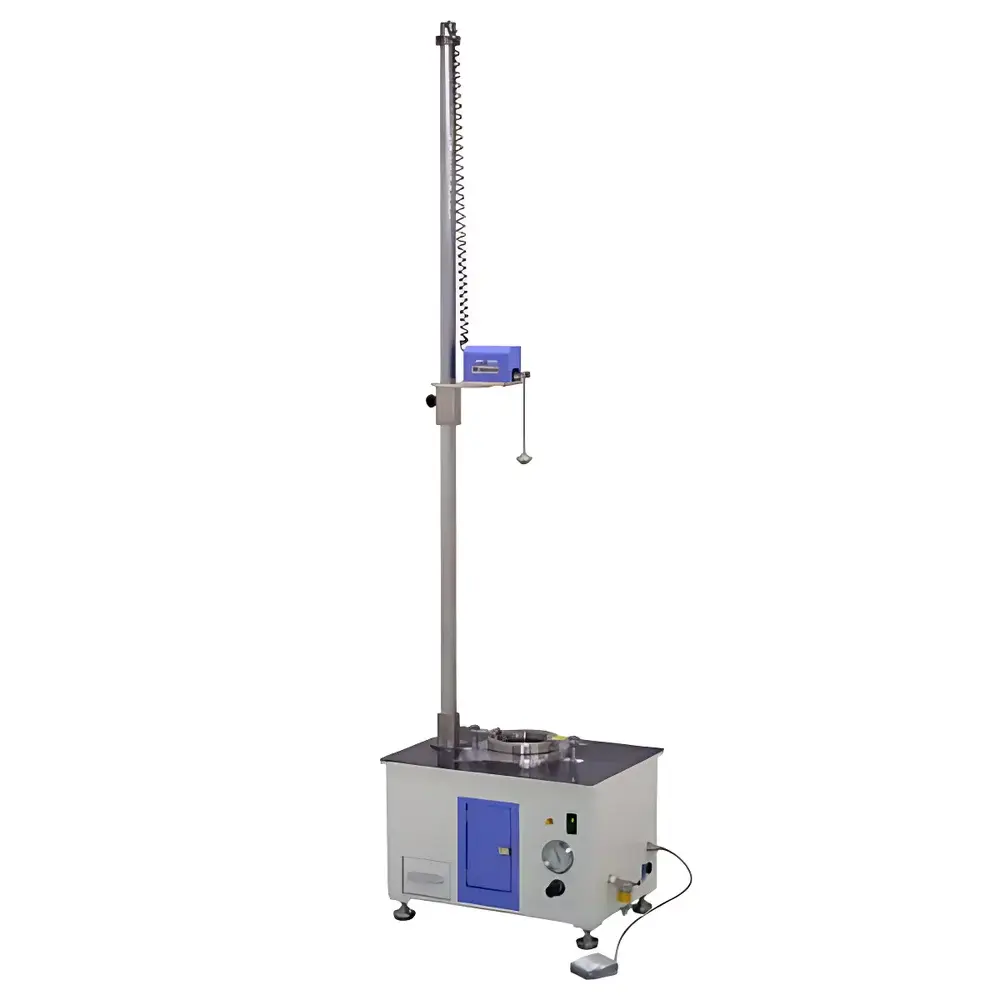
Yasuda No.220 Dart Impact Tester
| Brand | Yasuda |
|---|---|
| Origin | Japan |
| Model | No.220 |
| Test Standards | JIS K7124-1, JIS Z1702, JIS Z1707, ASTM D1709, ISO 7765-1 |
| Drop Height (Method A) | 0.66 ± 0.01 m |
| Drop Height (Method B) | 1.50 ± 0.01 m |
| Dart Geometry (Method A) | Hemispherical, φ38 ± 1 mm, 40 g |
| Dart Geometry (Method B) | Hemispherical, φ50 ± 1 mm, 320 g |
| Max Dart Mass | 890 g (Method A), 1410 g (Method B) |
| Clamp Inner Diameter | φ125 ± 2 mm |
| Pneumatic Pressure Range | 0–1.0 MPa (graduated at 0.05 MPa intervals) |
| Power Supply | AC 100 V, 15 A, 50/60 Hz |
| Air Supply Requirement | ≥0.5 MPa |
| Dimensions (W×D×H) | ≈620 × 400 × 2150 mm |
| Weight | ≈55 kg |
Overview
The Yasuda No.220 Dart Impact Tester is a precision-engineered free-fall impact testing system designed to evaluate the impact resistance of flexible plastic films and thin plastic sheets in accordance with internationally recognized standards including ASTM D1709, ISO 7765-1, JIS K7124-1, JIS Z1702, and JIS Z1707. Based on the staircase method (also known as the up-and-down method), this instrument determines the critical dart mass at which 50% of test specimens fail under standardized drop conditions. The test principle relies on gravitational acceleration applied to a hemispherical dart released from a precisely controlled height onto a clamped specimen—providing quantitative, statistically robust data essential for quality control, material development, and regulatory compliance in packaging R&D and production environments.
Key Features
- Two standardized test configurations: Method A (dart diameter φ38 ± 1 mm, nominal mass 40 g, drop height 0.66 ± 0.01 m) and Method B (dart diameter φ50 ± 1 mm, nominal mass 320 g, drop height 1.50 ± 0.01 m), each supporting distinct material thickness and toughness ranges.
- Pneumatically actuated specimen clamping system with adjustable pressure regulation (0–1.0 MPa, calibrated in 0.05 MPa increments) ensures consistent, repeatable grip force across diverse film types—including low-modulus polyolefins, metallized laminates, and co-extruded barrier structures.
- Stainless-steel dart holder and guided vertical drop column minimize lateral deviation and rotational instability, preserving impact energy fidelity and enabling high reproducibility (CV < 3% per ASTM D1709 inter-laboratory studies).
- Integrated foot-switch activation enables hands-free operation during high-throughput testing, reducing operator variability and enhancing process safety.
- Robust structural frame (≈55 kg) with vibration-dampening base design minimizes environmental interference, ensuring measurement stability in shared laboratory or production-floor settings.
- Optional accessories—including cryogenic chamber for low-temperature impact evaluation (e.g., −40 °C to +60 °C), safety shield compliant with IEC 61000-4-2 ESD requirements, and dedicated leveling stand—extend operational versatility without compromising metrological integrity.
Sample Compatibility & Compliance
The No.220 accommodates flat, non-porous specimens up to 150 mm × 150 mm, with typical thicknesses ranging from 20 µm to 500 µm. Compatible substrates include LDPE, LLDPE, PP, PET, PA, PVDC-coated films, aluminum foil laminates, and biodegradable polymers such as PLA and PBAT. All mechanical and pneumatic components meet Japanese Industrial Standard JIS B 8201 (general requirements for testing machines) and conform to CE marking directives for machinery safety (2006/42/EC). When configured with audit-trail-enabled software (see Software & Data Management), the system supports GLP/GMP-aligned workflows and satisfies FDA 21 CFR Part 11 requirements for electronic records and signatures.
Software & Data Management
While the base No.220 operates as a manually recorded mechanical tester, it is fully compatible with Yasuda’s optional PC-based data acquisition module (DART-Link v3.2). This software logs impact event timestamps, dart mass, failure/no-failure outcomes, and environmental metadata (ambient temperature/humidity if external sensors are connected). Statistical analysis includes probit regression for ED50 (effective dose 50%) calculation, confidence interval estimation (95%), and automated report generation in PDF/CSV formats. Raw data files are stored in encrypted SQLite databases with immutable audit trails, supporting traceability for ISO/IEC 17025 accreditation and internal quality audits.
Applications
- Quality assurance of food, pharmaceutical, and medical device packaging films during incoming inspection and batch release.
- Formulation screening for impact-modified resins and additive packages in polymer R&D labs.
- Validation of seal integrity and pouch durability under simulated distribution stresses (ASTM D4169).
- Comparative benchmarking of sustainable packaging alternatives against conventional materials.
- Supporting technical documentation for ISO 9001, IATF 16949, and ISO 13485 certified manufacturing systems.
FAQ
What standards does the Yasuda No.220 comply with?
It meets ASTM D1709 (Methods A and B), ISO 7765-1, JIS K7124-1, JIS Z1702, and JIS Z1707 for film impact resistance testing.
Is calibration certification included with delivery?
Yes—each unit ships with a factory-issued calibration certificate traceable to JCSS (Japan Calibration Service System), covering drop height accuracy, dart geometry verification, and pneumatic pressure transducer calibration.
Can the tester be used for rigid plastic sheets?
No—the No.220 is optimized for flexible films and thin sheets (≤500 µm); rigid substrates require alternative impact testers such as Izod or Charpy configurations.
What air supply specifications are required?
A clean, dry compressed air source delivering ≥0.5 MPa (72 psi) at ≥10 L/min flow rate is mandatory; an inline 5 µm filter and moisture trap are recommended.
Does the system support automated data export to LIMS?
When paired with DART-Link v3.2 and optional API license, it supports secure RESTful JSON export to validated LIMS platforms via TLS 1.2 encryption.





