
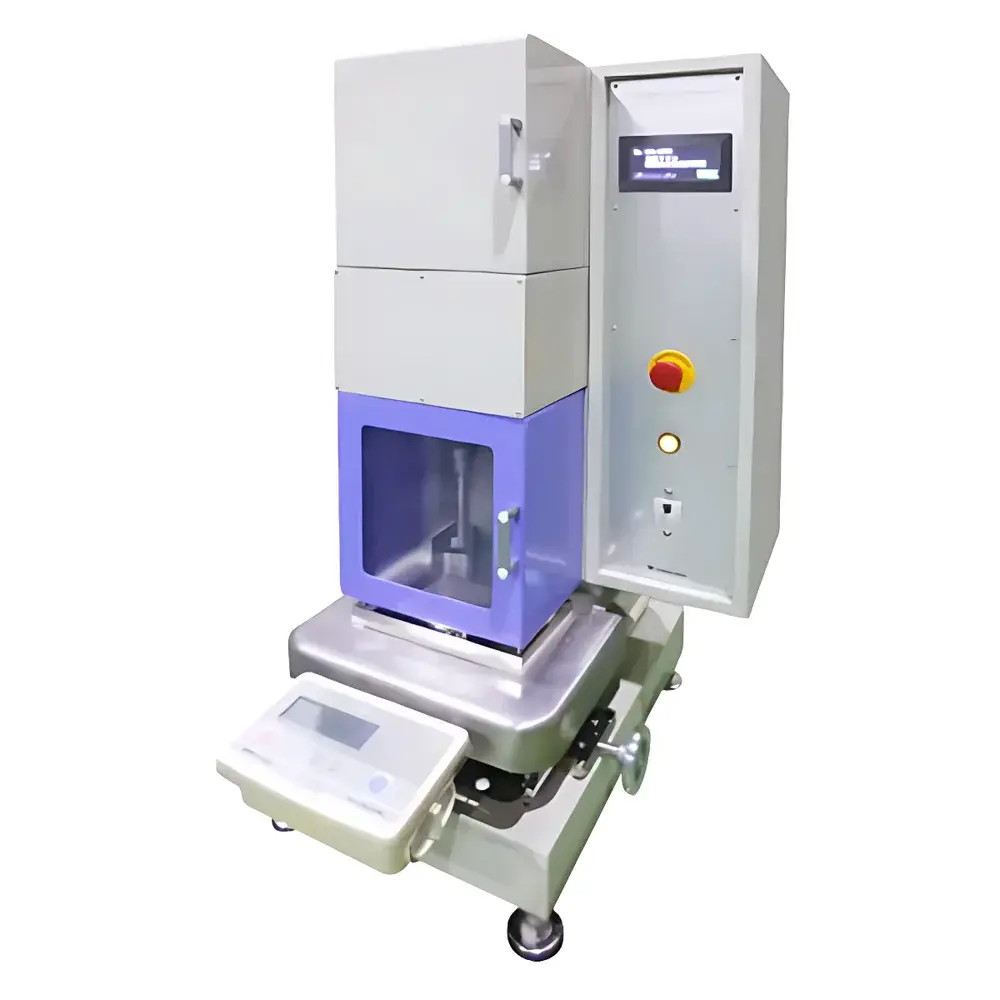
Yasuda No.156-AUTO Automatic Mooney Viscometer (Mooney Stress Relaxation Tester)
| Brand | Yasuda |
|---|---|
| Origin | Japan |
| Model | No.156-AUTO |
| Sample Mass | 50 ± 0.5 g |
| Rotor Diameter | Φ50 mm, Thickness: 13 mm |
| Rotor Speed | 1,000 ± 20 rpm |
| Load Application | True dead-weight loading with motorized vertical actuation |
| Load Range | 0–100 kgf (resolution: 0.05 kgf |
| standard test loads | 5, 10, 15 kgf) |
| Die Cavity | Internal diameter Φ76 mm, Height 85 mm |
| Timer Range | 0–99 h 99 min |
| Power Supply | 220 V, single-phase, 15 A, 50/60 Hz |
| Dimensions (W×D×H) | ≈550 × 750 × 1080 mm |
| Weight | ≈178 kg |
| Compliance | JIS K 6387, K 6392, K 6828 |
| Accessories | 10 polyethylene liners |
| Optional | Safety guard |
Overview
The Yasuda No.156-AUTO Automatic Mooney Viscometer is a precision-engineered instrument designed for standardized mechanical stability assessment of raw and compounded rubber materials under controlled thermal and shear conditions. It operates on the principle of Mooney stress relaxation—measuring the torque required to maintain a specified rotational speed of a calibrated rotor embedded in a heated, confined rubber sample. Unlike conventional viscometers relying on spring-based or hydraulic load application, the No.156-AUTO implements true dead-weight loading via motor-driven vertical actuation, ensuring traceable, reproducible force application per JIS K 6387 (Mooney viscosity), JIS K 6392 (scorch time determination), and JIS K 6828 (viscoelastic behavior under prolonged shear). The system integrates thermally stabilized die cavities, high-inertia rotor drive, and real-time torque transduction to deliver repeatable Mooney units (MU) and time-dependent relaxation profiles critical for compound development, quality control, and process validation in tire, conveyor belt, and elastomeric seal manufacturing.
Key Features
- True dead-weight loading mechanism with motorized vertical actuation—eliminates hysteresis and drift associated with pneumatic or servo-controlled load systems
- Calibrated rotor geometry (Φ50 mm × 13 mm) conforming to JIS and ISO 289 specifications for geometric consistency and shear field uniformity
- Precision timer with 1-second resolution and extended range up to 99 hours 99 minutes—enabling long-duration scorch and reversion studies
- Dual-mode operation: fully automated sequence (start → auto-descent → rotation → stop) and manual pressure override via dedicated toggle switch
- High-stability heating chamber maintaining ±0.5 °C uniformity across the die cavity (standard operating temperature: 100 °C or 125 °C)
- Integrated load platform with 0.05 kgf readability and full-scale capacity of 100 kgf—certified for traceable force calibration per JIS B 7738
- Robust cast-iron frame and vibration-damped base minimizing mechanical noise during low-torque measurements
Sample Compatibility & Compliance
The No.156-AUTO accommodates standard 50 ± 0.5 g rubber specimens within a cylindrical die cavity (Φ76 mm × 85 mm H), compatible with natural rubber (NR), styrene-butadiene rubber (SBR), ethylene propylene diene monomer (EPDM), nitrile rubber (NBR), and thermoplastic elastomers (TPEs). All operational parameters—including rotor speed (1,000 ± 20 rpm), temperature ramp profiles, and dwell times—are programmable to meet method requirements defined in JIS K 6387 (Mooney viscosity), JIS K 6392 (pre-vulcanization characteristics), and JIS K 6828 (time-temperature superposition analysis). The instrument satisfies metrological traceability requirements under ISO/IEC 17025 for testing laboratories and supports audit-ready documentation for GLP and GMP environments where rubber compounding data must be retained for regulatory review.
Software & Data Management
While the No.156-AUTO operates as a standalone benchtop unit with analog/digital hybrid instrumentation, it is compatible with optional PC-based acquisition modules supporting RS-232 or USB interface. These modules log torque vs. time, temperature, and load status at user-defined intervals (1–10 s), generating CSV or XML files compliant with ASTM E2500-22 for raw data archival. Calibration certificates for the load cell and temperature sensor are provided with NIST-traceable references. Audit trail functionality—including operator ID, timestamped parameter changes, and electronic signature support—is available through third-party LIMS integration, satisfying FDA 21 CFR Part 11 requirements when deployed in regulated production facilities.
Applications
- Mooney viscosity (ML1+4) determination for incoming raw material qualification per JIS K 6387
- Scorch time (t5, t35) and vulcanization onset analysis for accelerator system optimization
- Reversion resistance evaluation of highly filled compounds under extended dwell conditions
- Batch-to-batch consistency verification in high-volume rubber mixing operations
- Correlation studies between Mooney stress relaxation profiles and dynamic mechanical properties (e.g., tan δ, G′)
- Supporting ASTM D1646, ISO 289, and GB/T 1232.1 test execution in multinational R&D centers
FAQ
What standards does the No.156-AUTO comply with?
It is fully aligned with JIS K 6387, K 6392, and K 6828. Its rotor geometry, heating uniformity, and torque measurement methodology also satisfy ISO 289-1 and ASTM D1646 requirements.
Is the load application truly dead-weight, or is it servo-compensated?
The system uses a motor-driven mechanical descent to position certified dead weights onto the loading arm—no closed-loop force feedback is employed, ensuring direct traceability to mass standards.
Can the instrument operate without a PC connection?
Yes. All core functions—including automatic descent, timed rotation, and analog torque display—are self-contained. PC connectivity is optional for enhanced data logging and reporting.
What maintenance is required for long-term accuracy?
Annual verification of temperature uniformity (per JIS K 6387 Annex B), load cell calibration (using certified weights), and rotor/die surface inspection for wear or carbon buildup are recommended.
Is the safety guard included or optional?
The safety guard is an optional accessory—designed to ANSI/RIA R15.06-compliant interlock integration and CE-marked for use in EU-based production labs.
Related Products





