
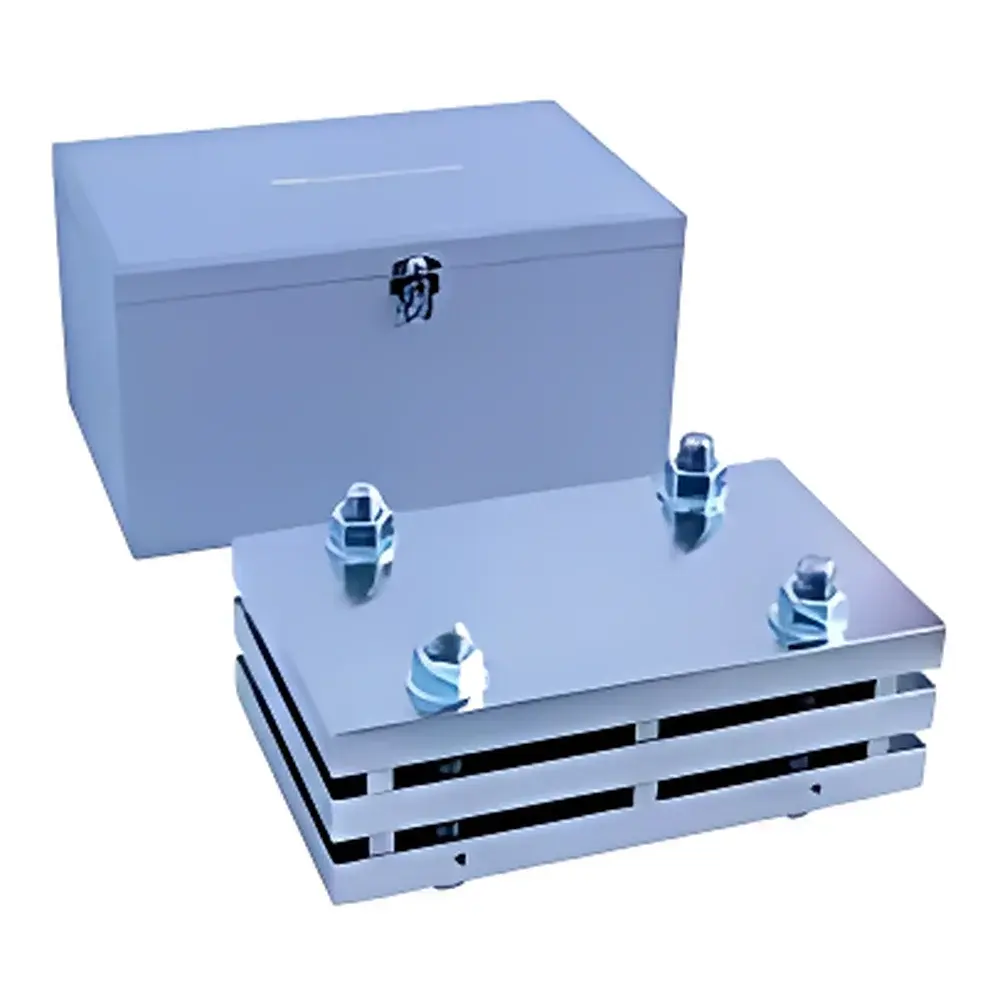
Yasuda No.171 Compression Set Tester
| Brand | Yasuda |
|---|---|
| Origin | Japan |
| Model | No.171 |
| Standards Compliance | JIS A 5756, JIS K 6262, ASTM D395 (Method A & B), ISO 815 |
| Application | Compression set measurement of vulcanized and thermoplastic elastomers |
| Load Configuration | Fixed-height compression via precision-machined spacers |
| Test Specimen Dimensions | Standard cylindrical specimens (diameter 29.0 ± 0.5 mm, height 12.5 ± 0.5 mm) per ASTM D395 and ISO 815 |
Overview
The Yasuda No.171 Compression Set Tester is a precision-engineered mechanical test instrument designed specifically for quantifying the permanent deformation behavior of elastomeric materials following sustained compressive loading under controlled thermal conditions. It operates on the fundamental principle of constrained axial compression: standardized cylindrical test specimens are compressed to a defined deflection (typically 25% strain), held at a specified temperature and duration (e.g., 70 °C for 22 h per ASTM D395 Method A), then allowed to recover under standard ambient conditions before measuring residual thickness. The resulting compression set value—expressed as a percentage of original specimen height—is a critical indicator of material resilience, crosslink density stability, and long-term sealing performance in dynamic or static gasket applications. Unlike universal testing machines requiring complex calibration and software interpretation, the No.171 employs a passive, geometry-defined mechanical architecture that ensures high inter-laboratory reproducibility and eliminates electronic drift or sensor nonlinearity as sources of uncertainty.
Key Features
- Fixed-compression geometry using hardened stainless steel spacers with certified dimensional tolerances (±0.02 mm), enabling repeatable 25% or custom strain application without force transducers or closed-loop control.
- Modular spacer system compatible with standard specimen dimensions per ASTM D395, ISO 815, JIS K 6262, and JIS A 5756—ensuring direct compliance with global rubber testing protocols.
- Thermally stable aluminum alloy frame with low coefficient of thermal expansion, minimizing dimensional drift during elevated-temperature exposure (up to 100 °C in compatible ovens).
- No moving parts or power requirements during test execution—reducing maintenance overhead and eliminating electromagnetic interference in shared lab environments.
- Calibration traceable to national metrology institutes via spacer dimension certification; no periodic recalibration of load cells or displacement sensors required.
Sample Compatibility & Compliance
The No.171 accommodates standard cylindrical rubber specimens (29.0 ± 0.5 mm diameter × 12.5 ± 0.5 mm height) as mandated by ASTM D395, ISO 815, and JIS K 6262. It supports both Method A (air oven) and Method B (liquid medium) conditioning protocols when used in conjunction with externally controlled environmental chambers. Specimens must be free of surface defects, voids, or contamination that could influence localized stress distribution. The tester is routinely deployed in quality control laboratories supporting automotive sealing systems, medical device gaskets, HVAC vibration isolators, and railway buffer components—where compression set data directly informs material qualification against OEM specifications (e.g., Ford WSK-M4D722-A2, GMW15635). All test reports generated using this apparatus satisfy GLP documentation requirements when paired with auditable specimen identification, oven calibration records, and manual measurement logs.
Software & Data Management
The Yasuda No.171 is a hardware-only instrument with no embedded firmware, display, or digital interface. Data acquisition is performed manually using calibrated micrometers (resolution ≤ 0.001 mm) or optical comparators compliant with ISO 13528 and ASTM E29. Measurement values are recorded in laboratory notebooks or LIMS-compatible spreadsheets. For regulated environments subject to FDA 21 CFR Part 11 or EU Annex 11, users implement procedural controls—including dual-operator verification of initial and recovered thickness measurements, documented spacer lot traceability, and retention of raw measurement sheets for audit review. The absence of proprietary software eliminates validation burden associated with electronic records and signatures.
Applications
- Validation of sulfur-cured NR, SBR, EPDM, and FKM compounds for static sealing applications where long-term relaxation resistance is mission-critical.
- Comparative screening of peroxide-cured TPEs versus dynamically vulcanized TPVs in consumer electronics enclosures exposed to thermal cycling.
- Failure analysis of extruded rubber profiles exhibiting premature gasket leakage after field service—correlating compression set results with crosslink density (via swelling tests) and network heterogeneity (via DMA).
- Raw material supplier qualification per ISO/TS 16949 clause 8.4.2.2, where compression set serves as a key release criterion for incoming elastomer batches.
- Supporting accelerated aging studies per ASTM D573, where compression set is measured at multiple timepoints to model service-life degradation kinetics.
FAQ
Does the No.171 require electrical power or pneumatic supply?
No. It is a purely mechanical compression fixture relying on spacer geometry for strain definition.
Can it be used for non-standard specimen geometries?
Only with custom-machined spacers validated per ISO 815 Annex B; standard compliance requires adherence to prescribed dimensions.
Is calibration certification included with shipment?
Spacer dimensional certification (including CMC traceability statement) is provided with each unit; user-performed micrometer calibration remains the responsibility of the accredited lab.
How does it differ from servo-hydraulic compression testers?
Unlike force-controlled systems, the No.171 applies fixed-strain loading—eliminating variability from modulus differences across compound families and ensuring consistent boundary conditions across diverse elastomer classes.
What environmental conditions must be controlled during testing?
Ambient recovery must occur at 23 ± 2 °C and 50 ± 5% RH per ISO 23529; conditioning temperature and duration are defined by the selected standard (e.g., 70 °C/22 h for ASTM D395A).





