
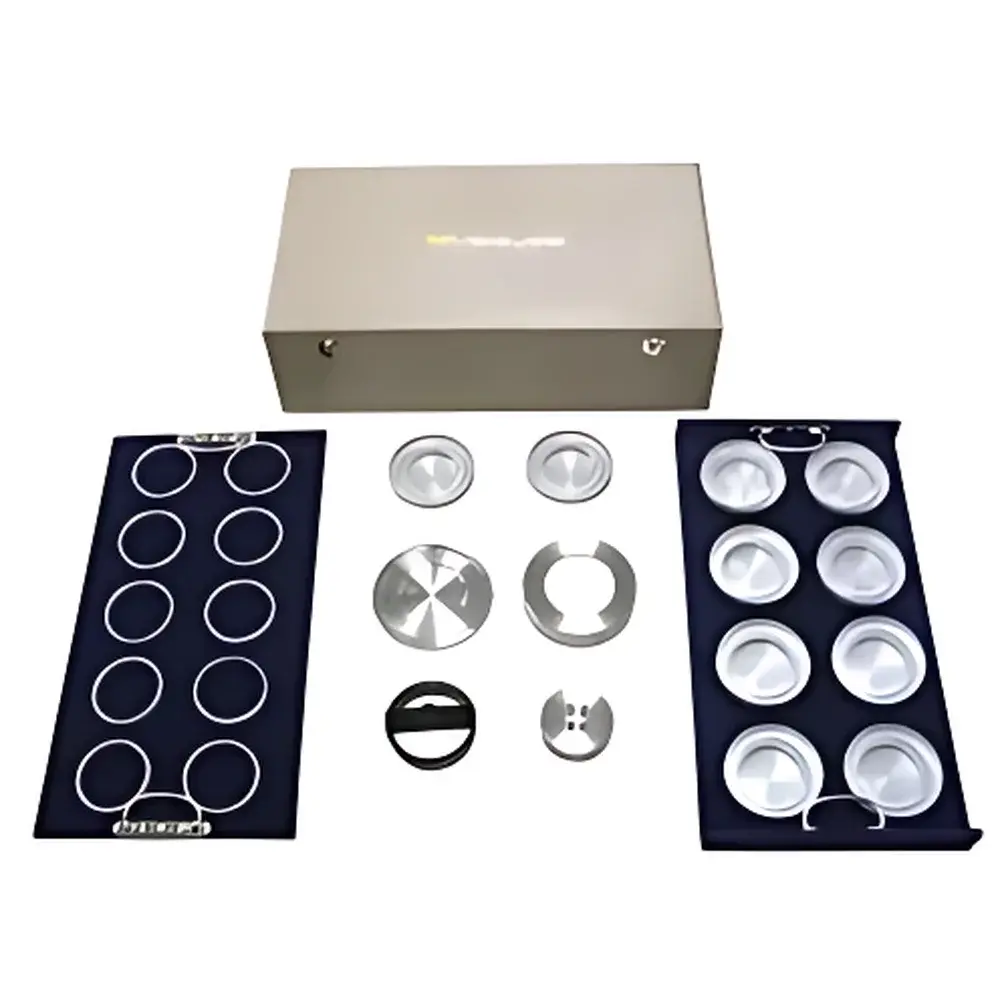
Yasuda No.318 Water Vapor Permeability Cup
| Brand | Yasuda |
|---|---|
| Origin | Japan |
| Model | No.318 |
| Applicable Standards | JIS K5400, JIS K6549, JIS Z0208, TAPPI T448, TAPPI T464, ISO 2528 |
| Measurement Principle | Gravimetric Cup Method (Desiccant or Water-filled) |
| Temperature & Humidity Control | Requires External Environmental Chamber |
| Sample Format | Flat Sheet Specimens (Circular or Square, Typically 50–100 mm Diameter) |
| Compliance | Designed for Conformance with ASTM E96, ISO 2528, and JIS Z0208 Gravimetric Test Protocols |
Overview
The Yasuda No.318 Water Vapor Permeability Cup is a precision-engineered gravimetric test fixture designed for standardized determination of water vapor transmission rate (WVTR) in flexible barrier materials. It operates on the fundamental principle of the cup method—defined in ISO 2528, JIS Z0208, and ASTM E96—as a primary reference technique for evaluating moisture barrier performance under controlled environmental conditions. The cup itself serves as a passive, reusable test cell: a rigid, corrosion-resistant metal housing (typically aluminum or stainless steel) with a precisely machined sealing flange and O-ring groove, enabling reproducible, leak-free mounting of flat sheet specimens. When paired with a certified analytical balance and housed within a temperature- and humidity-regulated chamber (e.g., 23 °C / 50% RH or 38 °C / 90% RH per standard protocols), the No.318 cup enables quantitative measurement of mass change over time—directly proportional to water vapor flux through the test specimen. Its design adheres strictly to dimensional tolerances specified in JIS K5400 and TAPPI T448, ensuring compatibility with international round-robin interlaboratory studies and regulatory submission packages.
Key Features
- High-precision machined cup body with calibrated internal volume and standardized orifice geometry per JIS Z0208 Annex B
- Interchangeable desiccant and water-fill configurations to support both dry-cup (low-humidity gradient) and wet-cup (high-humidity gradient) test modes
- Sealing interface engineered for uniform clamping pressure and minimal edge effects—critical for minimizing perimeter diffusion artifacts
- Material compatibility: suitable for polymeric films (PET, PE, PP, PVDC-coated), metallized substrates, laminates, coated papers, leather, and textile composites
- No integrated electronics or sensors—maintains metrological traceability by decoupling mechanical fixture performance from instrumentation variables
- Compliant with GLP documentation requirements when used with audit-trail-capable balances and environmental chamber loggers
Sample Compatibility & Compliance
The No.318 cup accommodates circular specimens up to 100 mm in diameter (standard test area: 49.1 cm² per JIS Z0208), with optional adapters available for square-format samples. Specimen thickness is unrestricted, though optimal results are obtained with materials ≤1 mm thick to ensure mechanical stability during sealing. All test procedures must be conducted in accordance with ISO/IEC 17025-accredited laboratories’ documented methods. The cup’s dimensional conformity enables direct substitution into existing test workflows compliant with FDA guidance for packaging integrity assessment (e.g., Guidance for Industry: Container Closure Systems for Packaging Human Drugs and Biologics), as well as EU Commission Regulation (EC) No 1935/2004 for food contact materials. Data generated using this fixture satisfy evidentiary requirements for ISO 9001 process validation and ICH Q5C stability protocol submissions.
Software & Data Management
As a passive mechanical component, the No.318 cup does not incorporate embedded firmware or proprietary software. Data acquisition relies entirely on external instrumentation: high-resolution analytical balances (0.01 mg readability minimum) with RS232 or USB output, and environmental chamber controllers logging temperature/humidity at ≥15-minute intervals. Raw mass vs. time datasets are processed using validated spreadsheet templates or LIMS-integrated calculation modules that implement the linear regression algorithm prescribed in ASTM E96 Section 11. All calculations include uncertainty propagation per GUM (JCGM 100:2008), and electronic records may be configured to meet FDA 21 CFR Part 11 requirements—including user authentication, audit trails, and electronic signatures—when deployed within validated IT infrastructure.
Applications
- Quality control of pharmaceutical blister lidding foils and cold-forming aluminum/PVC laminates
- Barrier performance validation of retortable pouch films for shelf-stable food products
- Comparative WVTR screening during R&D of bio-based packaging alternatives (e.g., PLA, PHA, cellulose nanocrystal coatings)
- Accelerated aging studies correlating permeability shifts with thermal oxidative degradation
- Third-party certification testing for JIS, TAPPI, and ISO-compliant declarations of conformity
- Reference material calibration against NIST-traceable permeation standards (e.g., NIST SRM 2046)
FAQ
Is the No.318 cup compatible with automated WVTR instruments?
Yes—its standardized dimensions and sealing interface allow integration with motorized cup-handling systems and robotic balance stations used in high-throughput QC labs.
Does Yasuda provide calibration certificates for individual cups?
No—calibration applies to the full test system (cup + balance + chamber), not the cup alone; users must perform system verification per ISO 2528 Annex A using certified reference films.
Can the cup be used for oxygen transmission rate (OTR) testing?
No—OTR requires gas-phase detection (e.g., coulometric or infrared sensors); the No.318 is exclusively configured for gravimetric water vapor measurement.
What maintenance is required?
Routine cleaning with isopropyl alcohol and visual inspection of the sealing surface and O-ring groove for scratches or debris; O-rings should be replaced annually or after 500 seal cycles.
Is there a version with built-in temperature sensing?
No—temperature monitoring is performed externally via chamber probes positioned adjacent to the cup per ASTM E96 Section 7.1 to avoid thermal perturbation of the test assembly.




