
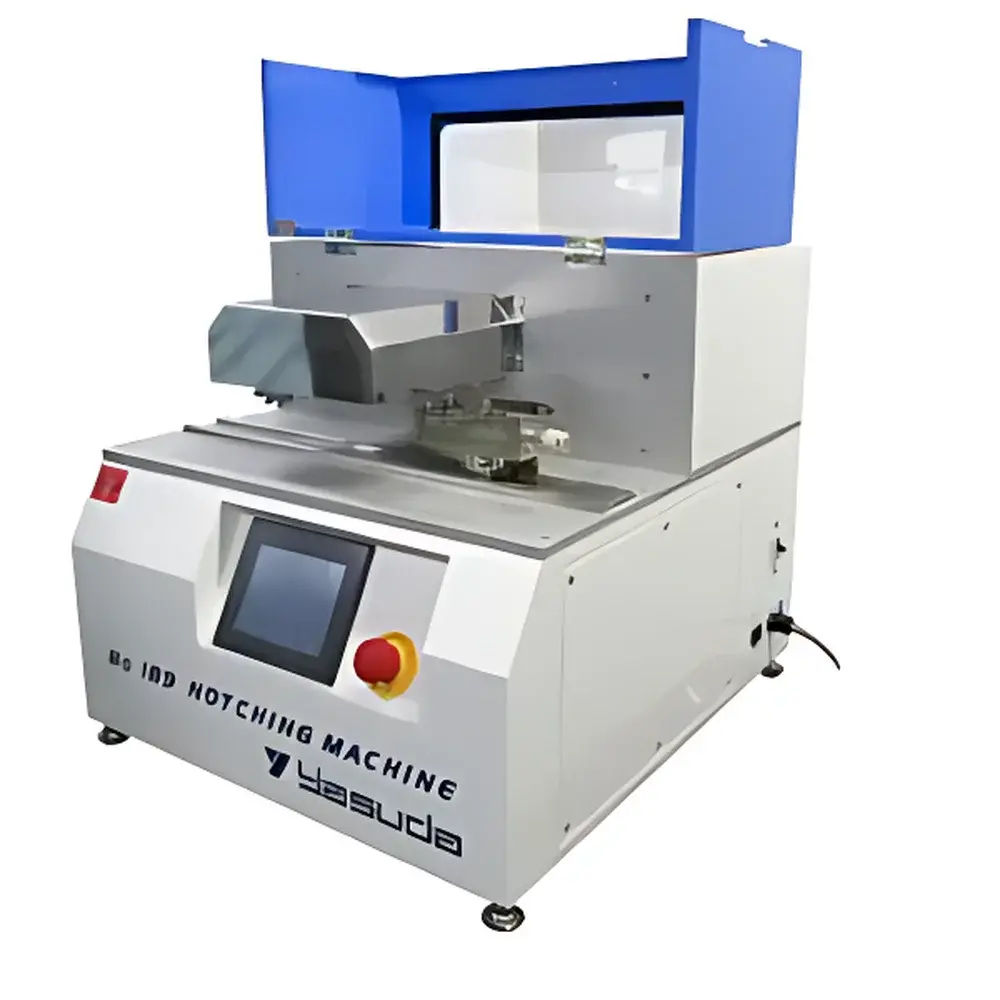
Yasuda No.189-PNCA Automatic Notched Specimen Preparation Machine
| Brand | Yasuda |
|---|---|
| Origin | Japan |
| Model | No.189-PNCA |
| Application | Thermoplastics, Engineering Plastics, Rigid Polymers |
| Compliance | GB/T 1043, GB/T 1843, ISO 2818, ISO 179, ISO 180, JIS K7144 |
| Control System | Digital Motorized Depth & Speed Regulation |
| 刀具配置 | Dual-axis Independent Rotating Cutters (Notching + Edge Trimming) |
| Sample Types | Dumbbell-shaped & Rectangular Bars |
| Safety | Dual-interlock Guarding System |
| Material Compatibility | PE, PP, PVC, PS, ABS, PC, POM, Modified High-Hardness Plastics |
Overview
The Yasuda No.189-PNCA Automatic Notched Specimen Preparation Machine is an engineered solution for high-precision notching of polymeric test specimens intended for standardized impact testing—particularly Izod and Charpy methods per ISO 179, ISO 180, ASTM D256, GB/T 1043, and GB/T 1843. Unlike manual or single-axis notching tools, this machine employs a dual-axis rotating cutter architecture to decouple notching and edge-trimming operations, eliminating cross-axis vibration interference and ensuring dimensional stability across repeated cuts. The system operates on the principle of controlled rotary milling rather than linear shearing, minimizing localized thermal buildup in thermally sensitive engineering plastics (e.g., PC, POM, reinforced PP), thereby preventing melt deformation, stringing, or micro-cracking at the notch root—a critical factor influencing fracture energy reproducibility.
Key Features
- Dual independent rotating cutter spindles: One dedicated to V-notch generation, the other to specimen edge conditioning—each with individually adjustable rotational speed (up to 3,000 rpm) and programmable feed rate.
- Motorized depth-of-cut control: Precise digital adjustment of notch depth (range: 0.1–5.0 mm in 0.01-mm increments), enabling compliance with multiple international standards—including ISO 179/180 (2-mm depth), ASTM D256 (2.54-mm depth), and custom specifications.
- Interchangeable high-speed steel (HSS) cutting inserts: Coated with TiAlN for enhanced thermal resistance and wear life; tool geometry optimized for brittle and semi-crystalline polymers; quick-release mounting for minimal downtime during maintenance.
- Optical alignment window and front-access design: Enables real-time visual monitoring of the cutting zone, immediate debris clearance, and rapid tool inspection without disassembly.
- Programmable multi-pass machining: Supports up to five sequential shallow-depth passes to reduce burr formation and improve surface finish—especially critical for high-hardness modified plastics (e.g., glass-filled PA6, flame-retardant ABS).
- Integrated dual-layer safety interlock: Mechanical guard door switch + infrared presence sensor ensures automatic spindle stop upon access, meeting IEC 60204-1 machinery safety requirements.
Sample Compatibility & Compliance
The No.189-PNCA accommodates standard tensile bars (e.g., ISO 527 Type 1A, ASTM D638 Type I) and dumbbell-shaped specimens (ISO 527-2, GB/T 1040.2) with widths from 4 to 20 mm and thicknesses from 2 to 12 mm. It is validated for use with rigid thermoplastics including polyethylene (PE), polypropylene (PP), polyvinyl chloride (PVC), polystyrene (PS), acrylonitrile-butadiene-styrene (ABS), polycarbonate (PC), polyoxymethylene (POM), and filled or flame-retardant variants. All notch geometries conform to ISO 2818 (machining of plastic test specimens), and final specimens meet traceability requirements under GLP-compliant laboratories when paired with calibrated depth gauges and documented SOPs.
Software & Data Management
The embedded controller supports parameter logging (notch depth, spindle RPM, pass count, timestamp) to internal non-volatile memory. Optional RS-232 or USB-C interface enables export of machining logs to LIMS or QA databases. While no proprietary software suite is bundled, the machine’s deterministic behavior and repeatable motion profiles ensure full compatibility with laboratory audit trails required under FDA 21 CFR Part 11 (when used in regulated environments with supplementary electronic signature controls). All operational settings are password-protected and version-locked to prevent unauthorized modification.
Applications
- Preparation of standardized Izod/Charpy impact specimens for quality control in polymer compounding facilities.
- R&D validation of notch sensitivity in newly formulated high-performance thermoplastics.
- Failure analysis labs requiring consistent notch root geometry for fractographic correlation studies.
- Certification testing per ISO/IEC 17025-accredited laboratories performing mechanical property assessments.
- Academic research on fracture initiation behavior in semi-crystalline vs. amorphous polymer systems.
FAQ
What standards does the No.189-PNCA support for notch geometry?
It complies with ISO 179 (Charpy), ISO 180 (Izod), GB/T 1043, GB/T 1843, JIS K7144, and ISO 2818 for specimen machining—covering both 45° V-notches and U-notches with user-defined depths.
Can it process specimens thicker than 10 mm?
Yes—maximum specimen thickness is 12 mm; however, optimal surface finish and notch root integrity are maintained at ≤10 mm for high-hardness materials (e.g., GF-PP, PC/ABS blends).
Is calibration documentation provided with the unit?
The machine ships with a factory verification report confirming repeatability of notch depth (±0.02 mm over 10 consecutive cuts) and positional accuracy of the V-groove centerline (±0.05 mm). NIST-traceable depth gauge calibration is recommended annually.
How is tool wear monitored?
No automated wear detection is built-in; users perform visual inspection via the front optical window and measure notch profile consistency using optical profilometry or SEM. HSS insert service life averages 2,500–4,000 cuts depending on material abrasiveness.
Does it support custom notch angles beyond 45°?
Standard configuration delivers 45° V-notches only; 30° or 60° angles require optional custom-ground cutters—available upon request with lead time and metrological validation.
Related Products



