
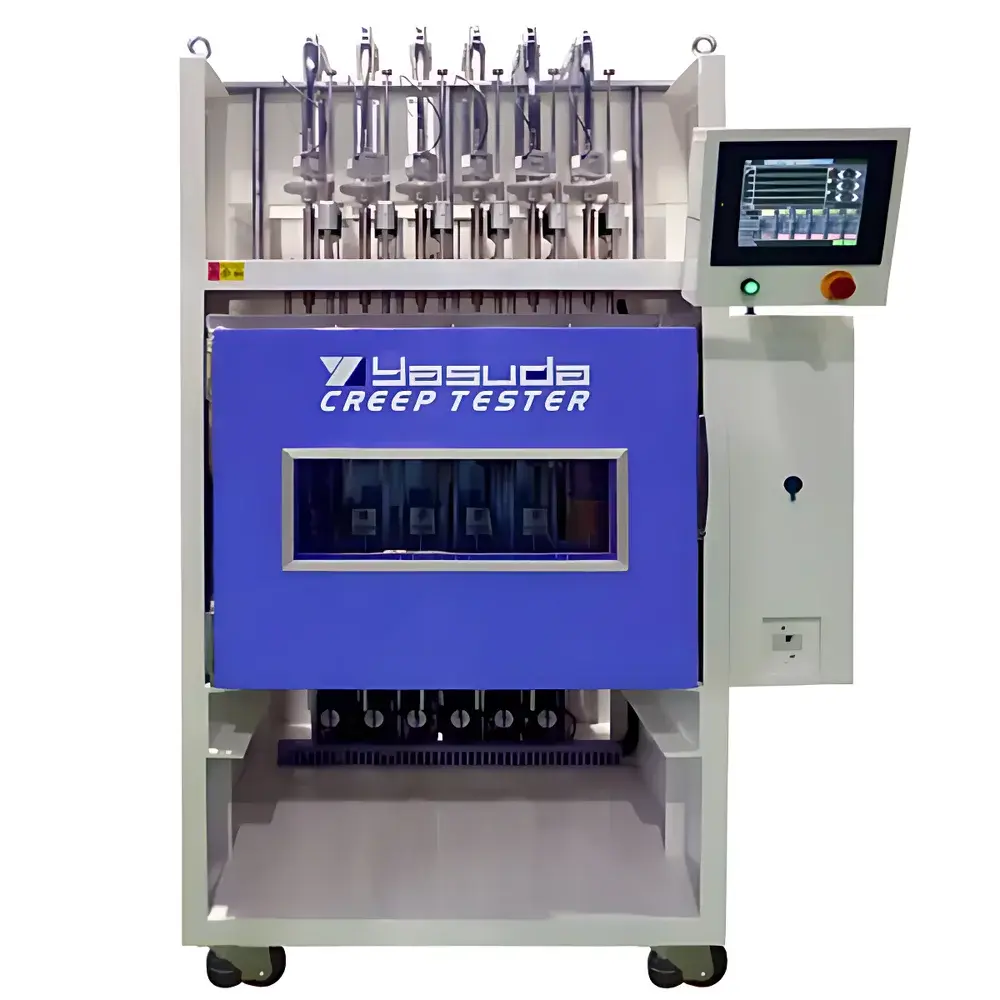
Yasuda No.145-A Light-Load Creep Tester
| Brand | Yasuda |
|---|---|
| Origin | Japan |
| Model | No.145-A |
| Standards Compliance | JIS K7115, ASTM D2990, ISO 899-1 |
| Maximum Load Capacity | 500 N (50 kgf) |
| Displacement Resolution | 0.01 mm |
| Displacement Range | 150 mm |
| Temperature Range | Up to 200 °C |
| Load Application Method | Sliding-type dead-weight loading |
| Displacement Sensor Type | Magnetic strain-based linear scale |
| Configurable Fixture Options | Tensile, Compression, and Flexural Jigs |
| Optional Environmental Chambers | Low-Temperature, Constant-Temperature & Humidity, Split-Type Chambers |
| Test Specimen Support Stations | 3, 6, or 10 positions |
| Software Platform | Windows-compatible proprietary creep analysis software |
| Power Supply | Configuration-dependent |
| Dimensions & Weight | Specification-dependent |
Overview
The Yasuda No.145-A Light-Load Creep Tester is a precision-engineered mechanical testing instrument designed for time-dependent deformation characterization of thermoplastic and thermosetting polymers under sustained static loading. It operates on the fundamental principle of uniaxial (or multi-axis, when equipped with optional fixtures) quasi-static load application, enabling quantitative measurement of strain evolution—creep compliance—as a function of time, temperature, and applied stress level. Unlike high-force universal testers, the No.145-A is specifically optimized for low-magnitude load regimes (up to 500 N), making it ideal for evaluating thin films, molded specimens, elastomeric compounds, and fiber-reinforced composites where excessive force may induce premature yielding or non-linear viscoelastic response. Its modular architecture supports standardized test configurations per JIS K7115 (Japanese Industrial Standard), ASTM D2990 (American Society for Testing and Materials), and ISO 899-1 (International Organization for Standardization), ensuring data comparability across global R&D, quality control, and regulatory submission environments.
Key Features
- Sliding-type dead-weight loading system ensures stable, drift-free force application without servo-controlled actuation—critical for long-duration tests exceeding 1,000 hours.
- Magnetic strain-based linear scale provides displacement resolution of 0.01 mm over a full 150 mm travel range, delivering high repeatability in dimensional change tracking under thermal and mechanical stress.
- Modular specimen station configuration: users select between 3-, 6-, or 10-position frames to accommodate parallel testing of multiple samples—enhancing statistical robustness and throughput in batch qualification.
- Thermal capability up to 200 °C enables elevated-temperature creep evaluation aligned with real-world service conditions for automotive under-hood components, electrical insulation materials, and packaging films.
- Interchangeable fixture set includes tensile grips, compression platens, and three-point bending fixtures—allowing single-platform execution of creep, stress relaxation, thermal shrinkage, and thermal shock protocols per JIS K7162.
- Windows-native control and analysis software supports automated data logging, time–strain curve fitting (e.g., Burgers, Findley, and Prony series models), compliance modulus derivation, and export to CSV, Excel, and PDF formats.
Sample Compatibility & Compliance
The No.145-A accommodates standard ASTM D638 Type I–V, ISO 527-2, and JIS K7113 dumbbell and rectangular specimens (thickness ≤ 10 mm). Its low-load design prevents buckling in slender compression samples and avoids edge fracture in brittle thermoplastics during tensile creep. All test procedures are traceable to internationally recognized standards: JIS K7115 for polymer creep behavior; ASTM D2990 for tensile, compressive, and flexural creep; ISO 899-1 for determination of creep behavior under constant tensile load; and JIS K7162 for thermal shrinkage and stress relaxation measurements. The system’s mechanical stability and calibrated load train meet GLP (Good Laboratory Practice) requirements for regulated environments, and its software architecture supports audit trail functionality—facilitating alignment with FDA 21 CFR Part 11 when paired with appropriate IT validation documentation.
Software & Data Management
The proprietary Windows-based software suite offers real-time monitoring of load, displacement, and chamber temperature (when integrated with environmental options). It implements automatic zero-point compensation, baseline correction, and user-defined hold/step sequences for multi-stage creep testing. Data files include metadata such as operator ID, sample ID, test start timestamp, ambient conditions, and calibration certificate references. Exported datasets retain full temporal resolution (configurable sampling intervals from 1 s to 1 h), enabling post-processing in MATLAB, Python (SciPy), or commercial rheology analysis platforms. Raw data integrity is preserved via binary logging; no interpolation or smoothing is applied prior to storage. Audit logs record all parameter modifications, file exports, and software updates—supporting traceability in GMP and ISO/IEC 17025-accredited laboratories.
Applications
- Creep resistance evaluation of polypropylene (PP), polyethylene (PE), polycarbonate (PC), and polyamide (PA) used in structural housings and load-bearing components.
- Long-term dimensional stability assessment of elastomeric seals and gaskets operating at elevated temperatures in HVAC and industrial fluid systems.
- Viscoelastic modeling input generation for finite element analysis (FEA) of polymer parts subjected to sustained mechanical loads.
- Quality assurance screening for incoming raw material lots against supplier specifications and internal creep modulus thresholds.
- Accelerated aging correlation studies linking short-term creep data (at elevated T) to predicted service life using time–temperature superposition (TTS) principles.
- Regulatory dossier preparation for medical device polymer components requiring ISO 10993-1 biocompatibility and mechanical longevity evidence.
FAQ
What types of polymers can be tested on the No.145-A?
The system is validated for thermoplastics, thermosets, elastomers, and filled composites with modulus ranges from ~100 MPa to 3 GPa—provided specimen geometry complies with JIS/ASTM/ISO dimensional guidelines.
Is the software compliant with 21 CFR Part 11?
Yes—when deployed with password-protected user roles, electronic signatures, and enabled audit trail logging, the software meets foundational requirements for electronic records and signatures in FDA-regulated settings.
Can the tester operate without an environmental chamber?
Yes—ambient-temperature creep testing is fully supported; thermal chambers are optional add-ons for elevated- or sub-ambient condition studies.
How is load accuracy verified?
Each unit ships with NIST-traceable calibration certificates for both load cell (±0.5% FS) and displacement sensor (±0.02 mm linearity); annual recalibration is recommended per ISO/IEC 17025.
What is the maximum test duration supported?
The system supports continuous operation for >6,000 hours (250 days) with uninterrupted power and stable environmental conditions—limited only by specimen degradation or maintenance scheduling.





