
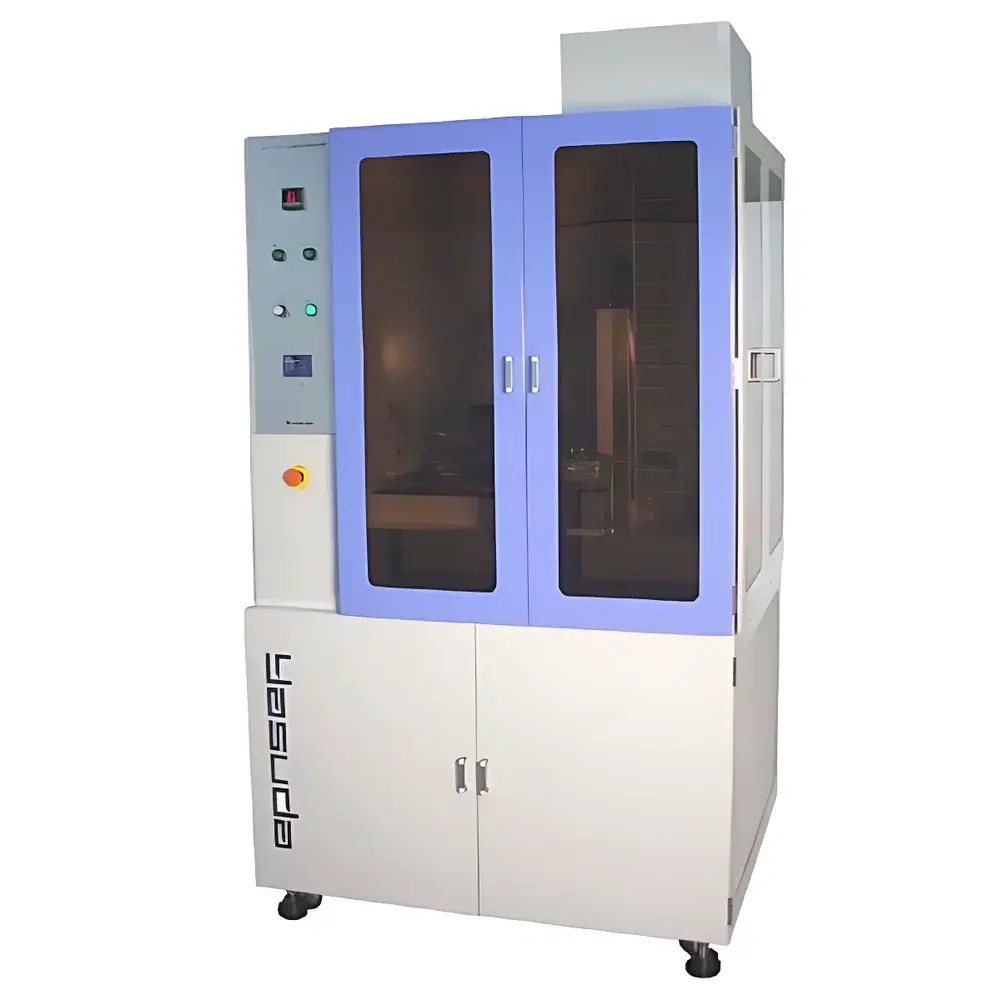
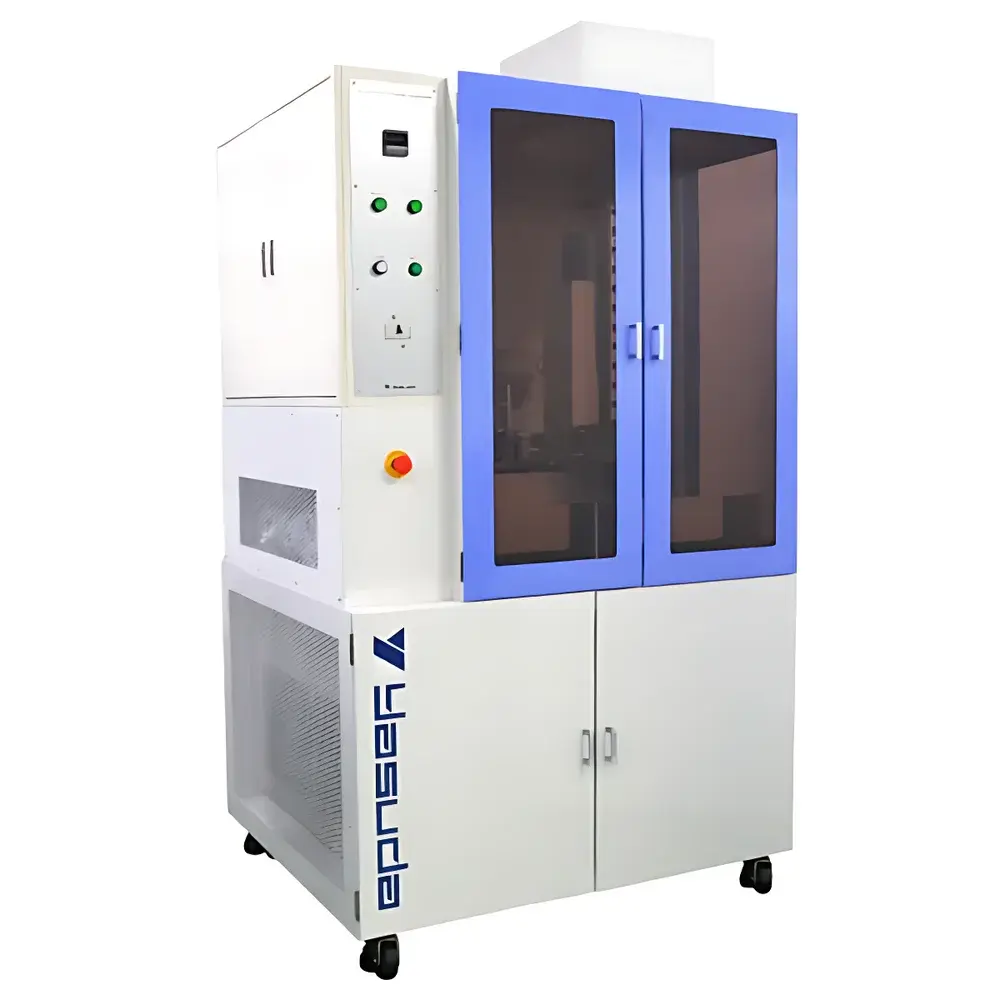
Yasuda No.121-AUTO Fully Automated Brittleness Temperature Tester
| Brand | Yasuda |
|---|---|
| Origin | Japan |
| Model | No.121-AUTO |
| Temperature Range | −70 °C to ambient (mechanical refrigeration) |
| Standards Compliance | JIS C 3005, JIS K 6261, JIS K 6723, JIS K 7216, ASTM D746, ISO 812, ISO 974 |
| Sample Capacity | Up to 40 holders (200 specimens total) |
| Automation Level | Fully robotic sample handling and impact sequencing |
| Cooling Method | Dual-mode (compressor-based + optional LN₂ boost) |
| Control Interface | Dedicated Windows-based software with programmable test protocols and audit-ready data logging |
Overview
The Yasuda No.121-AUTO Fully Automated Brittleness Temperature Tester is an engineered solution for determining the brittle temperature of polymeric materials—including thermoplastics, elastomers, vulcanized rubber, and coated cables—under precisely controlled low-temperature conditions. It operates on the principle of impact-induced fracture assessment: specimens are cooled to progressively lower temperatures and subjected to standardized pendulum or spring-loaded impact in accordance with international test methods. Unlike semi-automated systems requiring manual specimen transfer or temperature staging, the No.121-AUTO integrates a synchronized robotic handler, multi-zone cryogenic chamber, and programmable impact actuator to execute sequential, unattended testing across up to 200 specimens. Its dual-stage cooling architecture—comprising a high-stability mechanical refrigeration system (−70 °C baseline) augmented by optional liquid nitrogen injection—ensures rapid, uniform thermal equilibration and sub-zero stability critical for reproducible transition-point detection.
Key Features
- Fully integrated robotic specimen handling system with precision gripper arms and indexed holder carousel, eliminating manual intervention during thermal conditioning and impact cycles.
- Dual-mode temperature control: primary compressor-based refrigeration (−70 °C to +30 °C) supplemented by liquid nitrogen injection for extended range down to −100 °C with ±0.5 °C chamber uniformity over full load.
- Programmable test sequencing: users define stepwise temperature decrements (e.g., 2 °C or 5 °C intervals), dwell times (per ASTM D746: ≥1 min at target temperature), and impact energy levels via intuitive Windows-based software interface.
- Compliance-ready architecture: built-in timestamped event logging, user-access-level permissions, and electronic signature support aligned with GLP and FDA 21 CFR Part 11 requirements for regulated laboratories.
- Modular holder design accommodating standard dumbbell, strip, or cord-shaped specimens per JIS K 6261 and ISO 812; each holder secures five specimens, enabling batch validation with statistical confidence.
Sample Compatibility & Compliance
The No.121-AUTO supports a broad spectrum of polymeric forms—solid sheets, extruded profiles, insulated wires, molded gaskets, and vulcanized rubber compounds—provided they conform to dimensional tolerances specified in JIS C 3005 (electrical insulating materials), JIS K 6723 (polyvinyl chloride), and ASTM D746 (rigid plastics). Specimen thickness ranges from 0.5 mm to 4.0 mm; width and length adhere to standard 6.0 mm × 25.0 mm or 12.7 mm × 25.4 mm formats. All test procedures follow strictly defined thermal soak durations, impact velocity (2.0 m/s ± 0.2 m/s), and energy thresholds (e.g., 0.5 J or 2.0 J per ISO 812 Annex A). The system’s firmware and calibration documentation are traceable to JCSS-accredited standards, facilitating audit readiness under ISO/IEC 17025 and IATF 16949 quality management frameworks.
Software & Data Management
The proprietary Yasuda TestMaster™ software provides end-to-end workflow orchestration—from test method selection (ASTM, ISO, JIS presets) and parameter definition to real-time thermal profiling, pass/fail binary classification per impact response, and automated brittle point interpolation. Raw data (temperature, time, impact count, fracture status) are stored in encrypted SQLite databases with immutable audit trails. Export options include CSV, PDF test reports (with embedded digital signatures), and XML-compatible outputs for LIMS integration. Version-controlled software updates are distributed via secure TLS-encrypted channels, and all configuration changes generate timestamped change logs compliant with GxP data integrity principles.
Applications
This instrument serves critical quality assurance functions across automotive (cable harness cold resistance verification), medical device manufacturing (polymer tubing brittleness screening), aerospace (sealant and composite matrix low-temperature performance), and wire & cable industries (insulation integrity validation per UL 1581 and JIS C 3005). It is routinely deployed in R&D labs evaluating plasticizer efficacy, polymer blend compatibility, and aging-induced embrittlement. In regulatory submissions, its output directly supports material qualification dossiers under REACH Annex XIV and RoHS compliance assessments where low-temperature failure thresholds influence product safety classifications.
FAQ
What standards does the No.121-AUTO natively support?
It includes preconfigured test templates for JIS C 3005, JIS K 6261, JIS K 6723, JIS K 7216, ASTM D746, ISO 812, and ISO 974—with adjustable parameters to meet variant editions or laboratory-specific SOPs.
Is liquid nitrogen required for operation?
No. Mechanical refrigeration alone achieves −70 °C. Liquid nitrogen is optional and only engaged when testing below that threshold—typically for specialty fluoropolymers or aerospace-grade elastomers.
How is calibration verified?
The system ships with NIST-traceable platinum resistance thermometer (PRT) probes and certified impact energy calibrators. Annual verification follows Yasuda’s documented procedure QM-CT-017, which references ISO 17025 clause 6.5.2.
Can test data be exported to enterprise systems?
Yes. Native CSV and XML exports support direct ingestion into LabVantage, Thermo Fisher SampleManager, and Siemens Opcenter Quality modules without third-party middleware.
What maintenance intervals are recommended?
Compressor oil and filter replacement every 2,000 operating hours; LN₂ delivery line purge and dewar inspection quarterly; robotic arm lubrication and encoder recalibration annually per Maintenance Manual Rev. 4.2.



