
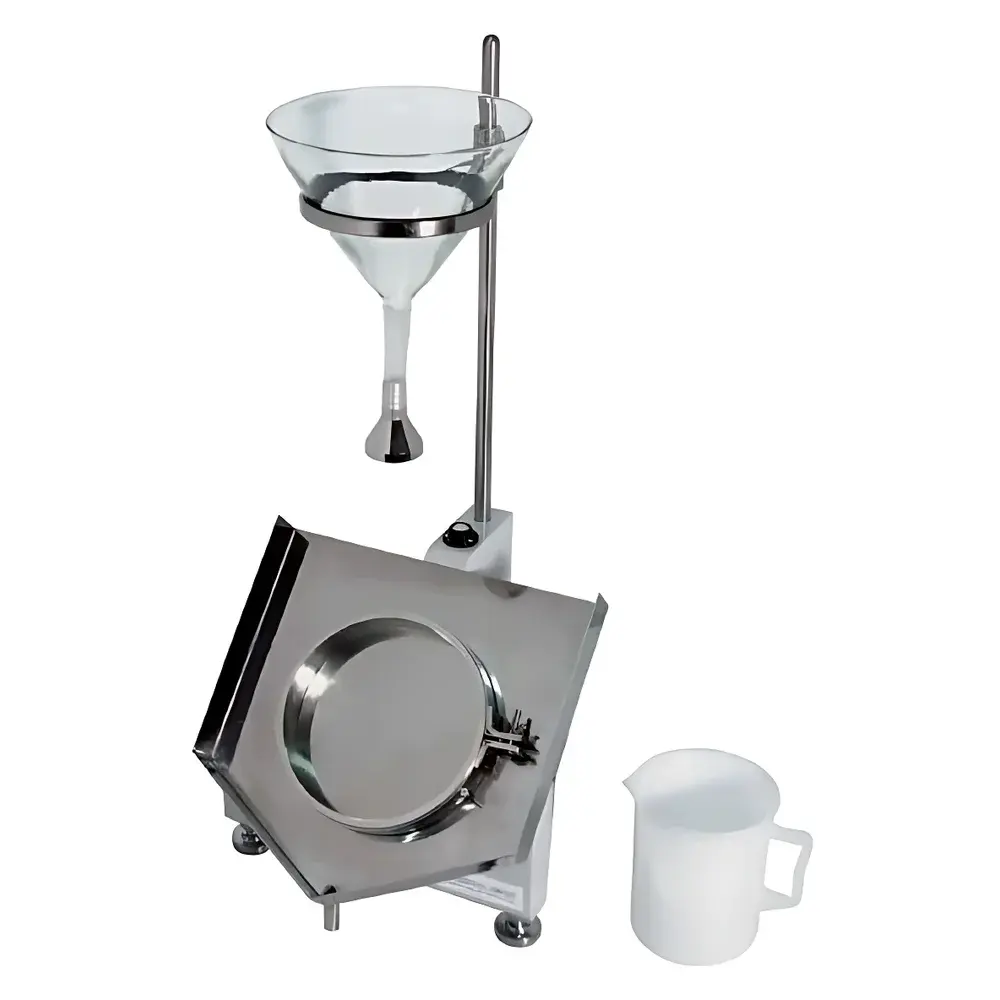
Yasuda No.402 Spray Tester
| Brand | Yasuda |
|---|---|
| Origin | Japan |
| Model | No.402 |
| Compliance Standards | JIS L1092, JIS K6404-8, ISO 4920 |
| Test Height | 150 mm |
| Spray Angle | 45° |
| Application | Water Repellency Evaluation of Textiles, Rubber, and Plastic Films |
| Supplier Type | Authorized Distributor |
| Import Status | Imported Instrument |
Overview
The Yasuda No.402 Spray Tester is a precision-engineered instrument designed for objective assessment of water repellency in flexible sheet materials—primarily textiles, coated fabrics, rubber sheets, and plastic films. It operates on the standardized spray test principle defined in JIS L1092 (Method A), JIS K6404-8, and ISO 4920, where a controlled volume of distilled or deionized water is delivered through a calibrated brass nozzle positioned at a fixed vertical height of 150 mm above the horizontal specimen plane. The nozzle directs the water stream at a consistent 45° angle relative to the specimen surface, simulating oblique rainfall exposure. After the 25-second spray cycle, the wetted pattern on the specimen is visually compared against an official ISO/JIS rating chart (0–5 scale), where 5 indicates no wetting and 0 signifies complete saturation. This method quantifies surface hydrophobicity without requiring electronic sensors or real-time data acquisition—relying instead on human-perceptible contrast between dry and wet regions under standardized lighting and viewing conditions.
Key Features
- Stainless-steel frame with corrosion-resistant finish for long-term laboratory durability and compliance with ISO 17025 environmental stability requirements.
- Precision-machined brass spray nozzle (ISO-specified orifice geometry) ensuring repeatable droplet size distribution and flow rate consistency across daily use.
- Fixed 150 mm nozzle-to-specimen distance maintained via rigid mechanical stop—eliminating operator-induced height variation that could compromise inter-laboratory reproducibility.
- Adjustable 45° spray orientation verified by integrated protractor scale and locking mechanism, conforming strictly to JIS L1092 geometric specifications.
- Drip tray with graduated collection reservoir for optional volumetric verification of delivered water (100 ± 5 mL per test cycle, per standard).
- Specimen clamp system accommodating standard 180 mm × 180 mm square samples with uniform tension—preventing edge curling or slippage during wetting.
Sample Compatibility & Compliance
The No.402 Spray Tester accepts flat, non-porous or semi-porous sheet specimens up to 3 mm thickness, including woven and knitted fabrics (cotton, polyester, nylon, blends), laminated technical textiles, elastomeric membranes, and thermoplastic films. It is explicitly validated for use in quality control environments governed by textile industry standards (JIS L1092 Class A, ISO 4920:2013) and referenced in ASTM D3182 for comparative water resistance evaluation. While not a quantitative gravimetric or pressure-based test, its pass/fail output supports GLP-aligned documentation when paired with traceable calibration records, operator training logs, and controlled ambient conditions (20 ± 2°C, 65 ± 5% RH per ISO 139). The device itself carries no electrical safety certification (e.g., CE, UL), as it contains no powered components—making it suitable for installation in wet-area laboratories without grounding or surge protection requirements.
Software & Data Management
The Yasuda No.402 is a manually operated mechanical instrument with no embedded electronics, firmware, or digital interface. Consequently, it does not require software installation, driver configuration, or network connectivity. All test execution—including timing (via external stopwatch), water volume dispensing (via calibrated cylinder), and rating assignment—is performed per written SOPs. For laboratories operating under FDA 21 CFR Part 11 or ISO/IEC 17025, full traceability is achieved through paper-based or LIMS-integrated test records documenting: specimen ID, lot number, conditioning history (per ISO 139), operator initials, ambient temperature/humidity, observed rating, and date/time stamp. Optional accessories—including certified reference rating charts (NIST-traceable visual standards) and humidity-controlled conditioning cabinets—support audit-ready workflows.
Applications
- Final QC release testing of outdoor apparel, workwear, and military-grade textiles prior to shipment.
- Process validation of durable water repellent (DWR) coating application on nylon ripstop or polyester taffeta substrates.
- Comparative screening of silicone vs. fluorocarbon finish performance under identical spray exposure.
- Pre- and post-wash evaluation of water repellency retention in home-laundry simulated cycles (per ISO 6330).
- Technical specification verification for automotive interior trim fabrics exposed to condensation or splash environments.
- Teaching laboratories demonstrating fundamental textile surface energy principles and standard test methodology alignment.
FAQ
Is the No.402 Spray Tester compliant with ISO/IEC 17025 accreditation requirements?
Yes—when used within a documented quality management system that includes operator competency assessment, periodic nozzle inspection, environmental monitoring, and sample conditioning controls per ISO 139, the instrument supports accredited testing per ISO 4920.
Can it be used for non-textile materials such as silicone rubber gaskets or PVC flooring?
Yes—provided the material is planar, dimensionally stable during wetting, and falls within the 180 mm × 180 mm specimen format. Validation per internal SOP is recommended for non-textile applications.
Does Yasuda provide calibration services or certified reference standards?
Yasuda supplies ISO-certified visual rating charts (0–5 scale) with batch-specific traceability documentation. Nozzle calibration verification kits and dimensional gauges are available through authorized distributors.
What maintenance is required to ensure long-term measurement consistency?
Monthly cleaning of the brass nozzle with ultrasonic degreasing and inspection for orifice deformation; annual replacement of rubber gaskets in the water delivery line; biannual verification of clamp tension uniformity using a calibrated force gauge.






