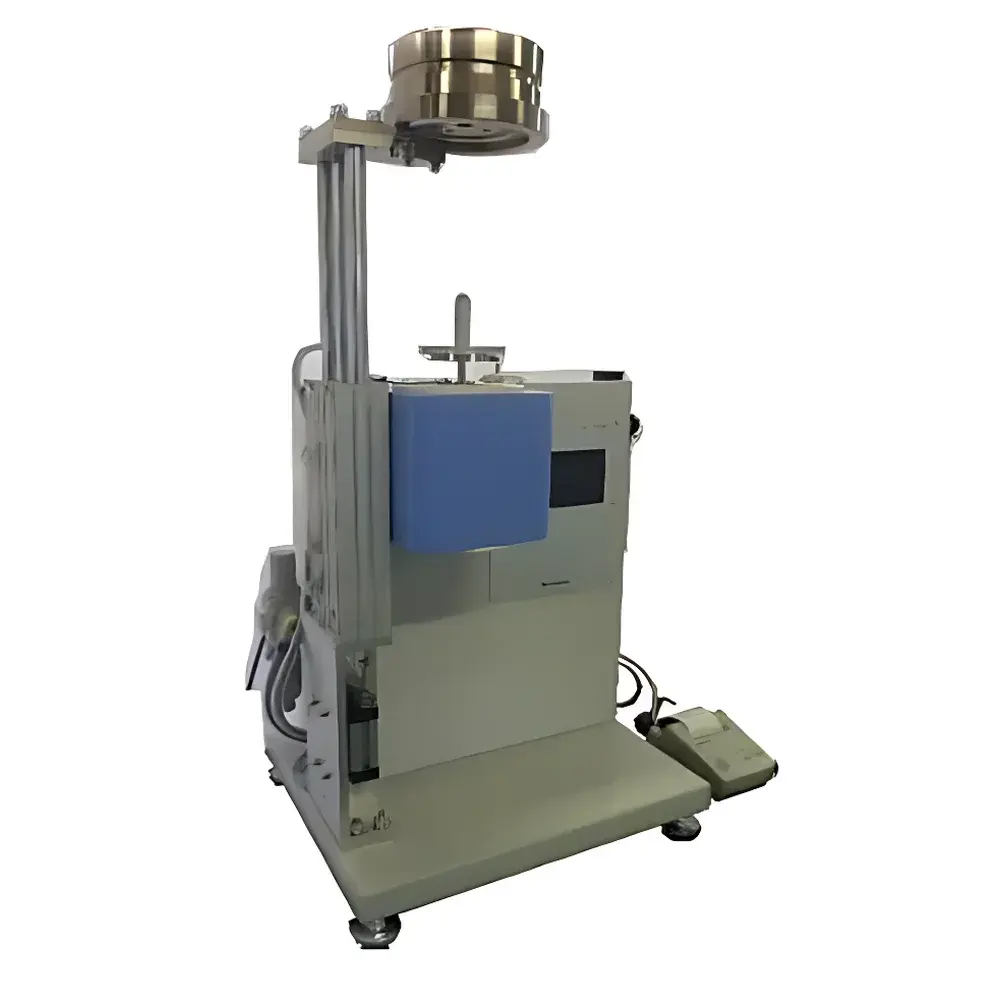
Yasuda No.120-FWP-C Melt Flow Indexer
| Brand | Yasuda |
|---|---|
| Origin | Japan |
| Model | No.120-FWP-C |
| Standards Compliance | ASTM D1238, ISO 1133, JIS K6719-1/2, K6921-2, K6922-2, K6923-1, K6924-1, K6926-2, K7210 |
| Temperature Range | Up to 400 °C |
| Control Method | PID-based digital temperature regulation |
| Loading Method | Automatic weight switching |
| Cutting Mechanism | Motorized auto-cutter (for Method A) |
| Interface | Touchscreen HMI |
| Optional | Integrated thermal printer |
Overview
The Yasuda No.120-FWP-C Melt Flow Indexer is a precision-engineered instrument designed for the quantitative determination of melt mass-flow rate (MFR) and melt volume-flow rate (MVR) of thermoplastic polymers under standardized load and temperature conditions. Based on the fundamental principle of extrusion rheometry—where molten polymer is forced through a standardized die under controlled gravitational or applied load—the system delivers repeatable, traceable results essential for quality control, material specification verification, and process development in polymer compounding, injection molding, and extrusion facilities. Its dual-method capability supports both ASTM D1238 Method A (mass-based, gravimetric cut) and Method B (volumetric, displacement-based), enabling laboratories to comply with global regulatory and contractual testing requirements without method revalidation or equipment duplication.
Key Features
- Dual-Method Operation: Fully supports both MFR (Method A) and MVR (Method B) determinations per ASTM D1238 and ISO 1133, with automatic mode recognition and parameter initialization.
- Automated Weight Handling: Electromechanical weight selector mechanism enables precise, operator-independent application of standard test loads (e.g., 2.16 kg, 5.00 kg, 10.00 kg), minimizing mechanical error and eliminating manual handling risks.
- Motorized Auto-Cutter: Integrated stepper-driven cutting unit performs timed, repeatable specimen extrudate cuts during Method A testing—synchronized with real-time timer and thermal stabilization status.
- PID Digital Temperature Control: High-stability microprocessor-controlled heating system ensures ±0.2 °C temperature uniformity across the barrel zone, rapid ramp-to-setpoint (<15 min to 300 °C), and drift <±0.1 °C over 30-minute continuous operation.
- High-Temperature Barrel Assembly: Constructed from hardened alloy steel with optional high-temp ceramic insulation; rated for sustained operation up to 400 °C, suitable for engineering resins including polyetherimide (PEI), polyphenylene sulfide (PPS), and polyetheretherketone (PEEK).
- Intuitive Touchscreen Interface: 7-inch capacitive HMI with multilingual UI (English, Japanese, Chinese), graphical real-time temperature profile display, test log navigation, and password-protected configuration access.
Sample Compatibility & Compliance
The No.120-FWP-C accommodates standard cylindrical specimens (typically 4 mm diameter × 10 mm length) prepared per ASTM D1238 Annex A1 and ISO 1133-1 Clause 6. It is validated for use with common thermoplastics—including polyethylene (PE), polypropylene (PP), polystyrene (PS), acrylonitrile butadiene styrene (ABS), polyamide (PA6/66), and thermoplastic elastomers (TPEs). All operational parameters—including die geometry (2.095 mm ±0.005 mm diameter, 8.000 mm ±0.025 mm length), piston dimensions, and preheat dwell times—are aligned with ISO 1133-1:2011 and ASTM D1238–22 dimensional tolerances. The instrument’s design facilitates GLP-compliant documentation workflows when paired with external LIMS or audit-trail-enabled software platforms.
Software & Data Management
While the embedded controller manages core acquisition and calculation (MFR = m/t × 600, where m = mass in grams, t = cut interval in seconds), data export is supported via USB 2.0 port in CSV format for post-processing in Excel, statistical analysis packages (e.g., Minitab), or enterprise QA systems. Optional firmware upgrade enables time-stamped test records with operator ID, environmental temperature/humidity metadata (when integrated with external sensors), and digital signature fields compliant with FDA 21 CFR Part 11 requirements when deployed with validated third-party electronic record software. Calibration logs, maintenance history, and sensor diagnostics are retained locally with date/time stamping and write-protection options.
Applications
- Raw material acceptance testing per supplier specifications (e.g., PE HD5002, PP H1606)
- In-process monitoring of melt index stability during extruder start-up and grade changeovers
- Correlation studies between MFR and mechanical properties (tensile strength, impact resistance) in R&D labs
- Validation of thermal degradation effects during multiple extrusion passes (recycling simulation)
- Supporting ISO 9001:2015 clause 8.5.1 (control of production and service provision) and IATF 16949:2016 process capability assessments
- Regulatory submission support for medical-grade polymer batches (ISO 10993-12, USP )
FAQ
Does the No.120-FWP-C support calibration traceability to national standards?
Yes—calibration certificates for temperature sensors (Pt100 Class A) and load cells (ISO 376 Class 0.5) are provided with NIST-traceable reference documentation upon installation.
Can the instrument be integrated into a laboratory network for centralized data collection?
The device does not feature native Ethernet or Wi-Fi; however, USB-hosted batch exports and optional RS-232 serial output enable integration with SCADA or MES systems using middleware gateways.
What maintenance intervals are recommended for long-term accuracy?
Barrel and die cleaning after every 10 tests; full piston and die calibration verification every 6 months or 500 test cycles; annual thermocouple validation using dry-block calibrator.
Is operator training included with purchase?
Yes—Yasuda-certified remote and on-site training modules cover method setup, troubleshooting, GMP documentation practices, and preventive maintenance protocols.