
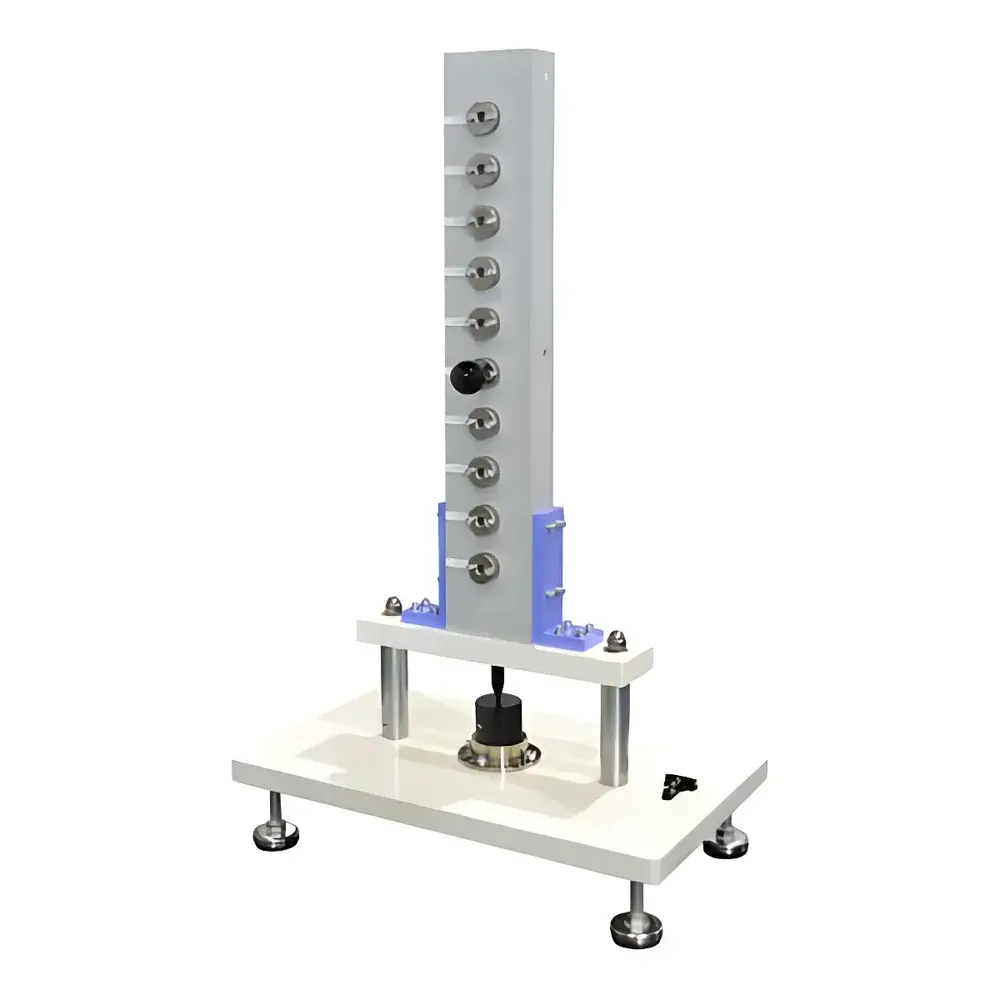
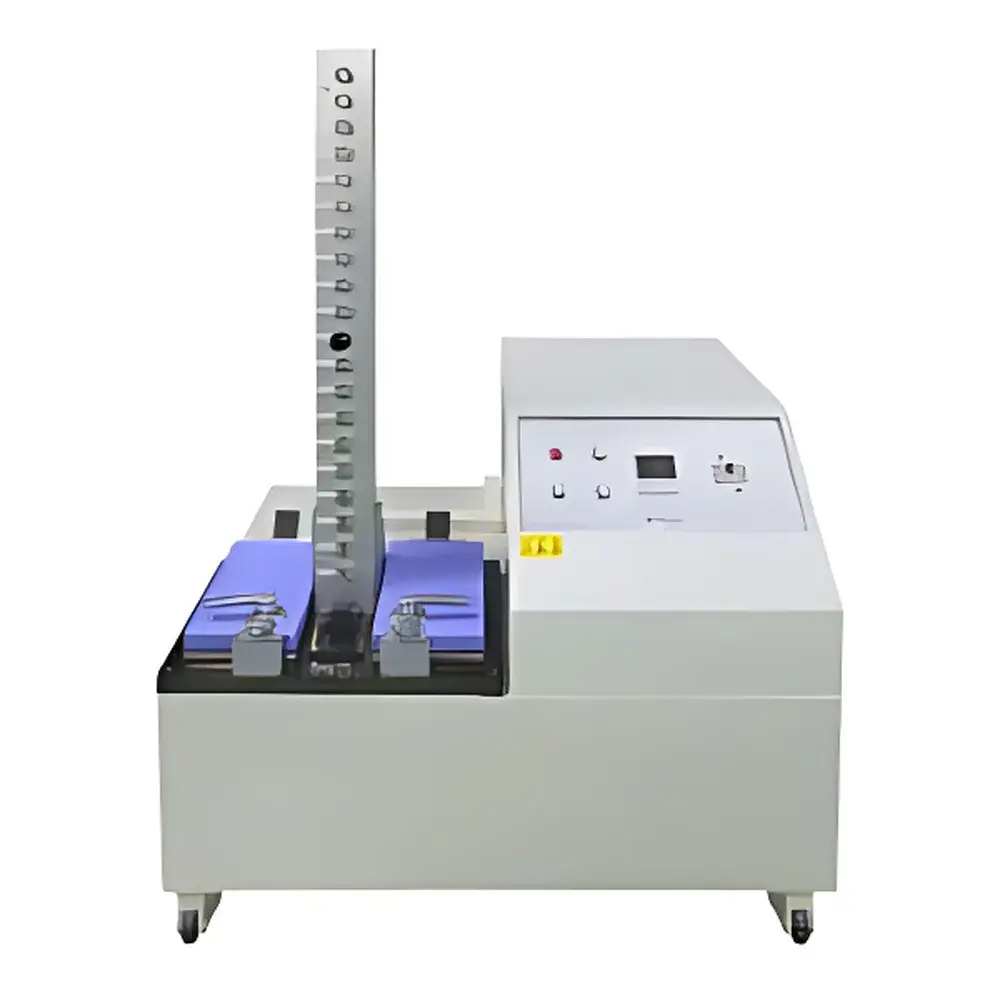
Yasuda No.517-L DuPont-Type Falling Weight Impact Tester with Integrated Low-Temperature Chamber
| Brand | Yasuda |
|---|---|
| Origin | Japan |
| Model | No.517-L |
| Instrument Type | Falling Weight Impact Tester |
| Standards Compliance | JIS K5400, JIS K5600-5-3, ASTM D2794, ISO 6272 |
| Temperature Control | Integrated cryogenic chamber (operating range: –30 °C to +50 °C) |
| Test Method | DuPont-style vertical drop impact with adjustable hammer mass (standard 1.0 kg, optional 0.5–2.0 kg) and variable drop height (10–100 cm in 1 cm increments) |
| Fixture | Dual-clamp specimen holder accommodating flat panels up to 150 mm × 150 mm × 6 mm thickness |
| Impact Head | Hemispherical steel indenter (Φ15.9 mm, Rockwell C58–62 hardness) |
| Repeatability | ≤±1.5% coefficient of variation (n=10, certified reference panels) |
Overview
The Yasuda No.517-L is a precision-engineered DuPont-type falling weight impact tester designed for standardized evaluation of coating adhesion, film integrity, and localized deformation resistance under controlled thermal conditions. Unlike conventional room-temperature impact testers, the No.517-L integrates a fully sealed, refrigerated environmental chamber—capable of stable operation from –30 °C to +50 °C—enabling rigorous assessment of coating performance at sub-ambient temperatures relevant to automotive clearcoats, aerospace primers, and low-temperature-cured industrial finishes. The instrument operates on the principle of gravitational energy conversion: a calibrated hammer of defined mass is elevated to a precise height and released vertically onto a horizontally mounted test specimen clamped between a hardened hemispherical impact head and a rigid anvil. The resulting plastic deformation, cracking, or delamination is assessed per pass/fail criteria defined in JIS K5400 (coating impact resistance), JIS K5600-5-3 (paint film toughness), ASTM D2794 (impact resistance of organic coatings on plastic substrates), and ISO 6272 (paints and varnishes — falling-weight impact test). Its mechanical architecture eliminates lateral deviation and rotational torque, ensuring high reproducibility across repeated tests.
Key Features
- Integrated low-temperature chamber with digital PID temperature controller, ±0.5 °C stability over full operating range (–30 °C to +50 °C)
- Adjustable hammer mass (standard 1.0 kg; optional 0.5 kg and 2.0 kg weights supplied with traceable calibration certificates)
- Precision-guided drop column with stainless-steel linear bearings and electromagnetic release mechanism for zero-friction, repeatable free-fall initiation
- Dual-point clamping fixture with micrometer-adjustable pressure (0–1.2 MPa) to ensure uniform substrate restraint without edge distortion
- Impact head conforming to ISO 6272 specifications: hardened steel hemisphere (Φ15.9 mm, Rc 58–62), mounted on a rigid, vibration-damped support
- Height adjustment scale with vernier readout (0.1 cm resolution) and mechanical lock for height retention during batch testing
- Compliance-ready design: all mechanical adjustments and operational parameters documented in accordance with GLP audit requirements
Sample Compatibility & Compliance
The No.517-L accommodates rigid and semi-rigid flat substrates—including cold-rolled steel, aluminum alloy, polycarbonate, ABS, and PET sheets—within dimensions of 150 mm × 150 mm × 6 mm maximum thickness. Specimens are prepared per ASTM D609 or ISO 1514 using standardized surface pretreatment and coating application protocols. The system supports both single-layer and multi-layer film systems, including UV-cured, epoxy, polyurethane, and acrylic-based formulations. Regulatory alignment includes full traceability to JIS K5400 Annex B (impact resistance classification), ISO 6272 Clause 7 (test report requirements), and ASTM D2794 Section 8 (acceptance criteria for plastic substrates). All hardware components meet RoHS Directive 2011/65/EU material restrictions, and chamber insulation complies with IEC 61000-6-3 EMC emission standards.
Software & Data Management
While the No.517-L is primarily a manually operated mechanical tester, it is compatible with third-party digital documentation workflows via optional USB-connected height/mass logging module (YAS-LOG-HM v2.1, sold separately). This module records timestamped test parameters—including hammer mass, drop height, chamber temperature at impact, and operator ID—for export to CSV or LIMS-compatible XML formats. Audit trails include electronic signatures compliant with FDA 21 CFR Part 11 when deployed with validated laboratory information management systems. Calibration records for hammer mass (NIST-traceable weights), height gauge (certified optical encoder), and temperature sensor (PT100 Class A) are maintained in accordance with ISO/IEC 17025:2017 clause 6.5.3.
Applications
- Evaluation of low-temperature brittleness in automotive topcoats and primer-surfacer systems
- QC screening of coil-coated metal panels prior to forming operations
- Development testing of high-gloss architectural coatings exposed to freeze-thaw cycling
- Adhesion validation for anti-graffiti and antimicrobial film laminates on polymer substrates
- Comparative impact resilience assessment of bio-based resins versus petrochemical analogues
- Supporting ASTM D7191 Annex A1 (cold-weather coating specification development)
FAQ
What temperature range does the integrated low-temperature chamber support?
The chamber maintains stable setpoints from –30 °C to +50 °C, with ramp rates programmable between 0.5 °C/min and 3.0 °C/min. Minimum stabilization time at target temperature is 30 minutes for 150 mm × 150 mm specimens.
Is the No.517-L suitable for testing flexible films or elastomeric coatings?
No. The fixture and impact geometry are optimized for rigid and semi-rigid substrates per ISO 6272 scope. Flexible films require alternative methods such as ISO 6272-2 (pendulum impact) or ASTM D3794 (Tukon microhardness correlation).
Can the instrument be used without the low-temperature chamber?
Yes. The chamber is mechanically decoupled and can be removed for ambient-temperature testing while retaining full compliance with JIS K5400 and ASTM D2794 procedures.
What calibration documentation is provided with shipment?
Each unit ships with a factory calibration certificate covering hammer mass (±0.05 g), drop height scale (±0.05 cm), chamber temperature sensor (±0.3 °C at –20 °C, +25 °C, +40 °C), and impact head geometry verification report.
Related Products



