
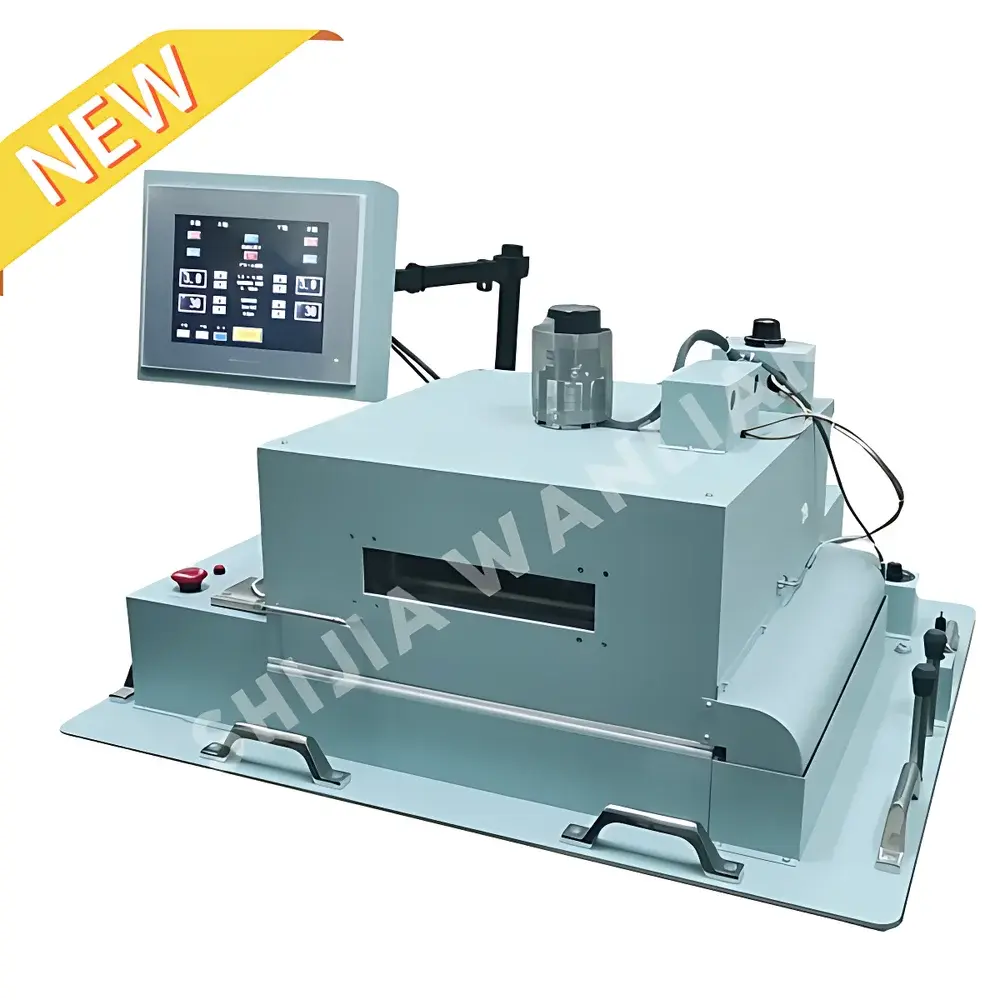
Shibayama X-Y Axis Stretching System
| Brand | Shibayama |
|---|---|
| Origin | Japan |
| Model | X-Y AXIS STRETCHING SYSTEM |
| Temperature Range | Ambient to 300 °C |
| Temperature Accuracy | ±2% of setpoint |
| Heating Power | 1 kW + 500 W Ni–Cr alloy heaters |
| Drive Mechanism | Ball-screw actuation (SUS304, M22×P2.5, MoS₂-coated) |
| Max Biaxial Extension Rate | 30 mm/s per axis (6× programmable scaling) |
| Chamber Configuration | Split two-part housing with hinged top lid |
| Safety | Built-in thermal cut-off thermostat |
| Compliance | Designed for ISO 1183, ASTM D882, ASTM D1894, and JIS K7127 test protocols |
Overview
The Shibayama X-Y Axis Stretching System is a precision-engineered biaxial tensile testing platform designed for controlled, synchronous or independent extension of polymeric films and thin sheet specimens along orthogonal (X and Y) axes. Unlike conventional uniaxial tensile testers, this system implements coupled electromechanical actuation based on high-precision ball-screw drives—each axis driven by a dedicated servo-controlled motor and guided by MoS₂-coated stainless-steel (SUS304) lead screws (M22×P2.5)—enabling reproducible strain application under defined thermal environments. The system operates within an integrated air-circulating environmental chamber, allowing real-time mechanical characterization across a thermally stabilized range from ambient to 300 °C. This capability supports fundamental research into thermo-mechanical behavior—including yield onset, necking propagation, strain-induced crystallization, and viscoelastic relaxation—critical for development and quality assurance of packaging films, battery separators, optical membranes, and biomedical substrates.
Key Features
- Independent or synchronized biaxial stretching modes: configurable for uniaxial (X- or Y-only), equal-biaxial (1:1 ratio), or asymmetric (e.g., 2:1, 3:1) extension profiles.
- High-speed electromechanical actuation: nominal maximum speed of 30 mm/s per axis, with 6× programmable rate scaling for fine-grained control during low-strain-rate creep or high-speed rupture studies.
- Integrated forced-air thermal chamber: dual-zone Ni–Cr heating elements (1 kW primary + 500 W auxiliary), PID-regulated airflow via induction-motor-driven electromagnetic blower, and split-shell construction with hinged access lid for rapid specimen loading.
- Thermal stability and fidelity: chamber maintains temperature accuracy within ±2% of setpoint across the full 25–300 °C operating range; validated against NIST-traceable reference thermocouples.
- Mechanical robustness: load frame constructed from stress-relieved aluminum alloy; all motion components engineered for minimal hysteresis and long-term dimensional stability under thermal cycling.
- Safety-integrated architecture: redundant overtemperature protection via mechanical thermostat and software-enforced thermal limits compliant with IEC 61000-6-2 EMC and IEC 61010-1 safety standards.
Sample Compatibility & Compliance
The system accommodates flat specimens up to 100 mm × 100 mm (standard clamp configuration), with optional custom fixtures supporting gauge lengths from 10 mm to 50 mm and thicknesses ranging from 5 µm (ultra-thin PET) to 500 µm (rigid polycarbonate sheets). Clamping force is pneumatically adjustable (0.2–1.2 MPa contact pressure) to prevent slippage without inducing edge damage. Test methodologies align with internationally recognized standards including ISO 1183 (density and dimensional stability), ASTM D882 (tensile properties of thin plastic sheeting), ASTM D1894 (coefficient of friction), and JIS K7127 (biaxial tensile testing of plastic films). The thermal chamber design satisfies ISO 291 conditioning requirements for preconditioning prior to mechanical testing.
Software & Data Management
Control and data acquisition are managed via Shibayama’s proprietary Windows-based software suite, supporting real-time synchronization of displacement, load (via optional external load cell integration), temperature, and time. Raw data streams are logged at ≥100 Hz with timestamped metadata (user ID, test protocol ID, calibration certificate hash). Export formats include CSV, HDF5, and XML-compliant .tdms for traceability in GLP/GMP environments. Audit trail functionality complies with FDA 21 CFR Part 11 requirements when paired with network-authenticated user accounts and electronic signature modules. Software includes preconfigured test templates for common industry protocols (e.g., “ISO 1183-3 Biaxial Creep at 120 °C”) and allows scripting via Python API for advanced experimental automation.
Applications
- Development and validation of biaxially oriented polypropylene (BOPP), polyethylene terephthalate (BOPET), and polyamide (BOPA) films used in food and pharmaceutical packaging.
- Characterization of thermal shrinkage behavior and dimensional stability of lithium-ion battery separator membranes under simulated cell operating temperatures.
- Quantification of strain-induced phase transitions in semi-crystalline polymers, including lamellar reorientation kinetics observed via in situ SAXS/WAXS coupling (compatible with synchrotron beamline integration).
- Quality control of medical device substrates such as silicone elastomer films and hydrogel-coated wound dressings subjected to dynamic mechanical loading.
- Fundamental rheological mapping of polymer melts during solid-state drawing processes, supporting extrusion and thermoforming process modeling.
FAQ
What sample dimensions and thicknesses are supported?
Standard clamping accepts specimens up to 100 mm × 100 mm with thicknesses from 5 µm to 500 µm; custom fixtures extend compatibility to smaller or thicker geometries.
Is the system compatible with external load cells or extensometers?
Yes—dedicated analog and digital I/O ports support third-party load cells (up to 500 N full scale) and non-contact video extensometry systems with sub-pixel resolution.
Does the software support automated compliance with ISO/ASTM reporting requirements?
Yes—the report generator auto-populates standardized tables, statistical summaries (mean, SD, CV%), and pass/fail flags per clause references in ISO 1183-3 and ASTM D882 Annex A4.
Can temperature and strain profiles be programmed independently per axis?
Yes—multi-step thermal ramps can be synchronized with position- or time-triggered biaxial strain sequences, enabling complex thermo-mechanical cycle testing.
What maintenance intervals are recommended for the ball-screw drive system?
MoS₂ coating provides dry-lubricated operation; recommended inspection every 500 hours of cumulative runtime, with grease replenishment only if visual wear or torque deviation exceeds ±5% of baseline.



