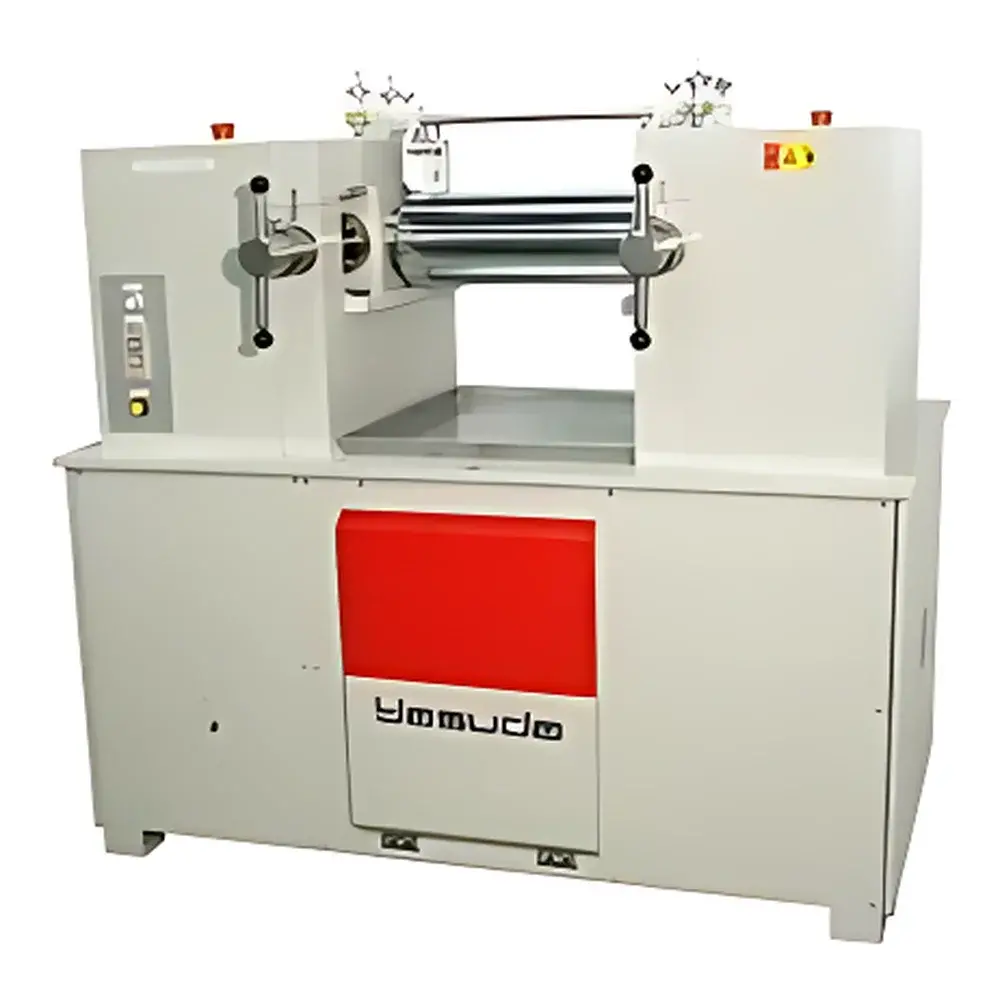
Yasuda No.191-WM Open Two-Roll Mill
| Brand | Yasuda |
|---|---|
| Origin | Japan |
| Model | No.191-WM |
| Roll Dimensions | φ3″ × 8″, φ4″ × 8″, φ5″ × 12″, φ6″ × 15″, φ8″ × 20″ |
| Heating Method | Steam (rotary joint type) |
| Max Roll Surface Temperature | 200 °C (at steam pressure ≥1.5 MPa) |
| Roll Speed Ratio | ~1:1.25 |
| Front Roll Speed | 12.5–31.25 rpm |
| Rear Roll Speed | 10–25 rpm |
| Safety Systems | Knee-actuated stop plates (front/rear), mushroom-type emergency stop button, overload protection circuit breaker (for rolls ≥5″), optional Y-bar emergency tilt bar, photoelectric safety curtain, reverse-rotation prevention device |
| Lubrication | Drip-type oil feed with needle valve |
| Standard Accessories | One set of PTFE collection board, calendering disc, hot bearing oil |
| Optional Accessories | Variable-speed drive, independent roll drive, digital temperature controller, oil circulation system, scraper assembly, warm-water circulation system (WM-series only) |
| Power Supply | AC 200 V, 3-phase, 20–50 A, 50/60 Hz |
Overview
The Yasuda No.191-WM Open Two-Roll Mill is a precision-engineered laboratory-scale mixing and compounding instrument designed for controlled thermomechanical processing of elastomers, thermoplastics, and composite formulations. Operating on the fundamental principle of shear-induced dispersion and homogenization between counter-rotating cylindrical rolls, the mill enables reproducible sample preparation for rheological characterization, vulcanization studies, filler dispersion evaluation, and small-batch formulation development. Its compact footprint and modular configuration make it especially suitable for R&D laboratories, quality control environments, and university polymer science facilities where space efficiency, operational repeatability, and process safety are critical. The machine adheres to core mechanical design principles common to ISO 289-1 (rubber—determination of Mooney viscosity) and ASTM D3182 (standard practice for rubber—materials, equipment, and procedures), supporting standardized test specimen conditioning prior to downstream analysis.
Key Features
- Five standard roll diameter–length configurations (φ3″ × 8″ through φ8″ × 20″) to accommodate varying sample volumes and shear intensity requirements.
- Steam-heated roll surfaces with rotary joints, capable of stable thermal control up to 200 °C under ≥1.5 MPa steam supply—ensuring uniform heat transfer without localized hot spots.
- Precision-machined roll geometry with fixed speed ratio (~1:1.25 front-to-rear), enabling predictable shear rate profiles across the nip zone.
- Dual independent speed ranges: front roll 12.5–31.25 rpm, rear roll 10–25 rpm—facilitating fine-tuned adjustment of residence time and shear history.
- Multi-layer safety architecture including dual knee-actuated stop plates, illuminated mushroom-type emergency stop, and thermal/magnetic overload protection for rolls ≥5″.
- Needle-valve-controlled drip lubrication system for consistent bearing oil delivery, minimizing frictional heating and extending service life.
- Modular upgrade path supporting optional digital PID temperature controllers, closed-loop oil circulation, automated scraper assemblies, and warm-water jacketing (WM-series exclusive).
Sample Compatibility & Compliance
The No.191-WM accommodates raw and compounded natural rubber (NR), synthetic elastomers (SBR, NBR, EPDM, silicone), thermoplastic elastomers (TPEs), masterbatches, carbon-black or silica-filled compounds, and thermoplastic resins (PP, PE, PVC, ABS). Its construction meets JIS B 8711 (safety requirements for rubber machinery) and incorporates fail-safe elements aligned with IEC 60204-1 (electrical equipment of machines). When integrated with optional digital controllers and audit-trail-capable software interfaces, the system supports GLP-compliant documentation workflows and can be validated per ASTM D1646 (Mooney viscometer calibration) prerequisites. All electrical components conform to IP54 ingress protection standards for laboratory dust and moisture exposure.
Software & Data Management
While the base No.191-WM operates as a manually supervised mechanical system, its optional digital temperature controller provides real-time roll surface temperature logging with ±0.5 °C accuracy and configurable alarm thresholds. When paired with third-party data acquisition systems (e.g., LabVIEW or custom SCADA), the mill’s analog output signals (0–10 V or 4–20 mA) enable synchronized recording of roll speed, surface temperature, motor current draw, and cycle timing. Optional firmware upgrades support CSV export, timestamped event logging (e.g., emergency stop activation, temperature deviation), and integration into centralized LIMS platforms compliant with FDA 21 CFR Part 11 when deployed with electronic signature modules and audit trail functionality.
Applications
- Preparation of standardized test specimens for tensile, hardness, and elongation testing (per ASTM D412, ISO 37).
- Dispersion assessment of nanofillers (e.g., graphene, CNTs) in elastomeric matrices via subsequent SEM/TEM analysis.
- Accelerated aging studies using controlled thermal–mechanical stress cycles.
- Development of low-volume prototype compounds prior to pilot extrusion or injection molding trials.
- Evaluation of scorch behavior and cure kinetics using parallel-plate rheometry samples prepared under defined shear histories.
- Teaching laboratories for polymer processing fundamentals, including melt fracture onset, die swell correlation, and Payne effect precursor formation.
FAQ
Is the No.191-WM compatible with vacuum-assisted degassing during mixing?
No—this model does not include integrated vacuum ports or sealed nip enclosures. Degassing requires post-mixing sheeting or external vacuum chamber protocols.
Can roll temperature be independently controlled for each roll?
No—steam heating is applied uniformly to both rolls via shared manifold; independent zone control is not supported in standard configuration.
What is the typical lead time for factory acceptance testing (FAT) and commissioning support?
Standard FAT includes mechanical run-in, safety interlock verification, and thermal stability validation at three setpoints (100 °C, 150 °C, 200 °C); lead time is 6–8 weeks from order confirmation.
Does Yasuda provide IQ/OQ documentation packages for GMP-regulated environments?
Yes—upon request, certified IQ/OQ templates aligned with ISO 13485 and pharmaceutical manufacturing guidelines are available for all optional digital and safety modules.
Are replacement parts such as roll covers or bearing housings stocked internationally?
Critical wear components (PTFE collection boards, calendering discs, needle valves) are maintained in regional distribution hubs across EU, US, and APAC; custom-machined rolls require 12–14 week fabrication lead time.
Related Products