
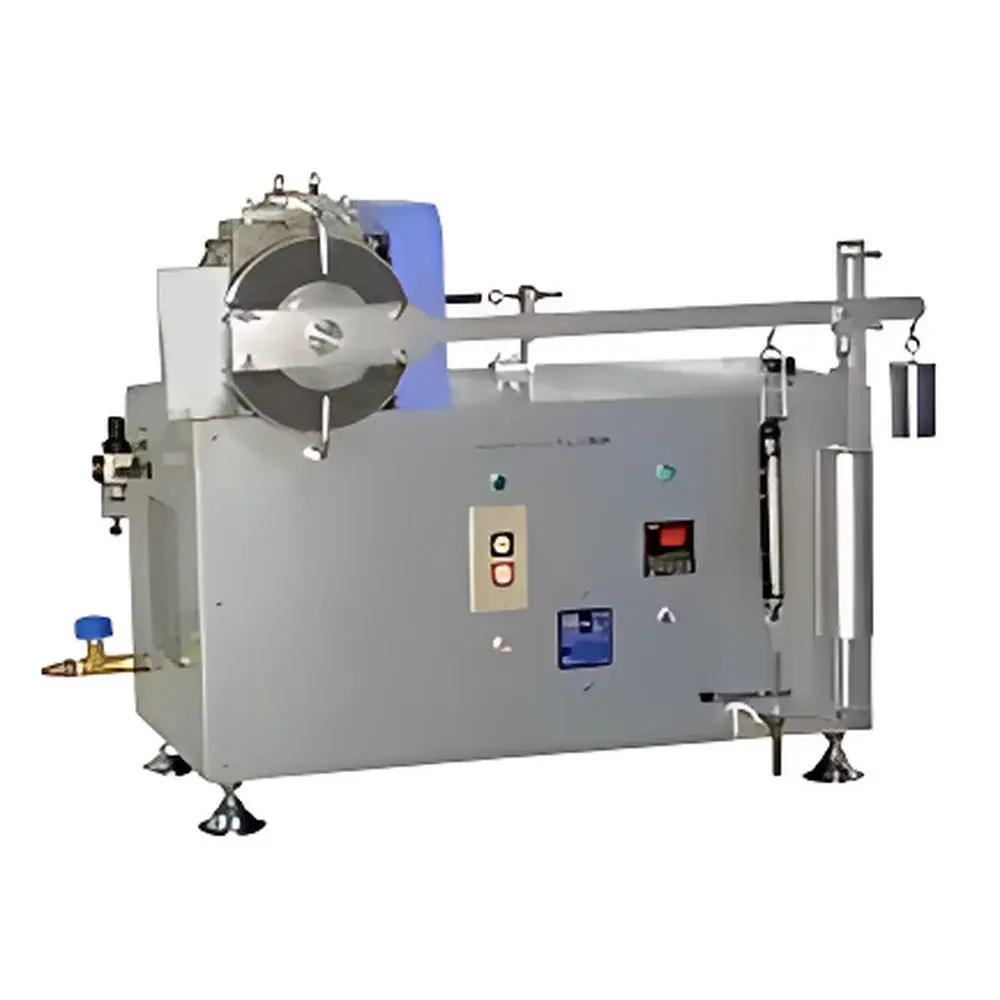
Yasuda No.275 William-Type Rubber Abrasion Tester
| Brand | Yasuda |
|---|---|
| Origin | Japan |
| Model | No.275 |
| Compliance | JIS K6264-2, ISO 4649 |
| Test Principle | Rotating abrasive wheel with vertical axis, dual-specimen horizontal mounting under controlled load |
| Application Scope | Vulcanized rubber, thermoplastic elastomers (TPE), tire treads, footwear outsoles |
| Load Range | Standard 26.7 N (adjustable per standard requirements) |
| Specimen Dimensions | 25 mm × 25 mm × 6 mm (typical) |
| Wheel Rotation Speed | 76 ± 2 rpm |
| Abrasion Distance | 40 m (standard cycle) |
| Unit of Result | mm³ loss volume |
Overview
The Yasuda No.275 William-Type Rubber Abrasion Tester is an internationally recognized tribological instrument engineered for quantitative evaluation of wear resistance in vulcanized and thermoplastic elastomers. It operates on the fundamental principle of controlled abrasive wear: two flat, rectangular test specimens are horizontally clamped in a fixed holder and pressed against the vertically oriented, rotating abrasive wheel under a precisely defined normal force. As the wheel rotates at a constant speed (76 ± 2 rpm), its surface—typically standardized aluminum oxide or silicon carbide grit—induces progressive material removal from both specimens simultaneously. The volumetric loss (in mm³) after a prescribed abrasion distance (commonly 40 m) is calculated from specimen mass loss and density, providing a reproducible, comparative metric for relative abrasion resistance. This method directly reflects real-world service conditions encountered by high-wear components such as automotive tire treads and footwear outsoles, making the No.275 a cornerstone instrument in QC laboratories adhering to JIS K6264-2 and ISO 4649.
Key Features
- Robust cast-iron frame with vibration-dampening base ensures mechanical stability during prolonged abrasion cycles.
- Dual-specimen holder enables parallel testing under identical loading and kinematic conditions—critical for statistical reliability and inter-laboratory comparison.
- Precision-machined vertical spindle assembly maintains concentricity and axial runout within ±0.02 mm, minimizing parasitic torque and ensuring uniform contact pressure distribution.
- Calibrated dead-weight loading system applies a nominal 26.7 N force (equivalent to 2.72 kgf), compliant with ISO 4649 Clause 6.3 and JIS K6264-2 Section 5.2; optional auxiliary weights allow verification across extended load ranges.
- Standardized abrasive wheel geometry (diameter: 168 mm, width: 25 mm, centerline height: 12.7 mm) conforms to ISO 4649 Annex A specifications for grit type, bond hardness, and surface finish.
- Integrated digital revolution counter and mechanical stop mechanism guarantee exact termination at the designated abrasion distance (e.g., 40 m), eliminating operator-dependent timing errors.
Sample Compatibility & Compliance
The No.275 accommodates standard test specimens measuring 25 mm × 25 mm × 6 mm (per ISO 4649, Section 4), though minor dimensional variations may be accommodated with certified calibration verification. It is validated for use with sulfur-cured natural rubber (NR), styrene-butadiene rubber (SBR), butadiene rubber (BR), nitrile rubber (NBR), thermoplastic polyurethane (TPU), and thermoplastic olefin (TPO) compounds. All operational parameters—including wheel speed, load application, specimen alignment, and environmental conditioning (23 ± 2 °C, 50 ± 5 % RH per ISO 23529)—are traceable to national metrology standards. The instrument satisfies the apparatus requirements stipulated in Clause 5 of ISO 4649:2010 and Section 4 of JIS K6264-2:2017. Routine performance verification is supported via certified reference materials (CRM) and documented calibration procedures aligned with ISO/IEC 17025–accredited laboratory practices.
Software & Data Management
While the No.275 is a manually operated, analog-controlled instrument, it is fully compatible with GLP-compliant data recording workflows. Test logs—including specimen ID, pre-/post-test mass (measured on Class I analytical balances per ISO 17025), ambient temperature/humidity, wheel serial number, and abrasion distance—are structured to support electronic lab notebook (ELN) integration. Optional digital weighing interfaces and barcode-scanned specimen tracking can be implemented without hardware modification. Audit trails for calibration certificates, maintenance records, and operator training documentation meet FDA 21 CFR Part 11 expectations when paired with secure, time-stamped electronic record systems. Full compliance with ISO 9001:2015 clause 8.5.1 (Control of production and service provision) is achievable through documented standard operating procedures (SOPs) and periodic equipment verification per ASTM E2586.
Applications
This tester delivers critical quality assurance data across multiple industrial sectors. In tire manufacturing, it supports compound development and batch release testing for tread compounds subjected to high-slip, high-load road contact. Footwear R&D labs utilize it to rank sole material formulations for durability against sidewalk and pavement abrasion. Conveyor belt producers apply it to evaluate cover rubber resistance to particulate-induced wear in mining and bulk material handling. Additionally, it serves as a reference method in academic polymer tribology studies investigating filler dispersion effects (e.g., silica vs. carbon black), crosslink density correlations, and aging-induced surface embrittlement. Its simplicity, repeatability, and global standardization make it indispensable for supplier qualification audits and regulatory submission dossiers requiring ISO-aligned wear data.
FAQ
What standards does the Yasuda No.275 explicitly comply with?
It meets all apparatus and procedural requirements specified in ISO 4649:2010 and JIS K6264-2:2017.
Can the No.275 test non-rubber elastomers such as TPU or TPE?
Yes—provided specimens conform to dimensional and conditioning requirements in ISO 4649, and wear mechanisms remain dominated by abrasive rather than adhesive or fatigue-driven failure modes.
Is calibration certification included with delivery?
Each unit ships with a factory calibration report covering spindle runout, load application accuracy, and rotational speed verification; third-party ISO/IEC 17025 calibration is available upon request.
What maintenance intervals are recommended for long-term accuracy?
Monthly inspection of wheel concentricity and bearing play, quarterly verification of load arm pivot friction, and annual replacement of abrasive wheels per ISO 4649 Annex B guidelines.
How is specimen thickness variation accounted for in volume loss calculation?
Volume loss is derived from mass loss divided by material density (ρ); therefore, consistent specimen density measurement—per ISO 2781 or ISO 1183—is essential prior to abrasion testing.
Related Products



