
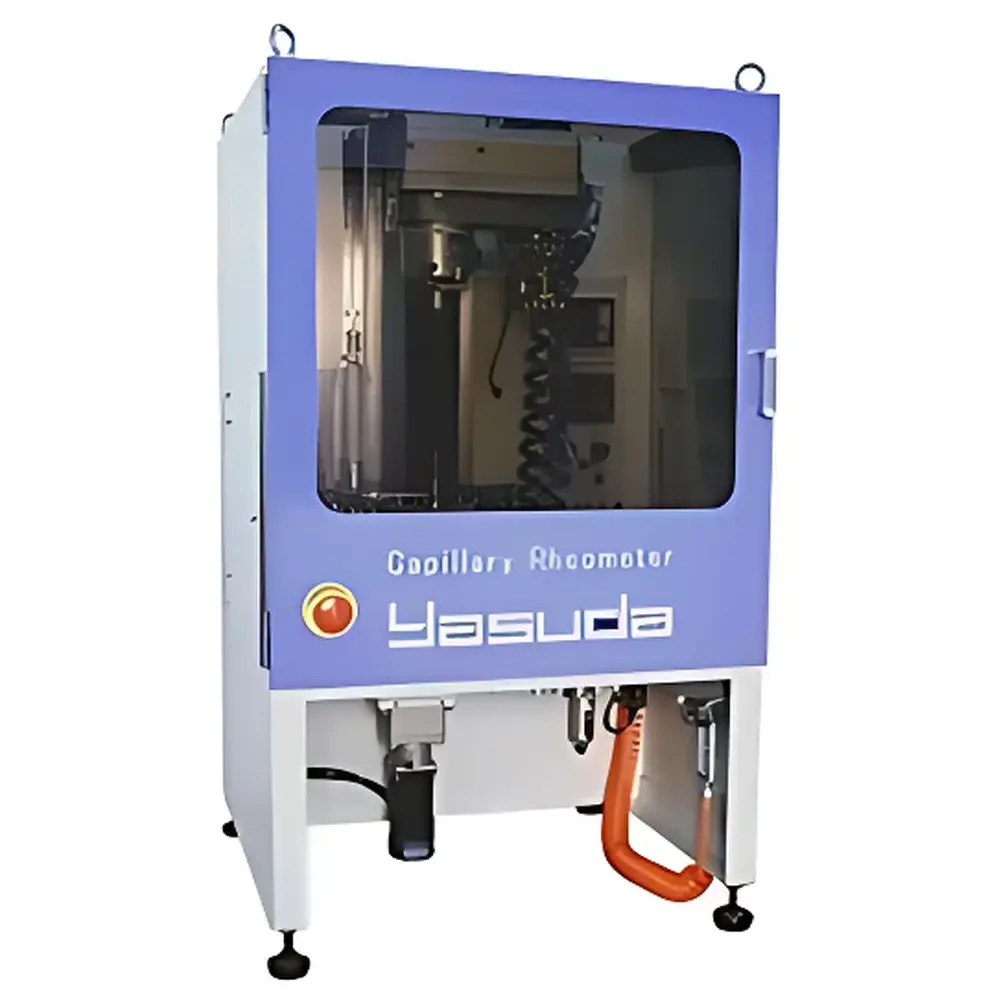
Yasuda No.140-SAS-2002 Semi-Automatic Capillary Rheometer (Low-Load Configuration)
| Brand | Yasuda |
|---|---|
| Origin | Japan |
| Model | No.140-SAS-2002 |
| Standards Compliance | JIS K 7199, ASTM D3835, ISO 11443 |
| Load Range | Low-load configuration (typically ≤ 50 kN nominal force capacity) |
| Temperature Control Range | Ambient to 400 °C (±0.5 °C stability) |
| Capillary Die Options | Standard L/D = 10, 20, 30 |
| Data Acquisition | Real-time shear stress, shear rate, apparent viscosity, pressure drop, and melt temperature monitoring |
| Automation Level | Semi-automatic cycle control with integrated die cleaning sequence |
Overview
The Yasuda No.140-SAS-2002 Semi-Automatic Capillary Rheometer (Low-Load Configuration) is a precision-engineered instrument designed for the rheological characterization of thermoplastic polymers in the molten state. Operating on the fundamental principle of capillary rheometry—based on the Rabinowitsch–Weissenberg correction for non-Newtonian flow—the system measures the relationship between applied pressure, volumetric flow rate, and extrudate geometry to derive true shear stress, shear rate, and apparent viscosity. This methodology enables quantitative evaluation of melt elasticity, extensional sensitivity, and processing-related flow instabilities (e.g., sharkskin, melt fracture), essential for extrusion, injection molding, and blow molding process development. The low-load configuration is specifically optimized for materials exhibiting moderate to low melt viscosity (e.g., polyolefins, engineering thermoplastics below 10⁴ Pa·s at 100 s⁻¹), ensuring high force resolution and minimal thermal drift during extended dwell periods.
Key Features
- Thermally stabilized barrel assembly with dual-zone PID-controlled heating (ambient to 400 °C), achieving ±0.5 °C uniformity over active length
- Hydraulically actuated piston drive with calibrated dead-weight loading system—enabling precise, drift-free application of loads up to 50 kN (configurable per standard)
- Interchangeable capillary dies with certified L/D ratios (10, 20, 30) and orifice diameters (0.5, 1.0, 1.5, 2.0 mm), all manufactured to ISO 11443 tolerance classes
- Integrated pressure transducers (0–200 MPa range, 0.1% FS accuracy) mounted upstream of the die entrance for direct entry pressure measurement
- Semi-automated test sequencing: programmable dwell time, load ramping, extrusion duration, and post-test die purging via heated cleaning rod mechanism
- Real-time acquisition of piston displacement (LVDT), melt temperature (embedded thermocouple), pressure, and elapsed time at 100 Hz sampling rate
Sample Compatibility & Compliance
The No.140-SAS-2002 supports granular, pelletized, and powder feedstocks typical of commodity and high-performance thermoplastics—including PP, PE, PS, ABS, PC, PA6/66, PBT, and filled compounds (up to 40 wt% mineral/glass). Sample mass requirements range from 3–8 g depending on barrel diameter (standard 9.55 mm ID). All operational protocols adhere strictly to internationally recognized standards: JIS K 7199 (Japanese Industrial Standard for polymer melt rheology), ASTM D3835 (Standard Test Method for Determination of Melt Flow Rates of Thermoplastics by Capillary Rheometry), and ISO 11443 (Plastics — Determination of the viscosity of polycarbonates and other thermoplastics in the molten state using capillary rheometers). The instrument architecture supports GLP-compliant documentation when paired with validated data acquisition software.
Software & Data Management
Data collection and analysis are performed using Yasuda’s proprietary RheoView™ v4.x software suite, compatible with Windows 10/11 (64-bit). The software implements automated Rabinowitsch correction, Bagley end-effect compensation, and Weissenberg-Rabinowitsch-Mooney (WRM) inversion algorithms to compute corrected shear viscosity curves (ηcorrected vs. γ̇). Export formats include CSV, Excel (.xlsx), and PDF reports compliant with internal QA/QC templates. Audit trail functionality logs user actions, method parameters, calibration events, and raw sensor timestamps—meeting foundational requirements for FDA 21 CFR Part 11 readiness when deployed in regulated environments. Raw binary files are stored with embedded metadata (sample ID, operator, date/time, environmental conditions).
Applications
- Development and validation of polymer grades for film extrusion, pipe manufacturing, and profile co-extrusion
- Quality control of incoming resin batches against viscosity master curves and flow activation energy (Ea) thresholds
- Formulation screening of additives (lubricants, nucleating agents, flame retardants) on melt rheology and die swell behavior
- Correlation of capillary-derived parameters (e.g., power-law index n, consistency index K) with rotational rheometer data for multi-mode modeling
- Root-cause analysis of processing defects such as melt fracture onset, die lip buildup, and output variability
- Supporting material submittals for automotive (SAE J2236), medical (ISO 10993-12), and packaging (ASTM F2096) regulatory dossiers
FAQ
What distinguishes the low-load configuration from heavy-duty capillary rheometers?
The No.140-SAS-2002 low-load variant employs a reduced-force piston actuation system optimized for viscosities below ~10⁴ Pa·s at typical processing shear rates (10–10⁴ s⁻¹), offering higher resolution in low-stress regimes and improved thermal stability during long-duration tests.
Can this instrument perform extensional viscosity estimation?
While primarily a shear-based capillary system, extensional viscosity can be inferred indirectly using the Trouton ratio (ηE/η) derived from capillary pressure overshoot analysis during start-up flows—provided combined with high-speed imaging or specialized die geometries (e.g., hyperbolic contractions), which are optional accessories.
Is routine calibration traceable to national standards?
Yes—pressure transducers are calibrated annually against NIST-traceable deadweight testers; temperature sensors are verified per ASTM E77 using certified reference materials; die dimensions are certified by third-party metrology labs per ISO/IEC 17025.
How is data integrity ensured during multi-shift operations?
RheoView™ enforces role-based access control, electronic signatures, and immutable audit logs synchronized with system clock (NTP-enabled); all raw acquisitions include checksum-verified headers and automatic backup to network-attached storage.
What maintenance intervals are recommended for sustained accuracy?
Barrel and die cleaning after every sample; piston seal inspection every 200 cycles; full thermal calibration and pressure sensor verification every 6 months or per ISO/IEC 17025 accredited lab schedule.



