
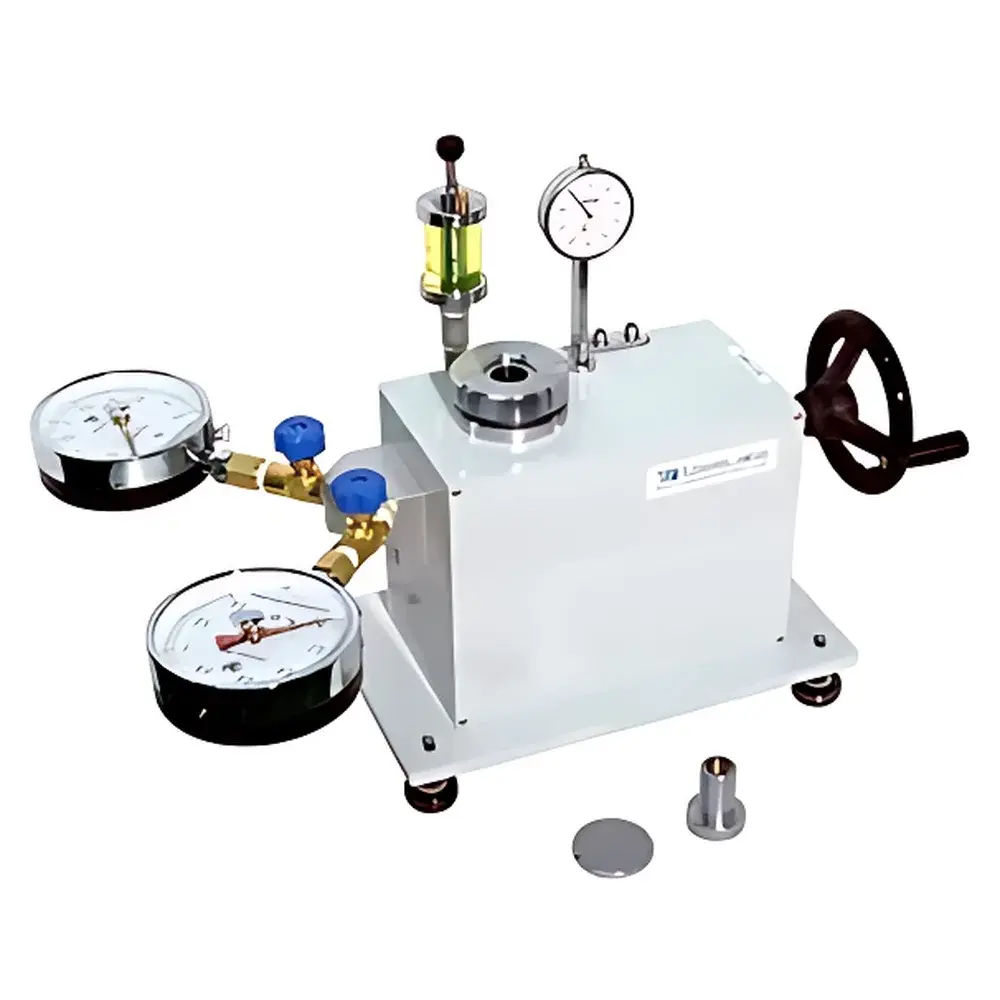
Yasuda No.236 Leather Grain Cracking Tester
| Brand | Yasuda |
|---|---|
| Origin | Japan |
| Model | No.236 |
| Compliance Standard | JIS K 6548 |
| Test Principle | Ball Burst / Internal Pressure Deformation Test |
| Sample Thickness Range | Suitable for thin leathers (e.g., shoe uppers, garment leathers) |
| Fixture Type | Annular clamping ring with central spherical indenter (steel ball) |
| Load Measurement | Analog or digital force transducer (configuration dependent) |
| Displacement Resolution | Sub-millimeter precision |
| Output | Peak load (N or kgf) and corresponding penetration height (mm) |
Overview
The Yasuda No.236 Leather Grain Cracking Tester is a dedicated mechanical testing instrument engineered for the quantitative evaluation of surface integrity and resistance to localized rupture in finished leather materials—particularly those used in footwear uppers, gloves, and high-value apparel. It operates on the principle of controlled ball burst deformation: a standardized steel sphere is hydraulically or mechanically driven against the reverse side of a centrally supported, annular-clamped leather specimen until visible grain cracking or surface failure initiates. This method directly simulates real-world stress concentrations experienced during flexing, stretching, or impact in end-use applications. Unlike tensile or tear tests, the No.236 focuses specifically on the cohesive strength of the grain layer—the outermost, most visually critical stratum of tanned leather—and its adhesion to the underlying corium. The test yields two primary metrics: the critical bursting load (in Newtons or kilogram-force) and the corresponding penetration displacement (in millimeters) at first observable grain fracture, both essential for comparative quality control and material specification validation.
Key Features
- Compliant mechanical architecture designed to meet the dimensional, loading, and fixture requirements specified in JIS K 6548:1994 “Testing Methods for Leather – Determination of Resistance to Grain Cracking by Ball Bursting”.
- Precision-machined annular clamping ring ensures uniform radial constraint of the specimen periphery, eliminating edge slippage and enabling reproducible stress distribution across the test zone.
- Standardized 12.7 mm (½ inch) diameter hardened steel spherical indenter, mounted on a vertically actuated plunger with calibrated force transmission path.
- Robust cast-iron or structural steel frame provides vibration-damping stability during dynamic loading cycles, minimizing measurement drift and enhancing repeatability.
- Manual or motor-driven loading mechanism options available; analog dial gauge or digital load cell readout configurations support integration into legacy QC workflows or modern data logging systems.
- No consumables or complex calibration fluids required—mechanical zeroing and periodic verification with traceable dead-weight standards suffice for routine metrological assurance.
Sample Compatibility & Compliance
The No.236 accommodates circular specimens with diameters typically ranging from 40 mm to 50 mm, cut from full-grain, corrected-grain, or split leathers with thicknesses between 0.8 mm and 2.5 mm. It is routinely applied to bovine, ovine, and equine leathers processed via chrome, vegetable, or synthetic tanning systems. While JIS K 6548 is the defining standard, test methodology aligns closely with functional aspects of ISO 2418 (leather sampling), ISO 2419 (physical test specimens), and ASTM D2209 (standard test method for bursting strength of leather). Data generated supports compliance documentation for footwear OEMs subject to EU REACH Annex XVII restrictions on chromium(VI) migration, as grain cracking propensity correlates with surface crosslink density and finish durability—key indicators of chemical stability under mechanical stress.
Software & Data Management
The base No.236 configuration operates without embedded firmware or proprietary software. However, when equipped with an optional digital load cell and analog-to-digital interface (e.g., USB-based signal conditioner), raw force-displacement time-series data can be acquired using third-party DAQ platforms such as LabVIEW, MATLAB Data Acquisition Toolbox, or open-source tools like Python’s PySerial + NumPy stack. Exported CSV files contain timestamped load (N) and displacement (mm) columns, enabling post-test derivation of bursting energy (area under curve), stiffness slope (dF/dx), and failure consistency indices. For regulated environments—including GLP-compliant leather development labs or GMP-aligned footwear component suppliers—the system supports audit-ready documentation when paired with electronic lab notebooks (ELNs) that enforce 21 CFR Part 11–compliant user authentication, electronic signatures, and immutable audit trails.
Applications
- Comparative assessment of grain cracking resistance across tannery lots, enabling objective selection of batches for premium footwear lines.
- Validation of finish formulations (e.g., acrylic, polyurethane topcoats) by quantifying how resin elasticity and film thickness modulate crack initiation thresholds.
- Process optimization in drumming, staking, and conditioning stages—correlating mechanical conditioning parameters with measured grain robustness.
- Root cause analysis of field failures: correlating laboratory-measured bursting loads with in-service cracking observed in consumer returns or wear-testing programs.
- Technical specification drafting for leather procurement contracts, where minimum bursting load (e.g., ≥ 350 N) and maximum allowable displacement (e.g., ≤ 4.2 mm) serve as contractual acceptance criteria.
FAQ
What leather types are suitable for testing on the No.236?
Full-grain, corrected-grain, and high-quality split leathers used in footwear, gloves, and upholstery—provided thickness falls within 0.8–2.5 mm and specimens are cut per JIS K 6548 sampling guidelines.
Is operator training required to achieve repeatable results?
Yes—consistent clamping torque, specimen centering, and visual identification of “first grain crack” require documented SOPs and periodic inter-operator reproducibility audits (e.g., ASTM E2709).
Can the No.236 be used for non-leather materials?
While not standardized for them, thin flexible composites (e.g., coated textiles, synthetic leathers, laminated membranes) may be evaluated qualitatively—but JIS K 6548 applicability and result interpretability are not assured.
How often should the steel ball indenter be inspected or replaced?
Visual inspection before each test series is mandatory; replacement is required if surface pitting, deformation, or dimensional deviation exceeding ±0.02 mm is observed.
Does Yasuda provide calibration certification with the instrument?
Factory calibration is performed using NIST-traceable dead-weight standards; users receive a calibration report valid for 12 months—subsequent verifications must follow ISO/IEC 17025-accredited procedures.



