
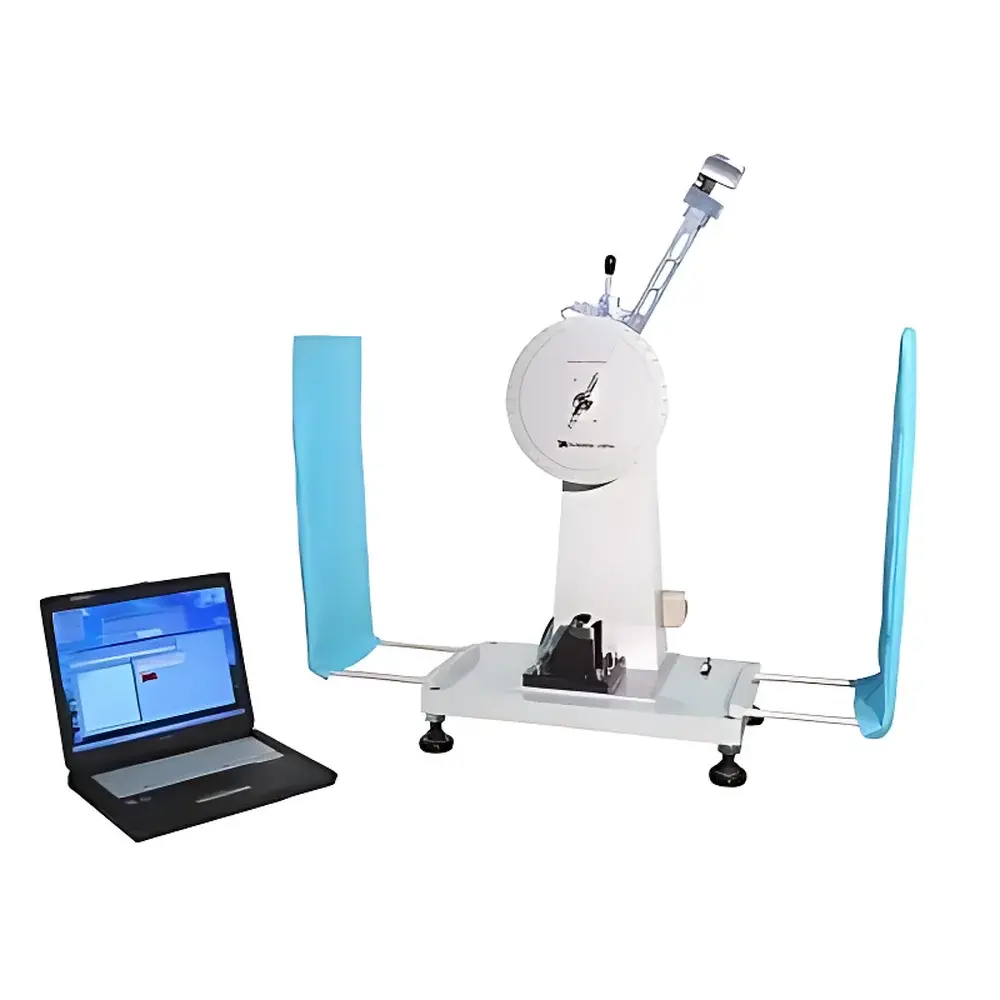
Yasuda No.258 Universal Impact Tester
| Brand | Yasuda |
|---|---|
| Origin | Japan |
| Model | No.258 |
| Configuration | Pendulum-type impact tester with interchangeable fixtures for Charpy (simply supported beam), Izod (cantilever beam), and tensile impact testing |
| Data Acquisition | Compatible with optical rotary encoder interface for digital data capture and PC-based storage (No.258-PC version) |
| Compliance Context | Designed to support ASTM D6110 (Charpy), ASTM D256 (Izod), ISO 179/ISO 180, and ISO 8256 (tensile impact) test methods |
Overview
The Yasuda No.258 Universal Impact Tester is a precision-engineered pendulum impact system designed for standardized mechanical characterization of polymeric materials under dynamic loading conditions. It operates on the fundamental principle of gravitational potential energy conversion: a calibrated pendulum arm—released from a fixed height—strikes a notched or unnotched specimen, and the energy absorbed during fracture is calculated from the residual swing angle. This instrument supports three distinct impact configurations within a single mechanical platform: Charpy (simply supported beam per ASTM D6110 and ISO 179), Izod (vertical cantilever beam per ASTM D256 and ISO 180), and tensile impact (per ISO 8256), enabling laboratories to consolidate multiple ASTM- and ISO-aligned test protocols without hardware duplication. Its modular fixture architecture allows rapid reconfiguration via mechanical interchange of anvil assemblies, pendulum hammers, and specimen clamps—minimizing downtime between test modes and ensuring traceable alignment per standard requirements.
Key Features
- Triple-mode mechanical adaptability: Integrated mounting interfaces for Charpy anvils (horizontal three-point bending), Izod supports (vertical clamping with 45° notch orientation), and tensile impact jaws (axial pulling geometry with guided striker)
- Pendulum system with certified mass distribution and calibrated radius of gyration; compliant with ISO 148-1 and ISO 13802 requirements for kinetic energy uncertainty
- Optical rotary encoder integration (standard on No.258-PC variant): High-resolution angular position tracking enables real-time energy calculation with ≤0.5% repeatability deviation across 1–50 J range
- Adjustable pendulum release mechanism with mechanical locking and manual trigger—ensuring consistent initial potential energy and eliminating operator-induced variability
- Robust cast-iron base with vibration-damping feet and rigid column assembly, minimizing energy loss through structural resonance during impact event
- Specimen alignment gauge included for precise notch depth verification (±0.05 mm tolerance) in accordance with ASTM D256 Annex A1
Sample Compatibility & Compliance
The No.258 accommodates standard rectangular plastic specimens (e.g., 80 × 10 × 4 mm for Izod, 55 × 10 × 10 mm for Charpy) as defined in ISO 179-1, ISO 180-1, and ASTM D256. Notch geometries—including A-type (depth 2 mm, radius 0.25 mm) and B-type (depth 2 mm, radius 1.0 mm)—are supported via interchangeable notch cutters and alignment fixtures. The system is engineered to maintain specimen temperature stability during ambient-condition testing and is compatible with environmental chambers (−40 °C to +80 °C) for low- or high-temperature impact evaluation. All mechanical components conform to ISO 148-2 (pendulum verification) and ISO 13802 (verification of impact machines), and test reports generated via the No.258-PC software include metadata required for GLP-compliant audit trails (test date, operator ID, calibration certificate ID, environmental conditions).
Software & Data Management
The No.258-PC configuration interfaces with Windows-based acquisition software that records raw encoder pulses, computes absorbed energy (J), and derives normalized values (kJ/m² or J/m). Data export supports CSV and XML formats for LIMS integration. Software features include automated pass/fail flagging against user-defined specification limits, statistical summary (mean, SD, CV%) across replicate tests, and graphical overlay of load–displacement curves reconstructed from angular velocity profiles. Audit logging complies with FDA 21 CFR Part 11 requirements when configured with electronic signatures and role-based access control. Calibration history, maintenance logs, and user activity timestamps are retained for ≥10 years—supporting regulatory inspections under ISO/IEC 17025 and GMP frameworks.
Applications
This tester serves quality control laboratories in polymer compounding, automotive interior material development, medical device packaging validation, and electronics housing certification. Typical use cases include comparative assessment of impact resistance across resin grades (e.g., PP vs. ABS vs. PC blends), evaluation of aging effects (UV exposure, thermal cycling), determination of ductile-to-brittle transition temperatures, and validation of recycled content impact performance. It is routinely deployed in supplier qualification programs where compliance with OEM specifications (e.g., Ford WSS-M99P1111-A, GMW14872) mandates reporting per ISO 179-2 or ASTM D6110 Annex X1.
FAQ
Does the No.258 meet ISO/IEC 17025 accreditation requirements for testing laboratories?
Yes—when operated with documented calibration procedures (traceable to NMI-Japan or equivalent), validated fixtures, and the No.258-PC software’s audit-trail functionality, it supports full compliance with ISO/IEC 17025 clause 6.4.3 (equipment verification) and 7.7 (result reporting).
Can tensile impact testing be performed without modifying the base frame?
Yes—the tensile impact configuration uses a dedicated horizontal jaw set and linear striker guide mounted directly onto the existing column; no structural retrofitting is required.
Is third-party calibration certification available for the pendulum system?
Yes—Yasuda-certified calibration services include moment-of-inertia verification, energy scale linearity checks (5–50 J), and anvil alignment certification per ISO 148-2 Annex B.
What is the minimum specimen thickness supported for Izod testing?
The standard clamp accepts specimens from 3.2 mm to 12.7 mm thick; thinner specimens (≥2.0 mm) may be tested using optional low-thickness adapters with recalibrated energy correction factors.
How frequently must the optical encoder be recalibrated?
Encoder drift is negligible under normal lab conditions; however, annual verification against a reference angular displacement standard is recommended per ISO/IEC 17025 clause 6.5.2.



