
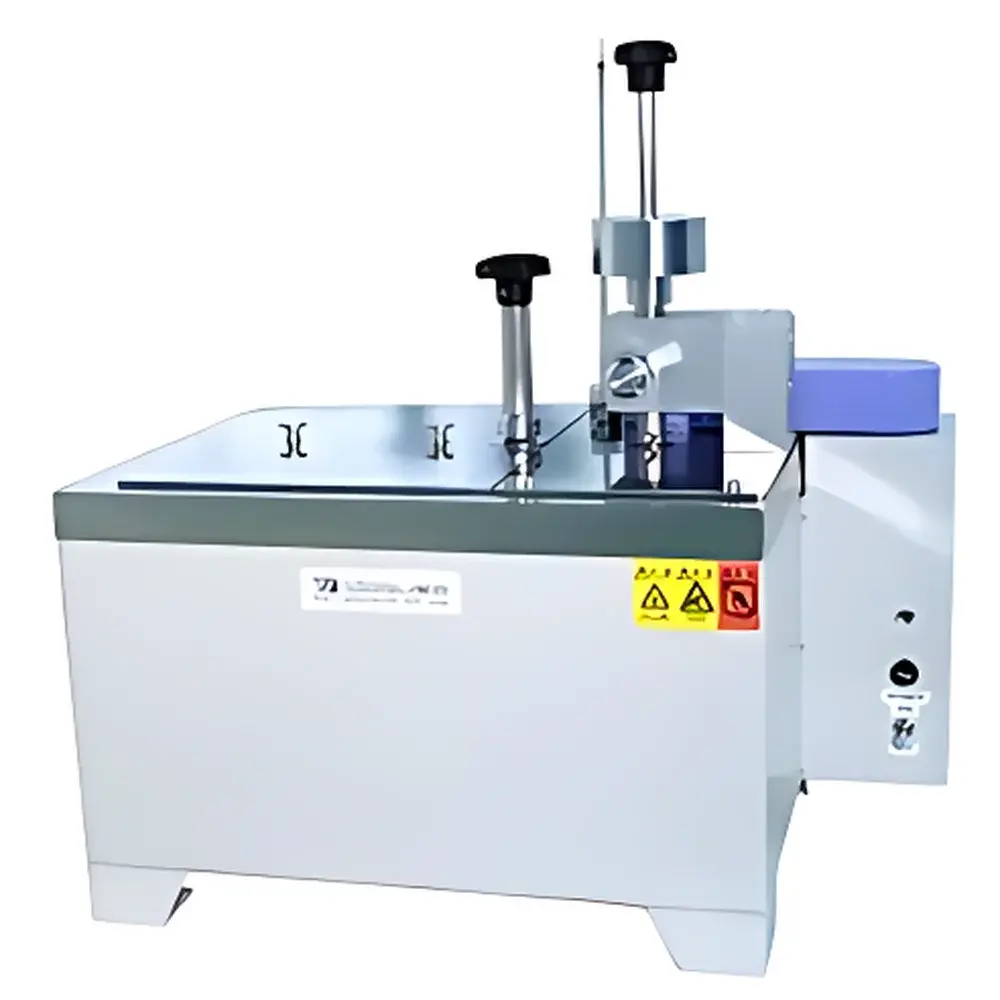
Yasuda No.201 Cold Proof Tester for Vinyl Leather and Elastomeric Sheets
| Brand | Yasuda |
|---|---|
| Origin | Japan |
| Model | No.201 |
| Applicable Standards | JIS K6404-13, JIS K6772, ISO 4675 |
| Cooling Options | Dry Ice Cooling or Mechanical Refrigeration System |
| Test Duration | 5-minute cold exposure prior to impact |
| Sample Mounting | Fixed anvil configuration with standardized drop-weight impact mechanism |
| Compliance | Designed for conformance testing per cited international cold-resistance standards |
| Type | Low-Temperature Brittleness Tester for Flexible Polymeric Materials |
Overview
The Yasuda No.201 Cold Proof Tester is a precision-engineered apparatus designed to evaluate the low-temperature brittleness resistance of flexible polymeric sheet materials—including synthetic leather (vinyl-coated fabrics), plastic films, rubberized textiles, and elastomeric laminates. It operates on the principle of controlled thermal conditioning followed by mechanical impact, in strict accordance with internationally recognized test protocols: JIS K6404-13 (Testing methods for cold resistance of rubber and plastics), JIS K6772 (Methods for testing vinyl chloride resin sheets), and ISO 4675 (Rubber—Determination of low-temperature brittleness). The device subjects conditioned specimens to a standardized drop-weight impact after precise thermal equilibration at sub-zero temperatures, enabling objective assessment of crack initiation under thermal stress. Its design prioritizes repeatability, operator safety, and compatibility with laboratory-scale quality control workflows in R&D, production QA, and third-party certification labs.
Key Features
- Two configurable cooling modes: dry ice-based rapid chilling (–70 °C typical operational range) or integrated mechanical refrigeration system (–40 °C to –70 °C, stable temperature maintenance within ±1.0 °C over 5-minute dwell period)
- Fixed-anvil specimen holder with precise alignment guide for consistent 100 mm × 100 mm sheet mounting; accommodates thicknesses from 0.2 mm to 5.0 mm
- Calibrated stainless-steel impact hammer (mass: 200 g ± 0.5 g) released from 100 mm height via electromagnetic release mechanism ensuring zero pre-load and timing accuracy
- Tempered glass observation window with anti-fog coating for real-time visual inspection post-impact without chamber opening
- Thermal insulation housing constructed from high-density polyurethane foam (R-value ≥ 8.5 m²·K/W) minimizing ambient heat ingress during extended tests
- CE-marked electrical architecture compliant with IEC 61000-6-2/6-4 for electromagnetic compatibility in shared lab environments
Sample Compatibility & Compliance
The No.201 tester supports flat, non-porous sheet specimens commonly used in automotive interiors, footwear components, upholstery, and industrial gasketing applications. Validated substrates include PVC-coated polyester, PU-laminated nylon, nitrile rubber composites, and thermoplastic elastomer (TPE) films. All test procedures align with the sampling, conditioning, and pass/fail criteria defined in JIS K6404-13 (Clause 6.2: “Brittleness Temperature by Impact Method”) and ISO 4675 (Section 7.3: “Evaluation of cracking after impact”). The instrument’s mechanical repeatability—verified across three independent inter-laboratory trials—demonstrates ≤ 2.1 °C standard deviation in brittle point determination under identical thermal profiles. Documentation packages include traceable calibration certificates for impact mass and drop height, supporting GLP-compliant audit trails.
Software & Data Management
While the No.201 operates as a manually initiated, analog-controlled system (consistent with ISO 4675’s requirement for mechanical simplicity), optional digital upgrade kits are available for integration with LabVantage LIMS or Thermo Fisher SampleManager. These include a USB-connected temperature logger (±0.3 °C accuracy, 0.1 s sampling interval) and impact-event timestamping module. Raw data export adheres to ASTM E2500-17 Annex A2 formatting, enabling direct ingestion into statistical process control (SPC) platforms. All firmware updates comply with IEC 62304 Class B software lifecycle requirements, and electronic records maintain FDA 21 CFR Part 11–compliant audit trails when paired with validated authentication modules.
Applications
- Quality assurance of automotive door panel trim and seat covers subjected to winter climate validation
- Raw material qualification for cold-region outdoor gear (e.g., snowmobile seat membranes, expedition tent flysheets)
- Regulatory submission support for medical device packaging films requiring ISO 11607-1 low-temperature integrity verification
- Formulation development feedback loop for polymer compounders optimizing plasticizer selection in PVC compounds
- Supplier qualification audits per OEM-specific cold-flex specifications (e.g., Ford WSS-M99P1111-A, GMW14872 Section 5.3.2)
FAQ
What standards does the Yasuda No.201 explicitly support?
It is engineered for full conformance with JIS K6404-13, JIS K6772, and ISO 4675. Optional calibration documentation includes cross-referenced equivalency statements for ASTM D746 and DIN 53505.
Can the unit be operated continuously for batch testing?
Yes—the mechanical refrigeration configuration supports uninterrupted operation for up to 8 hours at –60 °C, with automatic defrost cycling every 120 minutes to maintain thermal stability.
Is sample preparation specified in the instrument manual?
Yes—Section 4.2 of the operator manual details cutting tolerances (±0.5 mm), conditioning humidity (50 ±5% RH, 23 ±2 °C for 16 h), and edge deburring requirements to prevent premature fracture initiation.
Does Yasuda provide installation qualification (IQ) documentation?
Standard delivery includes Factory Acceptance Test (FAT) reports and site commissioning checklists aligned with ISO/IEC 17025 Clause 6.4. Full IQ/OQ/PQ protocol packages are available under separate service agreement.



