
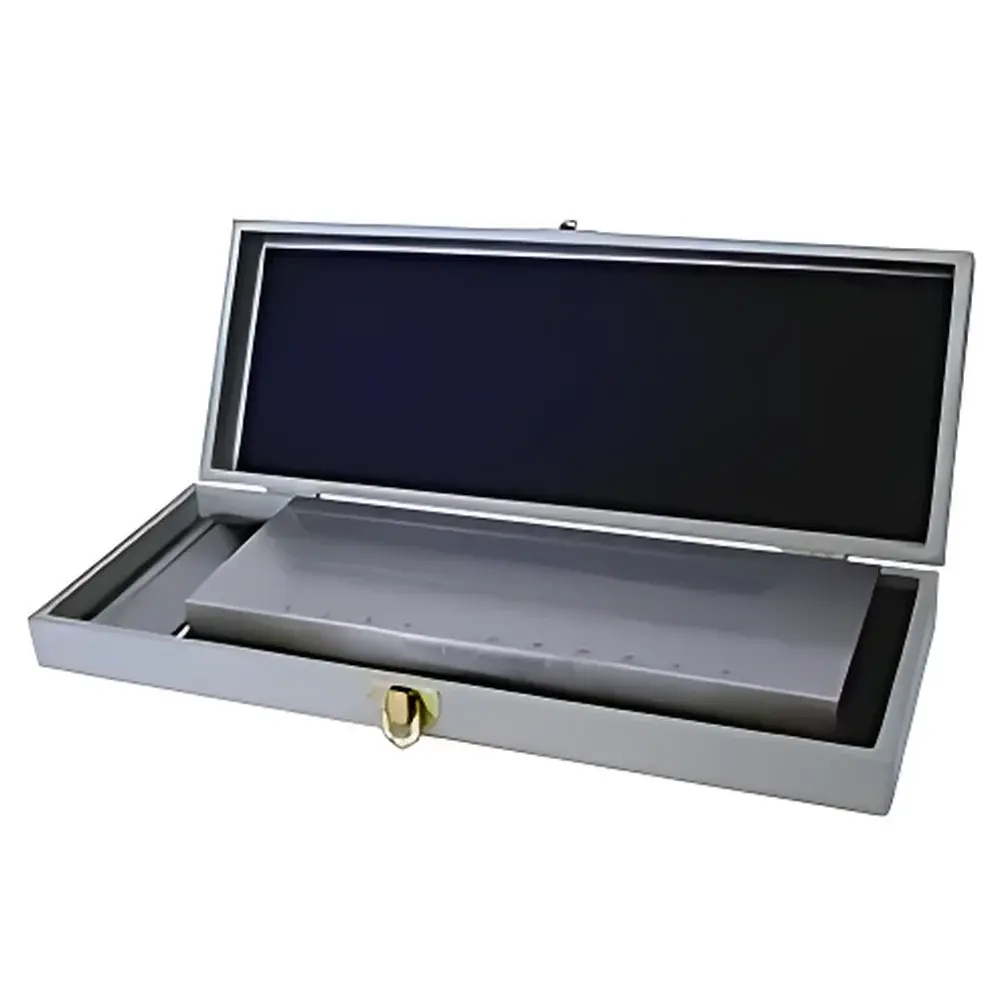
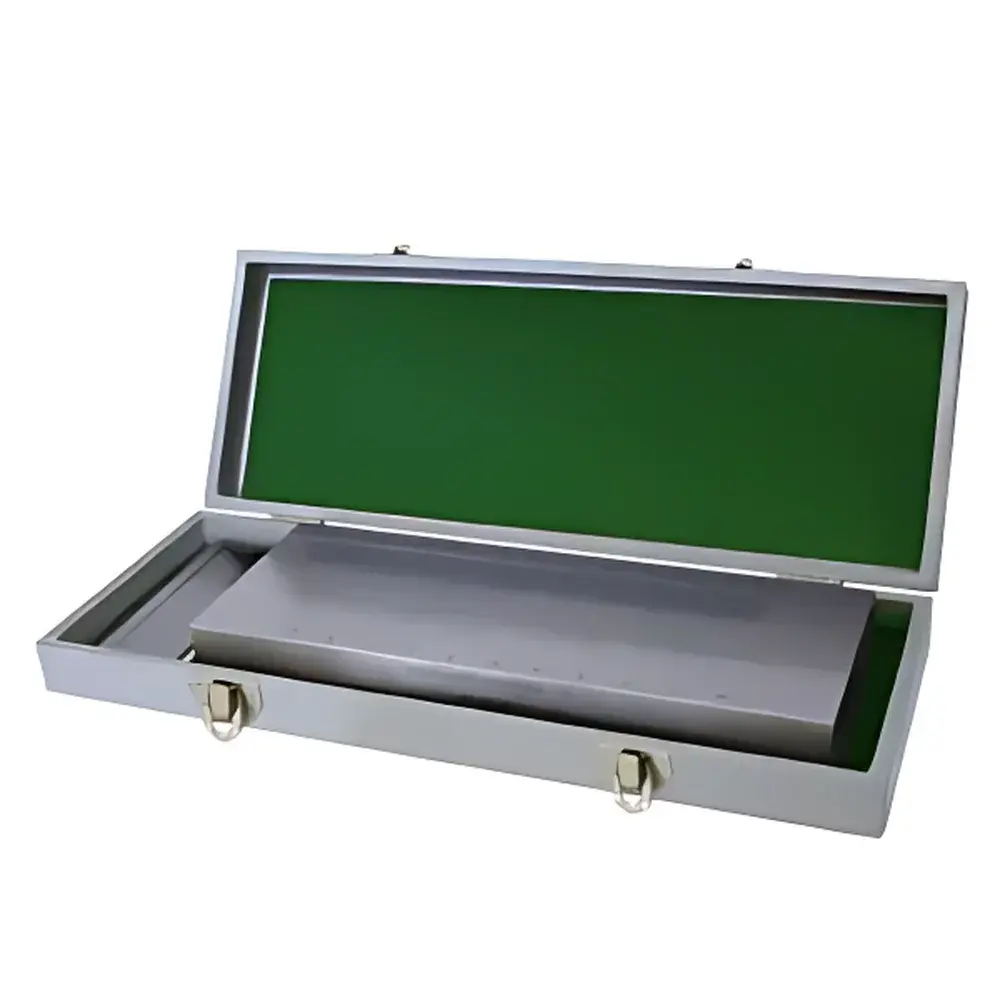
Yasuda No.527/547 Grindometer
| Brand | Yasuda |
|---|---|
| Origin | Japan |
| Model | No.527/547 |
| Standards Compliance | JIS K5101, JIS K5400, JIS K5600-2-5, JIS K5701-1, ASTM D1210, ISO 1524 |
| Measurement Principle | Mechanical groove-depth-based particle visibility detection |
| Groove Depth Range | 0–100 µm (typical linear scale) |
| Scale Resolution | 2.5 µm per division (standard JIS/ASTM scale) |
| Material | Hardened stainless steel body with precision-ground stainless steel groove plate |
Overview
The Yasuda No.527/547 Grindometer is a precision mechanical instrument engineered for the quantitative assessment of dispersion fineness in liquid-dispersed systems—primarily coatings, paints, pigments, and offset printing inks. It operates on the principle of controlled mechanical scraping across a linearly tapered groove milled into a hardened stainless steel plate. As a calibrated draw-down blade moves at constant speed from the deepest point (typically 100 µm) toward the shallowest (0 µm), the operator visually identifies the point where agglomerated particles or coarse pigment clusters first become visibly apparent against the smooth groove surface. This critical transition point corresponds directly to the maximum particle or agglomerate size present in the sample, reported in micrometers (µm) according to standardized scale graduations. Unlike optical or laser-based particle analyzers, the Grindometer delivers a functional, application-relevant metric: the largest discrete particle dimension that remains detectable under conditions simulating real-world film formation and shear during application.
Key Features
- Precision-machined stainless steel body and groove plate ensure long-term dimensional stability and resistance to corrosion and wear during routine cleaning and calibration.
- Linear groove taper conforming strictly to JIS K5101 and ASTM D1210 specifications: 0–100 µm depth range with 2.5 µm increments per graduation mark.
- Ergonomic, fixed-angle blade holder enables consistent draw-down velocity and normal force—critical for inter-laboratory reproducibility.
- Integrated reference scale etched directly onto the groove plate surface eliminates parallax error and eliminates reliance on external rulers or digital overlays.
- No electrical components, software, or consumables required—designed for robust operation in QC laboratories, production floors, and R&D environments with minimal maintenance.
Sample Compatibility & Compliance
The No.527/547 Grindometer is validated for use with Newtonian and mildly non-Newtonian suspensions exhibiting sufficient viscosity to retain particle position during draw-down (typically 100–50,000 mPa·s). Compatible matrices include solvent-borne and water-borne architectural paints, automotive basecoats, industrial primers, lithographic inks, and pigment concentrates. It meets the physical design and operational requirements of JIS K5101:2018, JIS K5400:2019, JIS K5600-2-5:2016, JIS K5701-1:2017, ASTM D1210–22, and ISO 1524:2022. While not a regulatory compliance tool per se, its output serves as objective evidence in GLP-compliant coating development workflows and supports internal quality control protocols aligned with ISO 9001 and IATF 16949 process validation requirements.
Software & Data Management
The Yasuda No.527/547 Grindometer is a fully manual, analog instrument requiring no embedded firmware, drivers, or proprietary software. Data recording follows paper-based or LIMS-integrated manual entry protocols. Users commonly log results—including sample ID, operator name, ambient temperature/humidity, and observed grind reading—in standardized QC forms or electronic lab notebooks (ELNs) compliant with FDA 21 CFR Part 11 when deployed in regulated pharmaceutical or medical device coating applications. Optional accessories include certified traceable calibration standards (e.g., NIST-traceable step-height artifacts) for periodic verification of groove geometry integrity.
Applications
- Final quality release testing of production batches of decorative and protective coatings.
- Optimization of milling time and dispersant dosage during pigment paste development.
- Comparative evaluation of dispersant efficiency across different polymer architectures or surfactant chemistries.
- Root-cause analysis of haze, gloss loss, or filter clogging in downstream application equipment.
- Technical support documentation for customer-facing product data sheets and material safety data reporting (SDS Annexes).
FAQ
How often should the groove plate be recalibrated or replaced?
Calibration verification using certified step-height standards is recommended before each shift in high-volume QC labs; full replacement is typically required after 12–18 months of daily use or upon visible groove deformation under 10× magnification.
Can the Grindometer be used for nanoparticle dispersions?
No—it is not sensitive below ~5 µm; nanoparticles require complementary techniques such as dynamic light scattering (DLS) or electron microscopy.
Is there a difference between No.527 and No.547 models?
Yes: No.527 features a single 0–100 µm groove for general-purpose testing; No.547 incorporates dual grooves (0–100 µm and 0–50 µm) enabling higher resolution assessment in the sub-25 µm range for premium ink formulations.
Does humidity affect measurement accuracy?
Indirectly—high ambient humidity may alter solvent evaporation rate during draw-down, potentially causing premature particle migration; testing should be conducted at 23 ± 2°C and 50 ± 5% RH per ISO 3270.
Can results be correlated to laser diffraction data?
Only qualitatively: Grindometer reports the largest detectable particle (a “top-size” proxy), whereas laser diffraction yields volume-weighted D90/D98 values; direct mathematical correlation is not scientifically valid due to fundamentally different measurement physics.






