
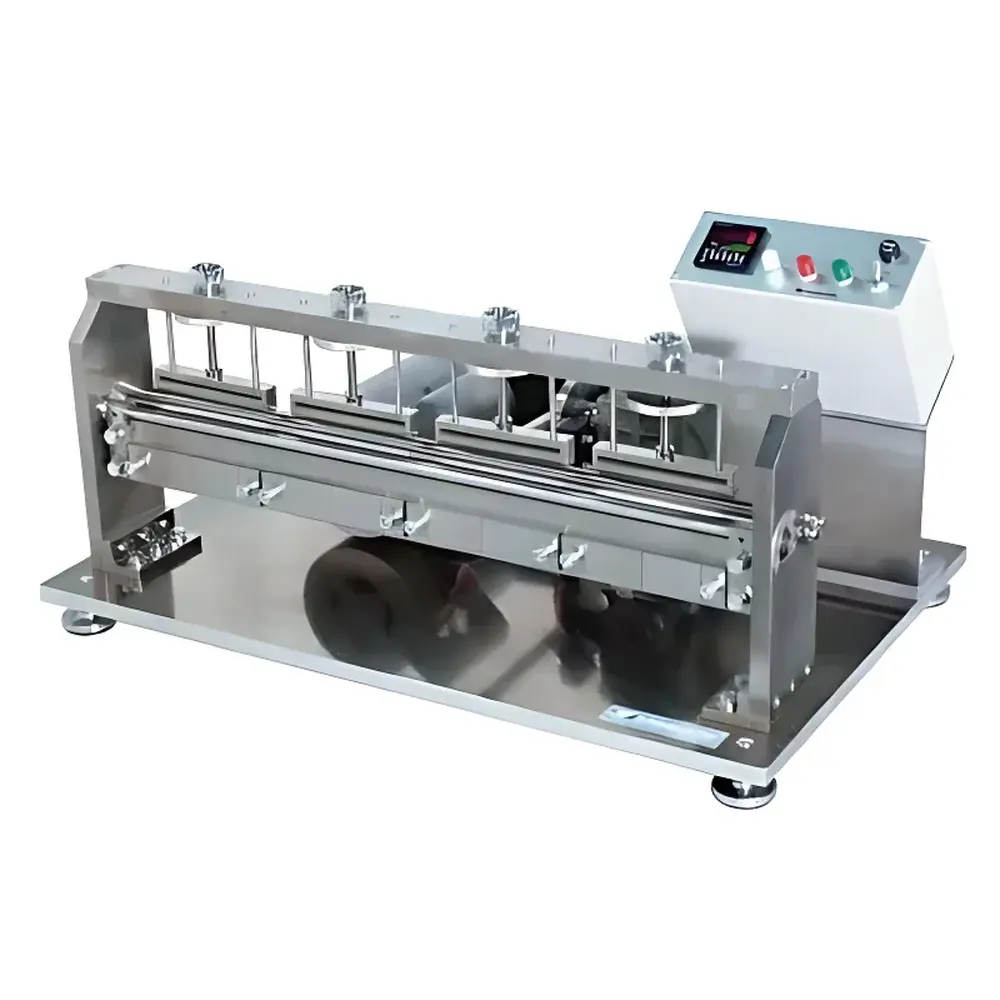
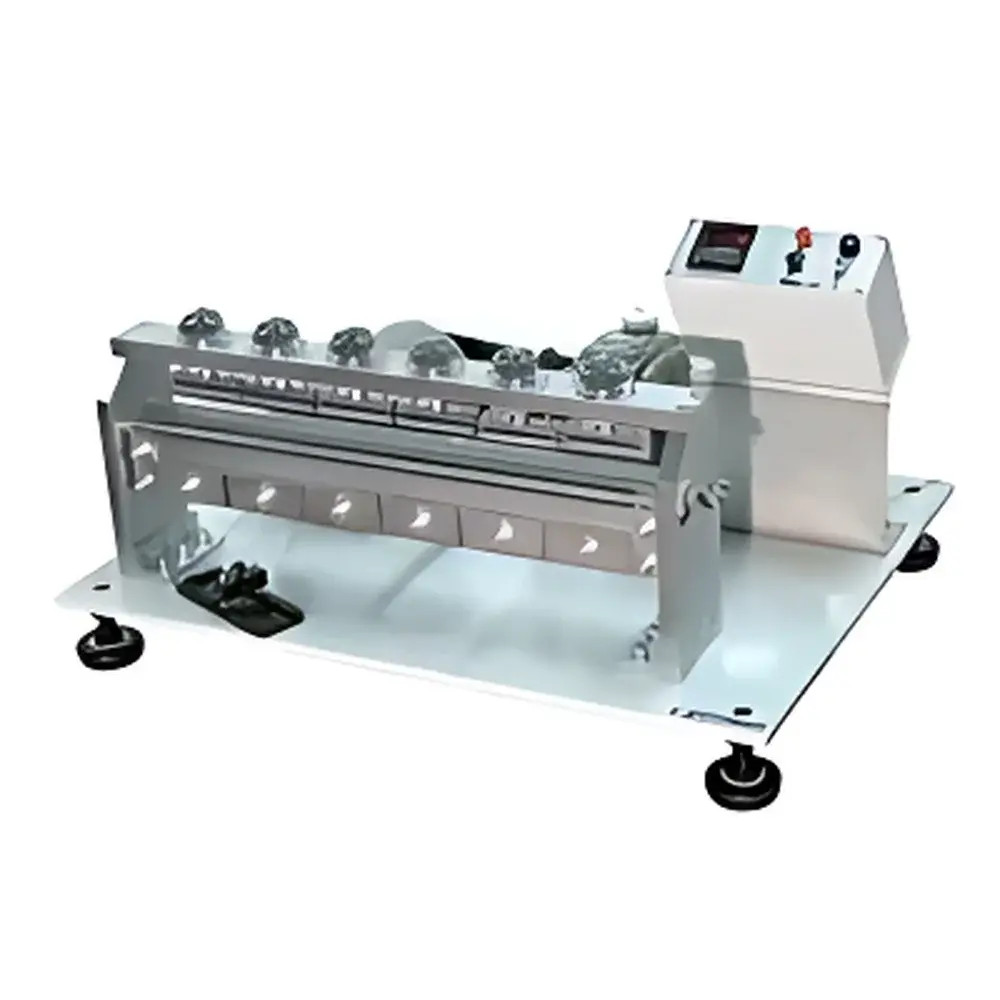
Yasuda No.270 Ross-Type Flexing Tester
| Brand | Yasuda |
|---|---|
| Origin | Japan |
| Model | No.270 |
| Applicable Standard | ASTM D1052 |
| Sample Mounting Capacity | 12 specimens (standard), 4 specimens (LFR low-temperature variant) |
| Test Angle | 90° fixed bend |
| Pre-cut Notch | 2.5 mm length at ~62 mm from clamped end |
| Flex Cycle Increment | 100%–500% strain intervals |
| Compliance | ASTM D1052 (Standard Test Method for Resistance of Rubber to Flex Cracking) |
Overview
The Yasuda No.270 Ross-Type Flexing Tester is a precision-engineered mechanical fatigue testing instrument designed to evaluate the resistance of elastomeric materials—particularly vulcanized rubber compounds used in footwear soles—to crack initiation and propagation under repeated bending deformation. Based on the classical Ross flexing principle, the device subjects standardized test specimens to controlled, cyclic 90° angular deflection about a fixed pivot point, simulating the dynamic flexing experienced during normal gait. The test method conforms strictly to ASTM D1052, “Standard Test Method for Resistance of Rubber to Flex Cracking,” which defines specimen geometry, notch placement, flex frequency, and failure criteria. Unlike torsional or axial fatigue systems, the Ross configuration generates a well-defined, uniaxial bending stress state localized at the pre-notched region—enabling high reproducibility in crack growth quantification across laboratories and production batches.
Key Features
- Robust cast-iron frame with hardened steel cam mechanism ensuring long-term dimensional stability and minimal hysteresis over >1 million cycles
- Fixed 90° bending angle maintained via precision-machined cam profile, eliminating operator-induced variability in deflection amplitude
- Standard configuration accommodates up to 12 test specimens simultaneously, each independently clamped and monitored for crack onset
- Dual-specimen mounting options: standard horizontal rack (12-position) and low-temperature LFR variant (4-position) compatible with external environmental chambers down to –40 °C
- Notch alignment fixture ensures consistent 2.5 mm incision placement at 62 mm from the clamped edge per ASTM D1052 requirements
- Mechanically driven crankshaft system operating at nominal 120 cycles/min (2 Hz), fully compliant with ASTM-specified test speed tolerance (±5%) without electronic speed control dependency
Sample Compatibility & Compliance
The No.270 accepts rectangular test strips measuring 127 mm × 25.4 mm × 6.35 mm (5″ × 1″ × ¼″), cut from molded or extruded rubber compounds. Specimens are prepared with a precisely located 2.5 mm longitudinal notch introduced 62 mm from the clamped end—this feature serves as the controlled stress concentrator initiating crack growth. The tester supports evaluation across compound families including natural rubber (NR), styrene-butadiene rubber (SBR), thermoplastic elastomers (TPE), and polyurethane (PU). All operational parameters—including stroke geometry, frequency, and specimen fixation—meet the metrological traceability and procedural rigor required for ASTM D1052 certification. Data generated is admissible in regulatory submissions supporting ISO 20344 (Personal Protective Equipment – Footwear) and EN ISO 20345 (Safety Footwear) compliance documentation.
Software & Data Management
While the base No.270 operates as a purely mechanical counter-based system—enhancing reliability and minimizing calibration drift—the optional digital cycle counter module (YAS-DCM-270) provides non-volatile storage of cumulative flex counts per station, timestamped start/stop events, and CSV export capability via USB interface. When integrated into GLP/GMP environments, the module supports audit-trail functionality compliant with FDA 21 CFR Part 11 requirements, including user authentication, electronic signatures, and immutable event logging. Raw cycle data may be imported into statistical process control (SPC) platforms for trend analysis of batch-to-batch fatigue performance, particularly during compound formulation validation or supplier qualification protocols.
Applications
- Quality assurance of outsole compounds in athletic, safety, and industrial footwear manufacturing
- Rubber formulation development: comparative assessment of carbon black dispersion, curative systems, and antidegradant efficacy on flex-crack resistance
- Accelerated aging studies correlating flex life with ozone exposure, thermal cycling, or humidity conditioning
- Failure mode analysis of field-return samples exhibiting premature sole cracking
- Supporting technical documentation for ISO/IEC 17025-accredited testing laboratories performing ASTM D1052 accreditation scope assessments
FAQ
What is the maximum recommended test duration per specimen before recalibration?
Calibration verification—primarily of cam geometry and clamp parallelism—is recommended after every 50,000 cycles or at the conclusion of each qualification run, whichever occurs first.
Can the No.270 be used for non-rubber polymers such as TPU or TPE?
Yes; provided specimens meet ASTM D1052 dimensional tolerances and exhibit sufficient modulus to sustain defined 90° bending without plastic hinge formation, the tester delivers valid comparative flex life data for thermoplastic elastomers.
Is the LFR low-temperature variant supplied with its own refrigeration unit?
No; the LFR configuration is a mechanically modified frame designed for integration with externally sourced environmental chambers meeting IEC 60068-2-1 (cold) and IEC 60068-2-2 (dry heat) specifications.
Does Yasuda provide NIST-traceable calibration certificates?
Yes; factory calibration services include dimensional verification of notch gauge, angular deviation measurement using optical encoder, and cycle counter accuracy validation against a primary quartz-referenced timebase.
How is crack initiation defined and recorded during testing?
Per ASTM D1052, crack initiation is the first observable surface fissure ≥1.0 mm in length originating at the notch tip, assessed visually under 10× magnification at designated cycle intervals (100%, 200%, 300%, etc.).



