
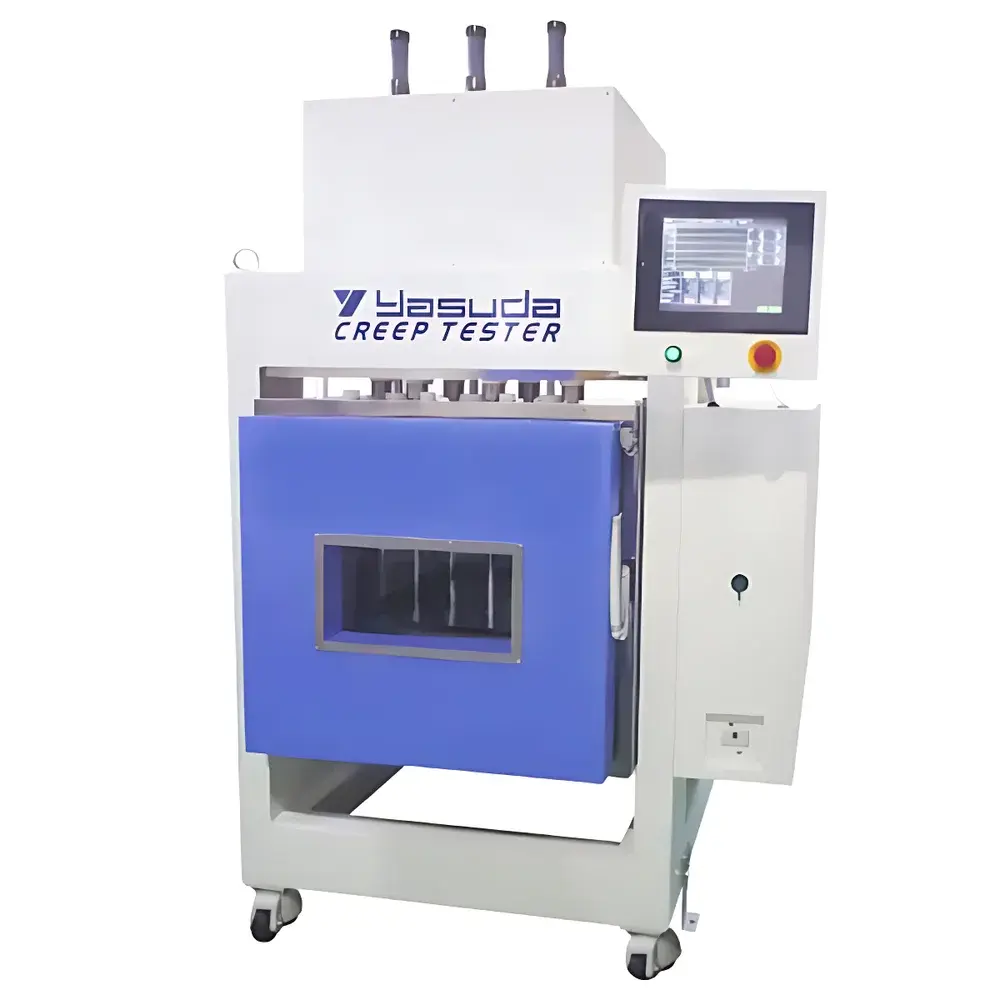
Yasuda No.145-C Hybrid Creep and Stress Relaxation Tester
| Brand | Yasuda |
|---|---|
| Origin | Japan |
| Model | No.145-C |
| Compliance | JIS K7115, ASTM D2990, ISO 899-1, JIS K6263, ISO 3384, JIS K7162 |
| Max Load Capacity | 5 kN (500 kgf) |
| Displacement Resolution | 0.01 mm |
| Displacement Range | 100 mm |
| Temperature Range | Up to 200 °C |
| Actuation | Servo Motor Drive |
| Displacement Sensor | Magnetic Strain-Type Linear Scale |
| Fixture Options | Tensile, Compression, Flexural, Cryogenic Chamber, Environmental Chamber (Constant Temp/Humidity), Segmented Chamber, Mark-to-Mark Displacement Module |
| Mounting Configurations | 3-, 6-, or 10-station test frame |
Overview
The Yasuda No.145-C Hybrid Creep and Stress Relaxation Tester is an electromechanical testing system engineered for precise, time-dependent mechanical characterization of elastomeric and thermoplastic polymer materials under controlled thermal and mechanical conditions. Based on the fundamental principles of linear viscoelasticity, the instrument applies a constant strain (for stress relaxation) or constant load (for creep) and quantifies the resulting time-dependent evolution of stress or strain—respectively—using high-fidelity servo-controlled actuation and calibrated magnetic strain-type displacement sensing. Its modular architecture supports dual-mode operation: tensile stress relaxation per JIS K7115 and ASTM D2990, and compressive or flexural relaxation per ISO 3384 and JIS K6263. Unlike conventional dead-weight creep testers, the No.145-C employs closed-loop servo motor actuation to maintain target strain with sub-micron positional stability over extended durations (hours to weeks), enabling reproducible evaluation of long-term dimensional stability, permanent set, and recovery behavior in vulcanized rubber, TPEs, and crosslinked polymeric compounds.
Key Features
- Servo motor-driven loading system delivering precise, programmable strain control with real-time feedback—eliminating drift inherent in gravity-based systems
- Magnetic strain-type linear scale with 0.01 mm resolution and 100 mm full-scale travel, optimized for low-noise, high-repeatability displacement measurement under dynamic thermal cycling
- Modular multi-station test frame supporting 3-, 6-, or 10-position configurations to enable parallel testing per JIS K7162, significantly improving throughput for QC labs and R&D validation protocols
- Integrated thermal management interface compatible with optional environmental chambers—including cryogenic (-40 °C), constant temperature/humidity (±0.5 °C, ±2 %RH), and segmented heating zones—to assess thermo-mechanical coupling effects
- Dedicated fixture sets for tensile, compression, and flexural stress relaxation, as well as specialized tooling for heat shrinkage and thermal shock testing per JIS K6263
- Structural rigidity and thermal mass design minimizing frame deflection and ambient-induced measurement artifacts during prolonged tests at elevated temperatures (up to 200 °C)
Sample Compatibility & Compliance
The No.145-C accommodates standard dumbbell, ring, and cylindrical specimens per ISO 37, ASTM D412, and JIS K6251. Its interchangeable jaw geometry and low-inertia grip mechanisms ensure uniform stress distribution across heterogeneous rubber compounds—including filled NR, SBR, EPDM, silicone, and thermoplastic elastomers—without premature slippage or localized yielding. All operational modes conform to internationally recognized standards: stress relaxation testing per JIS K7115 (rubber), ASTM D2990 (plastics), and ISO 899-1 (thermoplastics); compression set evaluation per ISO 3384 and JIS K6263; and thermal deformation assessment per JIS K7162. The system’s mechanical traceability aligns with ISO/IEC 17025 requirements for accredited testing laboratories, and its load cell calibration documentation supports audit readiness for GLP and GMP-regulated environments.
Software & Data Management
The No.145-C operates under Windows-compatible proprietary software providing ISO-compliant test method templates, real-time curve overlay, and automated parameter extraction—including initial modulus, relaxation modulus decay rate (logarithmic or exponential fitting), residual stress ratio (%), and time-to-half-relaxation (t½). Raw data export is supported in CSV and XML formats, preserving full timestamped sensor metadata (load, displacement, temperature, elapsed time) for secondary analysis in MATLAB, Python, or statistical packages. Audit trail functionality logs all user actions, method modifications, and calibration events in accordance with FDA 21 CFR Part 11 requirements when configured with electronic signature modules. Data integrity safeguards include write-protected storage, automatic backup to network drives, and checksum-verified file generation.
Applications
- Quantifying stress relaxation kinetics in automotive sealing compounds exposed to under-hood thermal cycles
- Evaluating long-term compression set resistance of medical-grade silicone gaskets per ISO 3384-1
- Characterizing thermal shrinkage and recovery behavior in extruded TPE profiles used in consumer electronics housings
- Validating viscoelastic master curves via time–temperature superposition (TTS) using isothermal relaxation datasets across 25–200 °C
- Supporting material selection for vibration-damping mounts by correlating relaxation spectra with dynamic mechanical analysis (DMA) loss factor data
- Generating input parameters for finite element modeling of rubber bushings and engine mounts under sustained preload conditions
FAQ
What standards does the No.145-C directly support for stress relaxation testing?
It complies with JIS K7115, ASTM D2990, ISO 899-1, and JIS K6263 for both tensile and compressive relaxation modes.
Can the system perform simultaneous multi-specimen testing?
Yes—configurable 3-, 6-, or 10-station frames allow concurrent testing under identical thermal and mechanical conditions, per JIS K7162 protocol.
Is the displacement sensor traceable to national metrology institutes?
The magnetic strain-type linear scale is factory-calibrated with NIST-traceable reference standards; calibration certificates are provided with each unit.
Does the software support automated pass/fail evaluation against specification limits?
Yes—user-defined acceptance criteria (e.g., maximum allowable residual stress after 100 h) trigger visual alerts and generate compliance reports.
What thermal accessories are available for low-temperature stress relaxation studies?
A liquid nitrogen-cooled cryogenic chamber (–40 °C to +80 °C) with integrated strain compensation is available as an OEM option.




