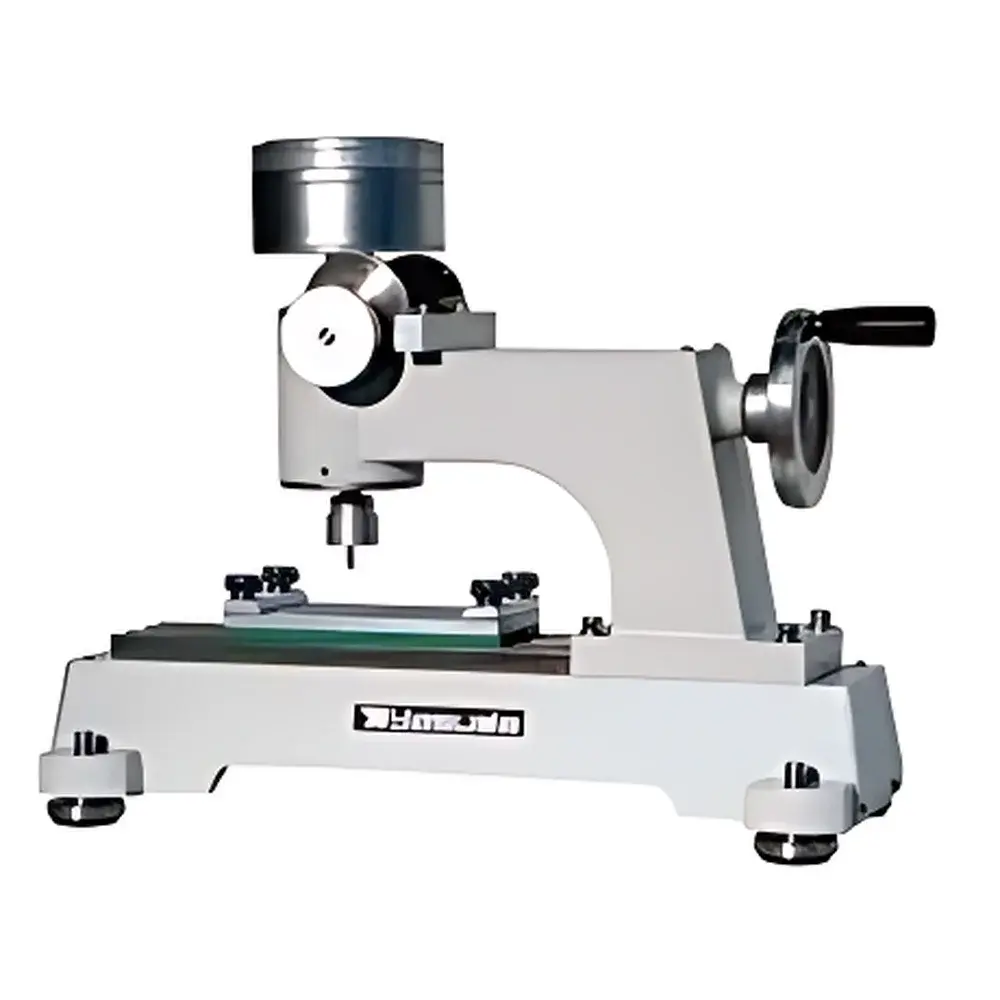
Yasuda No.519 Drawing Tester for Paint Film Adhesion Evaluation
| Brand | Yasuda |
|---|---|
| Origin | Japan |
| Model | No.519 |
| Standard Compliance | JIS K 6894 |
| Test Method | Spiral Scribe Adhesion Test |
| Load Application | Fixed Dead-Weight Loading |
| Stroke Pattern | Concentric Spiral (25 revolutions) |
| Evaluation Basis | Visual Comparison Against JIS Reference Charts |
| Sample Substrate | Metallic Panels with Fluoropolymer Coatings |
Overview
The Yasuda No.519 Drawing Tester is a precision-engineered mechanical instrument designed specifically for evaluating the adhesion strength of fluoropolymer-based paint films applied to metallic substrates. It implements the standardized spiral scribe method defined in JIS K 6894—Japan Industrial Standard for “Testing Methods for Adhesion of Organic Coatings on Metal Substrates.” Unlike pull-off or cross-cut methods, this tester applies controlled mechanical stress through a hardened steel stylus that traces a tightly wound concentric spiral path under a fixed dead-weight load. The resulting progressive delamination pattern provides a quantitative yet visually interpretable index of interfacial cohesion between coating and substrate. Its rigid cast-iron base, calibrated vertical loading column, and precision-machined turntable ensure repeatable test geometry and minimal operator-induced variability—critical for QC laboratories operating under GLP or ISO/IEC 17025 frameworks.
Key Features
- Fixed-load application mechanism utilizing calibrated dead weights (standard configuration: 200 g, 500 g, or 1,000 g; configurable per JIS K 6894 Annex A)
- Motor-driven turntable with synchronized 25-revolution indexing—ensuring consistent spiral diameter progression from center to outer edge
- Hardened stainless-steel scribing needle (tip radius: 0.2 mm ± 0.02 mm), replaceable and traceably certified
- Adjustable sample clamping system accommodating standard 100 × 150 mm metal panels (e.g., cold-rolled steel, aluminum alloy 1100)
- Mechanical counter integrated into drive train to verify exact 25-cycle completion prior to evaluation
- No electrical or pneumatic components in the core test path—eliminating drift, calibration drift, or signal noise affecting result reproducibility
Sample Compatibility & Compliance
The No.519 is validated for use with fluororesin coatings—including polyvinylidene fluoride (PVDF), polytetrafluoroethylene (PTFE), and ethylene-tetrafluoroethylene (ETFE)—applied via spray, dip, or coil-coating processes onto ferrous and non-ferrous metallic substrates. It complies fully with JIS K 6894:2013, including requirements for stylus geometry, load tolerance (±2% of nominal value), rotational speed stability (< ±1 rpm over full cycle), and environmental conditioning (testing conducted at 23 ± 2°C and 50 ± 5% RH per JIS Z 8703). While not inherently compliant with ASTM D3359 or ISO 2409, comparative correlation studies have been published in JPCL and Progress in Organic Coatings confirming empirical equivalency for fluoropolymer systems when evaluated using the JIS reference chart scale (Classes 0–5). Documentation supports audit readiness for automotive OEM supplier qualification (e.g., Toyota TSD 1301, Honda HES D 5001).
Software & Data Management
The No.519 operates as a stand-alone mechanical tester without embedded electronics or digital output. All test parameters—including load mass, substrate type, coating thickness (measured separately per JIS K 5600-1-7), and ambient conditions—are manually recorded in laboratory notebooks or LIMS-compatible spreadsheets. This analog architecture ensures immunity to firmware obsolescence, cybersecurity vulnerabilities, or software validation overhead—making it suitable for regulated environments where ALCOA+ principles (Attributable, Legible, Contemporaneous, Original, Accurate) govern recordkeeping. Users may integrate results into electronic quality management systems (eQMS) via structured CSV upload, with metadata fields mapped to ISO 15189 clause 5.9.2 requirements for test result traceability.
Applications
- Final release testing of architectural fluoropolymer-coated aluminum composite panels (ACPs) per JIS A 1520
- In-process adhesion verification during coil-coating line commissioning and changeover
- Supplier qualification audits for Tier-1 automotive trim components (e.g., roof rails, grille inserts)
- Root cause analysis of field failures involving coating blistering or edge lifting on metal façades
- Correlation studies between cure temperature/time and interfacial fracture energy in PVDF systems
- Reference method for validating accelerated adhesion testers employing servo-controlled scribes
FAQ
Does the No.519 support automated data logging or USB output?
No. It is a purely mechanical instrument with no embedded sensors, microcontrollers, or communication interfaces.
Can it be used for non-fluoropolymer coatings such as epoxy or polyester?
While physically operable, JIS K 6894 explicitly specifies fluororesin systems; interpretation of results for other chemistries requires internal method validation per ISO/IEC 17025 Clause 7.2.2.
What maintenance is required to maintain compliance with JIS K 6894?
Monthly verification of stylus tip radius (using optical comparator), biannual calibration of dead-weight masses (traceable to JCSS), and annual inspection of turntable runout (≤0.05 mm TIR) per manufacturer’s service manual.
Is operator training required for JIS-compliant operation?
Yes. JIS K 6894 mandates documented operator competency assessment—including demonstration of correct stylus alignment, load application sequence, and visual rating against certified reference charts (JIS K 6894 Annex B).