
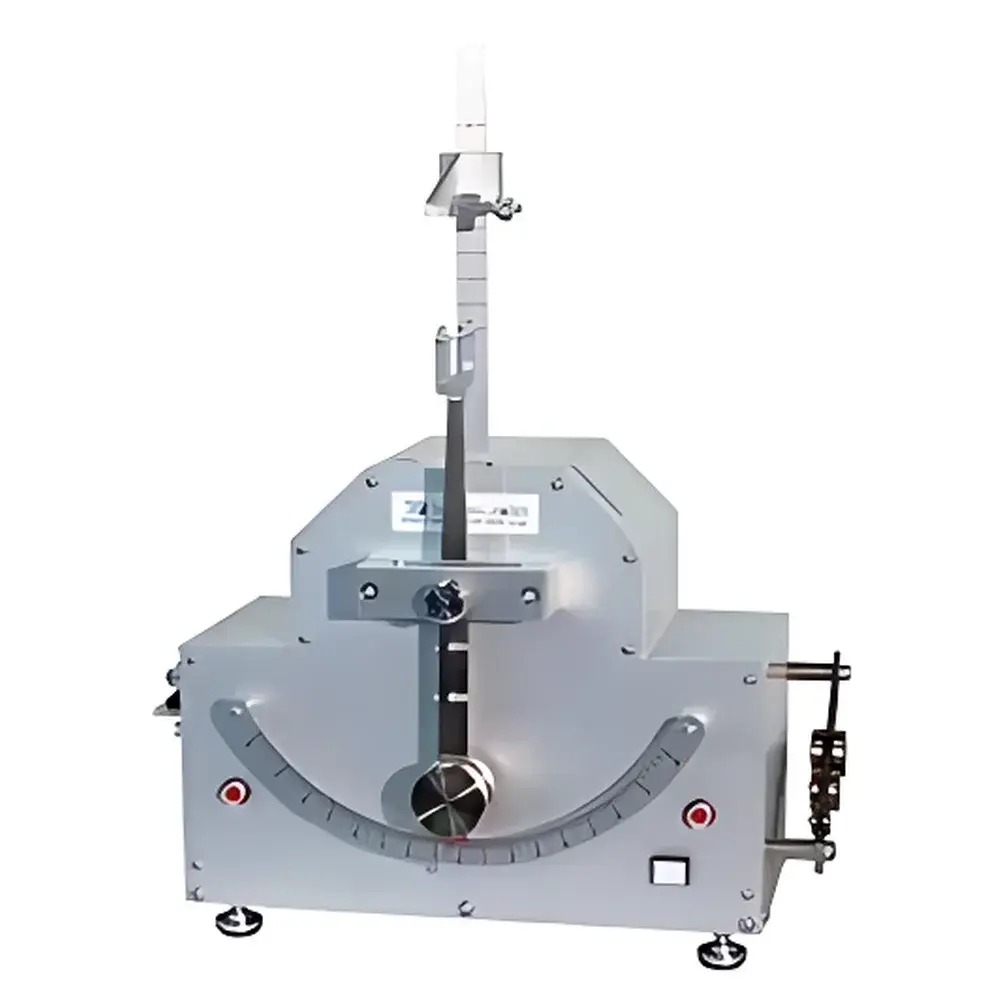
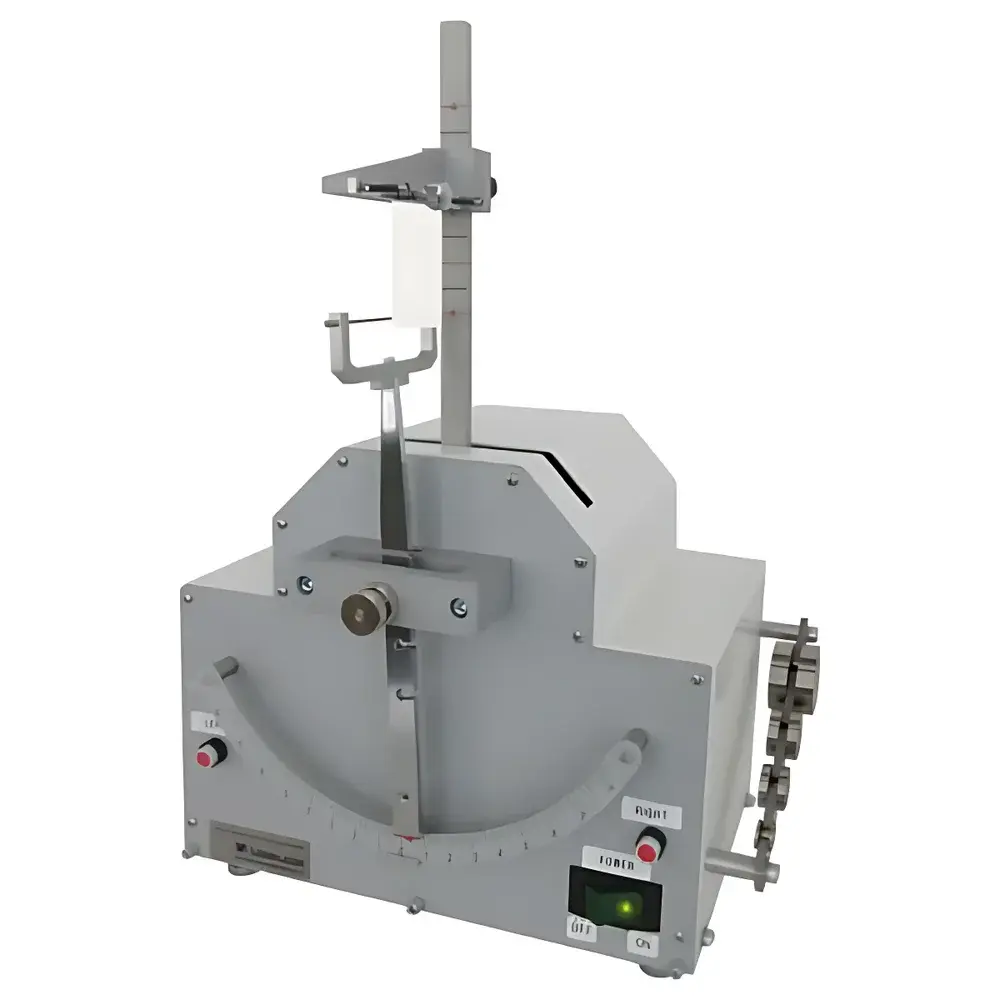
Yasuda No.311 Gurley-Type Stiffness Tester
| Brand | Yasuda |
|---|---|
| Origin | Japan |
| Model | No.311 |
| Standard Compliance | JIS L1018, JIS L1085, JIS L1096, TAPPI T543 |
| Specimen Width | 1/2″, 1″, 2″ |
| Specimen Length | 1″, 1½″, 2½″, 3½″, 4½″ |
| Clamp Position from Pendulum Tip | 1/2″, 1″, 1½″, 2″, 2½″, 3″, 3½″, 4″ |
| Arm Rotation Speed | 2 rpm |
| Weights | 5 g, 25 g, 50 g, 200 g |
| Weight Arm Lever Positions from Pivot | 1″, 2″, 4″ |
| Scale Range | ±0–8 (graduation: 0.2) |
| Power Supply | AC 100 V, Single-phase, 1 A, 50/60 Hz |
| Dimensions (W×D×H) | ≈350 × 200 × 500 mm |
| Weight | ≈7 kg |
Overview
The Yasuda No.311 Gurley-Type Stiffness Tester is a precision mechanical instrument engineered for the quantitative evaluation of bending resistance—commonly referred to as stiffness—in thin, flexible sheet materials. It operates on the classical Gurley pendulum principle, wherein a standardized specimen is clamped at one end and allowed to deflect under controlled torsional oscillation. As the specimen rotates at a fixed angular velocity (2 rpm), its resistance to bending causes a measurable deflection of a calibrated pendulum arm; the resulting scale reading—expressed in Gurley stiffness units—is directly correlated with material rigidity. This method is fundamentally rooted in torsional dynamics and moment-of-force equilibrium, making it especially suitable for comparative quality control and specification verification in industrial R&D and production environments.
Key Features
- Compliant mechanical architecture designed specifically for Gurley-type stiffness measurement per internationally recognized test standards.
- Adjustable clamp positions (eight discrete settings from 0.5″ to 4″ from pendulum tip) enable precise alignment with specimen geometry and standard-specified fulcrum distances.
- Modular weight system (5 g, 25 g, 50 g, 200 g) combined with three lever-arm attachment points (1″, 2″, 4″ from pivot) allows full range calibration across low- to high-stiffness materials.
- High-resolution analog scale (±0–8, 0.2-unit graduation) provides repeatable visual readout without reliance on digital electronics—enhancing long-term stability and minimizing drift-related uncertainty.
- Robust cast-metal frame and precision-machined bearing assembly ensure consistent rotational kinematics and minimal mechanical hysteresis over extended operational cycles.
- Compact footprint (≈350 × 200 × 500 mm) and lightweight design (~7 kg) facilitate integration into QC labs, packaging testing suites, and university teaching laboratories where space and mobility are constrained.
Sample Compatibility & Compliance
The No.311 accommodates a broad spectrum of planar, isotropic sheet materials including but not limited to coated and uncoated paperboard, corrugated linerboard, metallized polymer films (e.g., PET, PP, BOPP), nonwovens, and tightly woven textiles. Specimen dimensions are configurable via interchangeable width (1/2″, 1″, 2″) and length (1″ to 4½″) fixtures, ensuring strict adherence to specimen preparation requirements outlined in JIS L1018 (paper and board), JIS L1085 (plastic films), JIS L1096 (textiles), and TAPPI T543 (paperboard stiffness). The instrument’s mechanical repeatability and traceable calibration protocol support audit readiness for ISO/IEC 17025-accredited laboratories and GLP-compliant documentation workflows.
Software & Data Management
The Yasuda No.311 is a fully manual, analog-operated tester with no embedded firmware or digital interface. All measurements are recorded manually by trained operators following documented SOPs. This architecture eliminates software validation overhead and ensures compliance with regulatory frameworks where deterministic mechanical measurement is preferred—such as FDA-regulated packaging validation (21 CFR Part 11 does not apply to purely analog instrumentation). For laboratories requiring digital data capture, external documentation systems—including LIMS-integrated electronic lab notebooks (ELNs)—can be employed to log scale readings, specimen IDs, environmental conditions (temperature/humidity per JIS Z 8901), and operator signatures. Calibration records and periodic verification checks (e.g., using NIST-traceable reference specimens) are maintained separately in accordance with ISO 9001 and IATF 16949 quality management requirements.
Applications
- Quality assurance of folding cartons and rigid packaging substrates during incoming inspection and process validation.
- Comparative analysis of calendering or coating effects on paperboard stiffness in pulp & paper manufacturing.
- Development-stage evaluation of biodegradable film formulations for food packaging applications.
- Educational demonstration of torsional mechanics and material property relationships in undergraduate materials science curricula.
- Third-party certification testing for JIS- and TAPPI-compliant product declarations in export-oriented supply chains.
FAQ
Is the Yasuda No.311 compatible with ASTM D726 or ISO 2493?
No—the No.311 implements the Gurley pendulum method defined exclusively in JIS and TAPPI standards. ASTM D726 specifies a different apparatus (Taber stiffness tester), while ISO 2493 employs a cantilever beam deflection principle.
Can the instrument be recalibrated in-house?
Yes—mechanical recalibration is performed using certified reference weights and geometric verification of lever-arm distances and pendulum center-of-mass position, per Yasuda’s published maintenance manual.
Does it require annual metrological certification?
While not mandatory, accredited calibration against national standards (e.g., JCSS in Japan or UKAS in the UK) is recommended every 12 months for ISO/IEC 17025 compliance and audit traceability.
What environmental conditions are required for valid testing?
Testing must be conducted in a conditioned environment per JIS Z 8901: temperature 23 ± 1 °C and relative humidity 50 ± 2 % RH, with specimen equilibration for ≥4 hours prior to measurement.
Is operator training provided with purchase?
Yasuda-certified application engineers offer on-site or virtual training covering setup, specimen preparation, zero-point adjustment, reading interpretation, and routine maintenance protocols.



