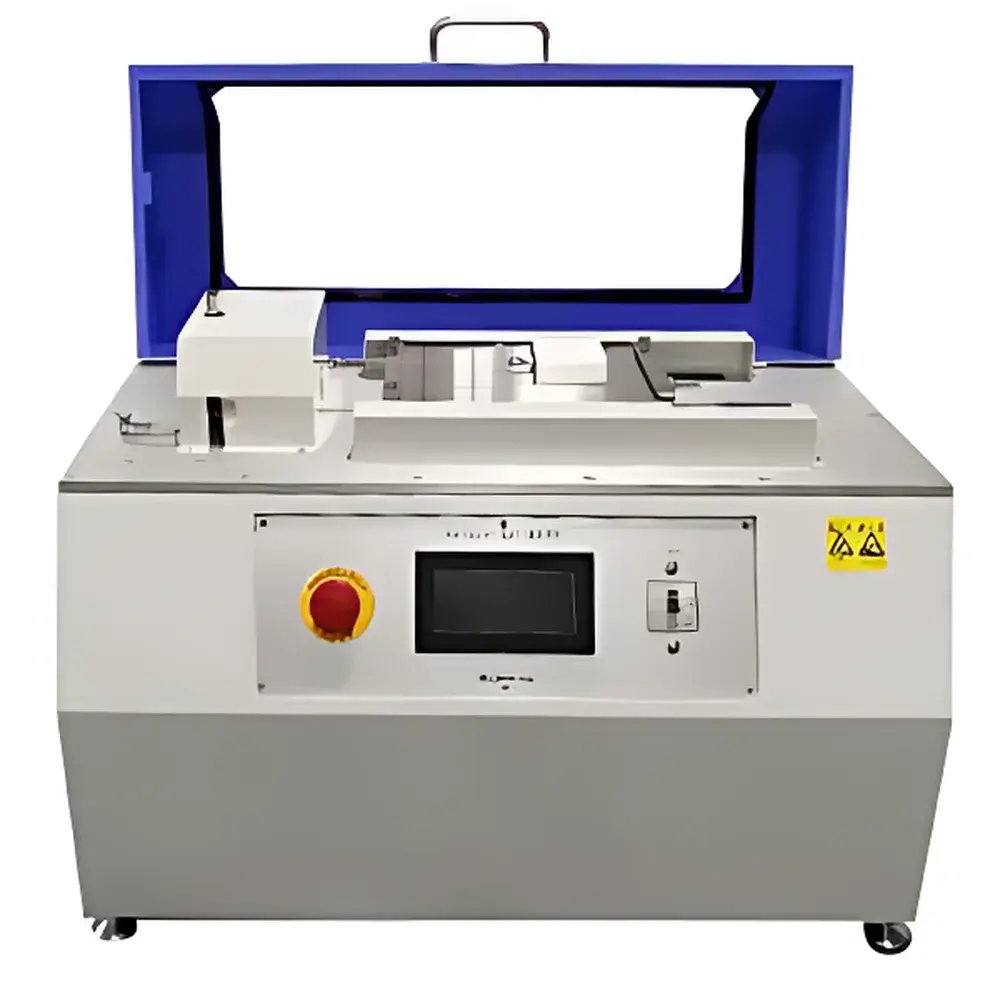
Yasuda No.162-FS Coefficient of Friction Tester (Lateral Method)
| Brand | Yasuda |
|---|---|
| Origin | Japan |
| Model | No.162-FS |
| Standards Compliance | JIS K7125, ISO 8295, ASTM D3247, TAPPI T816, P8147 |
| Measurement Principle | Lateral pull-type static & kinetic COF determination via load cell transduction |
| Sample Mounting | Dual-surface clamping (stationary bed + sliding sled) |
| Output | μs (static) and μk (kinetic) values |
Overview
The Yasuda No.162-FS Coefficient of Friction Tester (Lateral Method) is a precision-engineered instrument designed for the quantitative evaluation of static (μs) and kinetic (μk) coefficients of friction between flexible packaging materials—primarily plastic films, laminates, coated papers, and corrugated board substrates. It operates on the lateral pull principle: a standardized sled, rigidly affixed with the test specimen, is drawn horizontally across a stationary counter-surface (also specimen-mounted) at controlled speed and normal force. A high-stability load cell integrated into the pulling mechanism captures real-time tensile force data, enabling direct calculation of frictional resistance relative to applied normal load. This method aligns rigorously with internationally recognized standards including ISO 8295 (Plastics — Determination of coefficient of friction), ASTM D3247 (Standard Test Method for Coefficient of Friction of Plastic Film and Sheeting), JIS K7125 (Testing methods for plastic films), TAPPI T816 (Coefficient of Friction of Paper and Paperboard), and Japanese industrial specification P8147. The system’s mechanical architecture ensures minimal inertial error, consistent sled acceleration profile, and repeatable contact geometry—critical factors for inter-laboratory reproducibility in QC/QA environments.
Key Features
- Lateral pull configuration compliant with ISO 8295 Annex A (Method A) and ASTM D3247 Section 7, eliminating vertical force vector artifacts associated with inclined-plane testers.
- Integrated digital load cell with calibrated range optimized for low-force measurement (typically 0–50 N), delivering resolution sufficient for sub-0.01 μ discrimination under standard 200 g normal load conditions.
- Adjustable sled mass (standard 200 g ±0.1 g) and interchangeable sled bases to accommodate varying surface roughness and compliance requirements per material class.
- Mechanically stabilized horizontal drive system with regulated travel speed (typically 150 mm/min ±5 mm/min), meeting tolerance specifications defined in ISO 8295 Clause 6.3 and ASTM D3247 Section 8.2.
- Modular sample clamping fixtures featuring spring-loaded, uniform-pressure jaws to ensure full-width specimen engagement without edge curl or slippage during testing.
- Robust aluminum alloy frame with vibration-dampening base plate, engineered for stable operation on standard laboratory benches without dedicated anti-vibration mounts.
Sample Compatibility & Compliance
The No.162-FS accommodates specimens up to 150 mm wide × 300 mm long, supporting both sheet and roll-fed formats common in packaging R&D and production line validation. It is routinely deployed for testing seal-to-seal, film-to-film, film-to-metal, and paper-to-paper interfaces—particularly relevant for evaluating slip additives (e.g., erucamide, oleamide), silicone coatings, corona-treated surfaces, and metallized barriers. All test procedures executed on this platform are fully traceable to GLP-compliant documentation frameworks. When paired with validated SOPs and operator training records, the instrument supports audit readiness for ISO 9001, IATF 16949, and FDA-regulated packaging validation (21 CFR Part 11 data integrity considerations apply when interfaced with compliant software).
Software & Data Management
While the No.162-FS operates as a stand-alone analog/digital hybrid instrument, it features a standard RS-232 or USB-C output interface compatible with third-party data acquisition systems. Users may integrate it with validated laboratory software platforms (e.g., LabVIEW-based custom modules, MATLAB scripts, or commercial QC suites) to automate data logging, statistical process control (SPC) charting, and PDF report generation—including embedded test parameters, raw force-time curves, calculated μs/μk values, and operator ID timestamps. For regulated environments, configuration control, electronic signature capability, and audit trail functionality must be implemented at the host software level per 21 CFR Part 11 requirements. Yasuda provides interface protocol documentation and calibration certificate templates aligned with ISO/IEC 17025 metrological traceability guidelines.
Applications
- Quality control of incoming polymer films and release liners used in medical device pouches and pharmaceutical blister packaging.
- Development and optimization of anti-block and slip additive packages in polyethylene and polypropylene extrusion lines.
- Validation of surface energy modifications (e.g., plasma treatment, flame treatment) on flexible barrier webs prior to printing or lamination.
- Comparative friction analysis of heat-seal layers to prevent jamming in vertical form-fill-seal (VFFS) and horizontal form-fill-seal (HFFS) packaging machinery.
- Regulatory submission support for packaging compatibility dossiers under USP , ISO 11607, and EU MDR Annex I essential requirements.
FAQ
What is the difference between the lateral (No.162-FS) and inclined-plane methods for COF testing?
The lateral method applies horizontal traction force directly against a fixed normal load, minimizing gravitational influence on dynamic response—making it preferred for low-friction films and thin substrates. Inclined-plane methods rely on angle-of-repose thresholds and are more sensitive to surface heterogeneity and specimen stiffness.
Does the No.162-FS require annual recalibration?
Yes. Load cell calibration must be performed annually—or after any mechanical impact or firmware update—using NIST-traceable deadweight standards per ISO/IEC 17025 clause 6.5. Yasuda-certified service centers provide calibration certificates with uncertainty budgets.
Can the instrument measure COF under elevated temperature or humidity?
Not natively. Environmental control requires external climate chambers with feedthrough-compatible sled access. Yasuda offers optional sled thermal isolation kits and humidity-stable mounting adapters for such configurations.
Is operator training included with purchase?
Basic operational training is provided remotely or on-site by authorized distributors; advanced method validation and GLP implementation support are available as billable consultancy services.
Related Products