
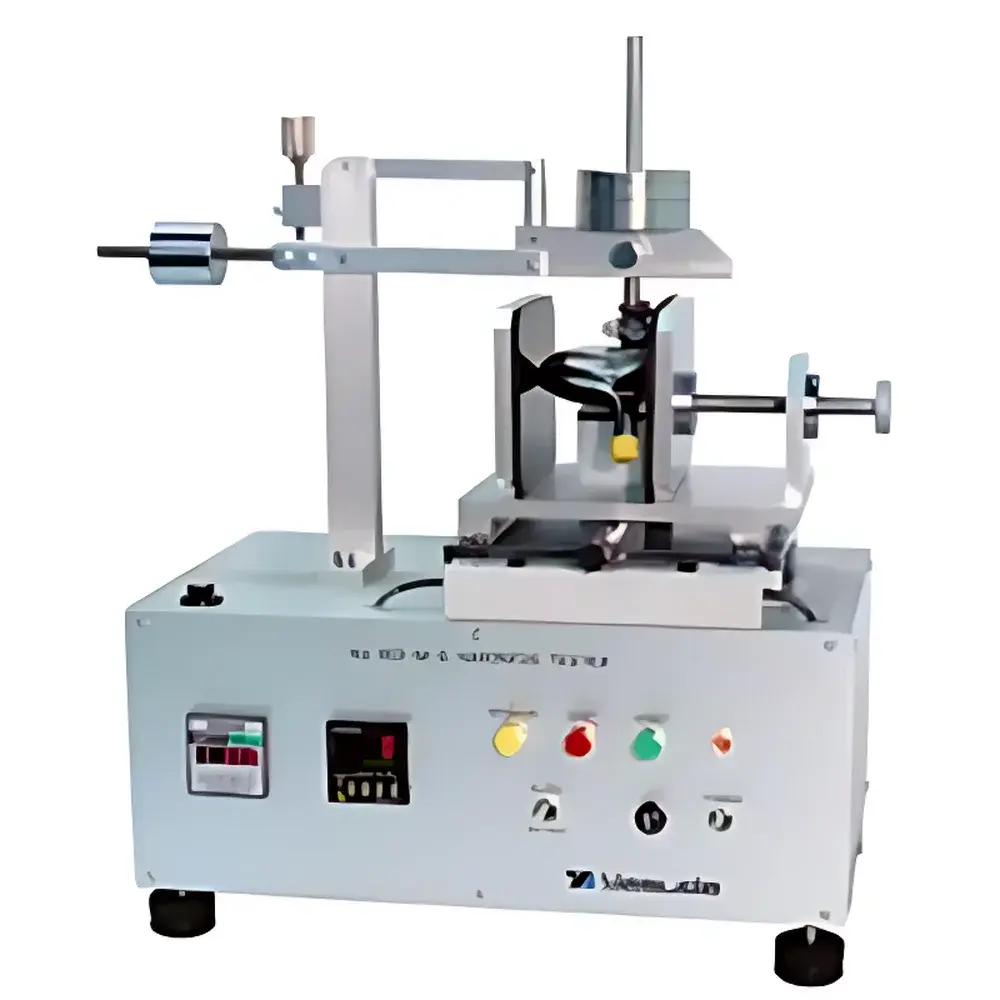
Yasuda No.650 Electric Reciprocating Tribological Tester for Golf Club Head Abrasion Assessment
| Brand | Yasuda |
|---|---|
| Origin | Japan |
| Model | No.650 |
| Application | Golf club head abrasion resistance evaluation under controlled reciprocating motion |
| Drive Type | Electric motor-driven linear reciprocation |
| Load Application | Adjustable vertical dead-weight or pneumatic loading system (typical range: 0.5–10 N) |
| Stroke Length | Adjustable (e.g., 5–50 mm) |
| Reciprocating Frequency | 10–120 cycles/min |
| Test Duration Control | Programmable timer (0–9999 min) |
| Sample Mounting | Custom fixture for golf club head geometry (incl. hosel clamping and face-angle alignment) |
| Compliance | Designed in accordance with ISO 7148-1, ASTM D5963, and JIS K 6264-2 for rubber and coated surface abrasion testing |
Overview
The Yasuda No.650 Electric Reciprocating Tribological Tester is a precision-engineered instrument designed specifically for standardized abrasion resistance evaluation of golf club heads—particularly those featuring electroplated, PVD-coated, or hard-anodized surfaces. It operates on the principle of controlled linear reciprocation, where a standardized abrasive counterface (e.g., alumina cloth, silicon carbide paper, or custom-shaped wear pins) moves in repeated back-and-forth motion against the club head’s striking face or leading edge under defined normal load, stroke length, frequency, and duration. This methodology replicates real-world mechanical wear mechanisms encountered during impact, turf interaction, and sand play, enabling quantitative assessment of coating integrity, substrate exposure, and dimensional loss. The tester is not a generic wear simulator but a purpose-built solution calibrated to the geometric constraints and functional failure modes unique to golf club head materials—including stainless steel, titanium alloys (e.g., Ti-6Al-4V), and composite-faced hybrids.
Key Features
- Motor-driven linear reciprocation with high positional repeatability (< ±0.1 mm stroke deviation over 10,000 cycles)
- Adjustable vertical loading mechanism supporting both dead-weight and optional pneumatic load control (0.5–10 N range, traceable to NIST-traceable force standards)
- Digital programmable controller enabling precise setting of stroke length (5–50 mm), reciprocating frequency (10–120 cpm), total cycle count (1–999,999), and dwell time per cycle
- Dedicated golf club head fixture system with three-axis alignment capability: vertical tilt (±5°), horizontal rotation (0–360°), and axial translation to accommodate variable hosel angles and sole curvatures
- Integrated optical inspection port and standardized mounting interface for post-test surface analysis using digital microscopy or profilometry
- Robust aluminum alloy frame with vibration-dampened base, compliant with ISO 2041 mechanical vibration classification for laboratory-grade test instrumentation
Sample Compatibility & Compliance
The No.650 accommodates full-size golf club heads (driver, fairway wood, hybrid, iron, and wedge) with standard hosel diameters (0.335″–0.370″) and face angles up to 64°. Fixturing ensures repeatable contact geometry between abrasive medium and critical wear zones—such as the impact zone (center face), heel/toe edges, and sole leading edge. Test protocols align with internationally recognized tribological standards: ISO 7148-1 (rubber and elastomer abrasion), ASTM D5963 (abrasion resistance of rubber by the Akron abrader—adapted for linear reciprocation), and JIS K 6264-2 (abrasion testing of vulcanized rubber and thermoplastic elastomers). While not inherently GLP-certified, the system supports audit-ready documentation when integrated with validated software (see Software & Data Management section) and meets baseline requirements for ISO/IEC 17025-accredited materials testing laboratories performing coating durability qualification.
Software & Data Management
The No.650 operates via an embedded microcontroller with RS-232/USB-C interface for external data logging. Optional PC-based control software (Yasuda TMS v3.2) provides full protocol scripting, real-time parameter monitoring (load, position, cycle count), automatic pass/fail flagging based on user-defined thresholds (e.g., “coating breach detected at >5,000 cycles”), and export of CSV-formatted test logs compatible with LIMS platforms. Audit trail functionality records operator ID, timestamp, parameter changes, and calibration events—supporting compliance with FDA 21 CFR Part 11 when deployed in regulated R&D environments. All firmware updates are digitally signed and version-locked to ensure configuration integrity across multi-user lab deployments.
Applications
- Quantitative comparison of electroplated gold, rhodium, or black DLC coatings on stainless steel club faces
- Accelerated wear life estimation for new titanium alloy surface treatments under simulated sand-blast conditions
- Validation of coating adhesion per ASTM B571 (adhesion tests for metallic coatings) following reciprocating abrasion exposure
- Root cause analysis of premature finish degradation observed in field returns
- Supporting material selection decisions during new club head design iteration (e.g., Ti-6Al-4V vs. beta-titanium vs. maraging steel substrates)
- Generating comparative datasets for technical marketing claims requiring third-party verification
FAQ
What types of abrasive media are compatible with the No.650?
Standard options include Grade 120–600 silicon carbide papers, 3M Trizact™ abrasives, and custom-machined ceramic or tungsten carbide wear pins. Media selection must be documented per test method.
Can the No.650 be used for non-golf applications?
Yes—its modular fixture design allows adaptation for flat or curved coated components (e.g., automotive trim, surgical instrument tips, or watch bezels), provided geometric constraints and load requirements fall within operational limits.
Is calibration certification included with purchase?
A factory-issued calibration report covering stroke linearity, frequency accuracy, and load verification is provided; annual recalibration is recommended per ISO/IEC 17025 guidelines.
Does the system support automated image capture during testing?
Not natively—but the optical access port is dimensionally aligned for integration with machine vision systems (e.g., Keyence VHX series) using third-party synchronization triggers.
What maintenance intervals are recommended?
Lubrication of linear guide rails every 200 operating hours; inspection of drive belt tension and fixture fasteners every 500 hours; full metrological verification annually or after 10,000 cycles, whichever occurs first.



