
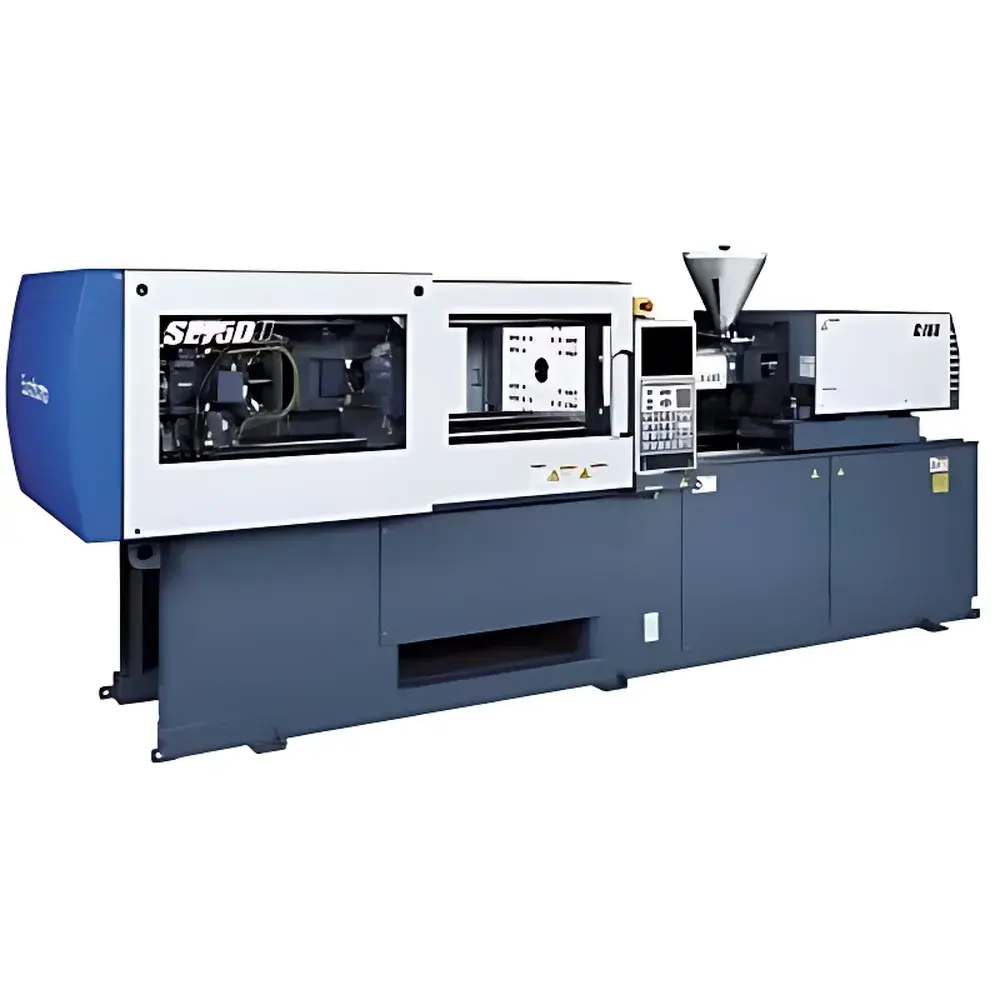
Sumitomo SU20 Direct-Drive Injection Molding Machine
| Brand | Sumitomo |
|---|---|
| Origin | Japan |
| Manufacturer Type | Authorized Distributor |
| Origin Category | Imported |
| Model | SU20 |
| Pricing | Upon Request |
Overview
The Sumitomo SU20 is a high-precision, servo-driven injection molding machine engineered for demanding rubber and plastic processing environments. Unlike conventional hydraulic or belt-driven systems, the SU20 implements a fully direct-drive architecture across all major motion axes—plastication, injection, mold clamping, and ejection—eliminating mechanical backlash, transmission losses, and positional drift. This architecture is integrated with Sumitomo’s proprietary servo control system, leveraging low-inertia direct-drive motors and real-time closed-loop feedback to achieve sub-millisecond response times and micron-level repeatability in position, pressure, and velocity control. The machine embodies Sumitomo’s ZERO MOLDING philosophy, introduced in 2008, which targets multi-cavity production, ultra-short cycle times, and zero-defect output under stringent process stability requirements. Its design prioritizes thermal stability, energy efficiency, and long-term dimensional consistency—critical for medical-grade components, optical lenses, microfluidic devices, and automotive precision parts where ±0.01 mm tolerance and <0.5% shot-to-shot weight variation are mandatory.
Key Features
- Direct-Drive Actuation: All functional axes—including screw rotation, injection plunger, clamp toggle, and ejector pins—utilize brushless servo motors coupled directly to mechanical loads. This eliminates gearboxes, hydraulics, and timing belts, reducing maintenance intervals by up to 60% and improving positioning accuracy to ±0.005 mm.
- FFC (Full-Field Control) Injection Technology: A pressure- and velocity-synchronized filling strategy that maintains optimal melt front velocity throughout cavity filling. Enables complete cavity fill at lower peak injection pressures—reducing flash formation, minimizing residual stress, and mitigating short shots in thin-walled or complex geometries.
- Center-Point Mold Clamping (CPC): Applies clamping force radially from the center of the moving platen, ensuring uniform pressure distribution across the entire mold surface. Prevents localized deflection, improves part dimensional fidelity, and extends mold service life by up to 35% compared to conventional four-poster systems.
- MCM (Multi-Cycle Modulation) Clamping: Dynamically adjusts clamping force during mold closing, holding, and opening phases based on real-time cavity pressure feedback. Enhances venting efficiency, suppresses burn marks, reduces power consumption by ~22%, and supports extended mold maintenance cycles without compromising part quality.
- Feed-Forward Lock Force Regulation: Integrates load-cell feedback from the clamping unit with real-time cavity pressure data to auto-adjust clamping force within ±1.5% of setpoint—ensuring consistent flash-free operation across material viscosity variations and ambient temperature fluctuations.
Sample Compatibility & Compliance
The SU20 is compatible with thermoplastics (e.g., PP, ABS, PC, PEEK, LCP), thermoplastic elastomers (TPE, TPU), and engineering resins requiring precise thermal and shear management. Its robust platen parallelism (≤0.02 mm/m) and thermal-stable tie-bar structure support ISO-A through ISO-F, ASTM D256, D638, D648, D790, UL 94, and custom test specimen geometries—including multi-level stepped plates, spiral flow channels (1150 × 5 × 2–3 mm), color streak blocks (90 × 55 × 2 mm), and Ø85 × 3 mm discs. The machine complies with CE Machinery Directive 2006/42/EC, ISO 13850 (emergency stop), ISO 14120 (guarding), and supports integration into ISO 9001, IATF 16949, and FDA-regulated manufacturing workflows. Optional validation packages include IQ/OQ documentation aligned with ASTM E2500 and GAMP5 guidelines.
Software & Data Management
Equipped with Sumitomo’s iQ-Monitor v4.2 control platform, the SU20 provides full-cycle traceability via timestamped process parameter logging (injection speed, melt temp, clamp tonnage, back pressure, cooling time) at 100 Hz resolution. Data export conforms to CSV, XML, and OPC UA protocols for seamless integration with MES (e.g., Siemens Opcenter, Rockwell FactoryTalk) and statistical process control (SPC) systems. Audit trails meet FDA 21 CFR Part 11 requirements—including electronic signatures, user access tiers, and immutable event logs. Optional cloud-based remote monitoring enables predictive maintenance alerts using vibration, current draw, and thermal signature analytics.
Applications
The SU20 serves high-value applications where repeatability, surface integrity, and regulatory compliance are non-negotiable: precision micro-molded connectors for implantable devices; optical-grade lens arrays for AR/VR headsets; thin-wall packaging for pharmaceutical blister trays; multi-material overmolded automotive sensors; and flame-retardant enclosures certified to UL 94 V-0. Its low thermal inertia and high-resolution pressure control make it especially suited for crystalline polymers (e.g., POM, PA66) and heat-sensitive biopolymers (e.g., PLA, PHA), where narrow processing windows demand deterministic control.
FAQ
What distinguishes the SU20’s direct-drive system from hybrid servo-hydraulic machines?
The SU20 eliminates hydraulic oil, accumulators, and proportional valves entirely—replacing them with torque-controlled servo motors on every axis. This removes fluid compressibility effects, thermal drift, and valve hysteresis, enabling true deterministic motion profiles with <0.1% velocity deviation across 10,000+ cycles.
Can the SU20 be validated for use in regulated medical device manufacturing?
Yes. With optional IQ/OQ documentation, Part 11-compliant software, and traceable calibration certificates for all embedded sensors (load cells, RTDs, linear encoders), the SU20 meets FDA, MDR, and ISO 13485 requirements for Class II and III device production.
Does the machine support real-time cavity pressure monitoring?
It integrates seamlessly with third-party cavity pressure transducers (e.g., Kistler, PTI) via analog input or CANopen interface, enabling closed-loop pressure-based hold switching and defect detection algorithms.
What is the typical lead time for delivery and commissioning?
Standard configuration units ship within 12–14 weeks ex-factory in Japan; commissioning—including mechanical alignment, thermal stabilization, and process qualification support—requires 5–7 working days on-site with Sumitomo-certified engineers.





