
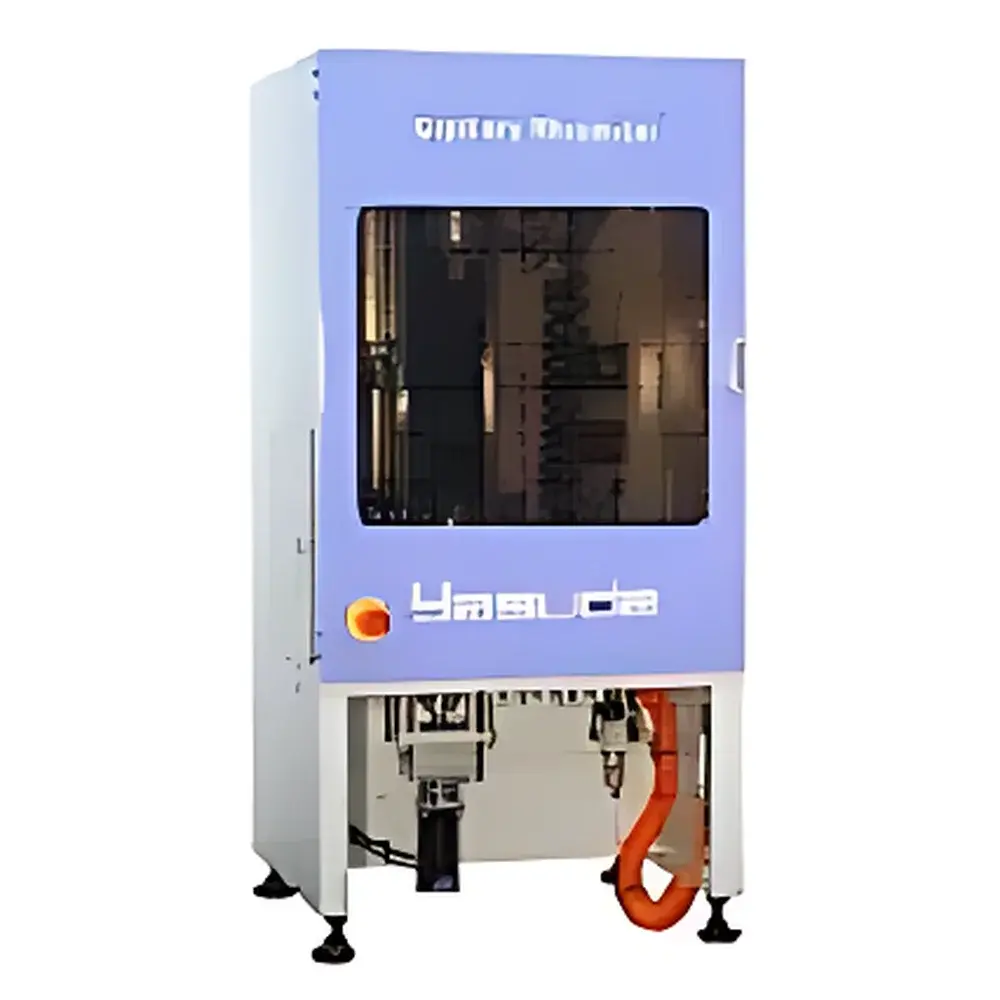
Yasuda No.140-SAS-2005 Semi-Automatic Heavy-Load Capillary Rheometer
| Brand | Yasuda |
|---|---|
| Origin | Japan |
| Model | No.140-SAS-2005 |
| Standards Compliance | JIS K7199, ASTM D3835, ISO 11443 |
| Load Capacity | Heavy-Load Configuration |
| Automation Level | Semi-Automatic (Single-Cycle Auto-Cleaning Enabled) |
| Measurement Principle | Capillary Extrusion Rheology (Piston-Driven Melt Flow) |
| Temperature Control Range | Up to 400 °C (typical for polymer melt testing) |
| Die Geometry | Standardizable Capillary Dies (L/D ≥ 10 recommended per ISO 11443) |
Overview
The Yasuda No.140-SAS-2005 Semi-Automatic Heavy-Load Capillary Rheometer is an engineered solution for quantitative rheological characterization of thermoplastic polymers in the molten state. Based on the fundamental principles of capillary extrusion rheology, this instrument applies a controlled compressive load via a precision-machined piston to force molten polymer through a standardized capillary die. Simultaneous measurement of piston displacement rate (yielding apparent shear rate) and applied load (converted to wall shear stress using die geometry and Bagley correction) enables calculation of apparent viscosity, extensional viscosity (via entry pressure analysis), and flow activation energy. Designed specifically for high-viscosity, high-melt-strength materials—including engineering resins, filled compounds, and reactive thermoplastics—the heavy-load configuration supports test loads up to 100 kN (configurable), ensuring mechanical stability and data fidelity under demanding extrusion-simulating conditions. Its thermal architecture features zone-controlled cylinder heating with ±0.5 °C uniformity across the barrel length, meeting the stringent temperature stability requirements defined in ASTM D3835 and ISO 11443 for reliable time–temperature superposition analysis.
Key Features
- Heavy-load mechanical frame with reinforced hydraulic or servo-electric actuation system, optimized for sustained loading at elevated temperatures without frame deflection or thermal drift
- Semi-automatic operation mode: user initiates test sequence; system executes piston descent, real-time pressure/displacement acquisition, automatic die purging, and post-test cleaning cycle upon completion
- Modular die holder accommodating interchangeable capillaries (standard L/D = 10, 20, 30, and 40 geometries) with integrated thermocouple ports for direct wall temperature monitoring
- Dual-sensor transduction: high-accuracy load cell (ISO 376 Class 0.5) and linear variable differential transformer (LVDT) with sub-micron resolution for displacement tracking
- Integrated Bagley and Rabinowitsch corrections applied in real time during data acquisition to yield true shear stress, shear rate, and viscosity functions
- Thermal management compliant with JIS K7199 Annex B: active cooling channels in barrel flanges prevent heat migration to load train components
Sample Compatibility & Compliance
The No.140-SAS-2005 accommodates solid polymer granules, pellets, and pre-compounded masterbatches—compatible with polyolefins (PP, PE), engineering thermoplastics (PC, PBT, PA6/66), thermoplastic elastomers (TPEs), and filled systems (glass-, mineral-, or carbon-fiber reinforced). Sample mass range: 3–12 g depending on barrel diameter (standard 9.55 mm or 12.0 mm). All operational protocols align with internationally recognized standards: ASTM D3835 (Standard Test Method for Rheological Properties of Thermoplastics by Capillary Rheometry), ISO 11443 (Plastics — Determination of the Rheological Properties of Thermoplastics Using Capillary Rheometers), and JIS K7199 (Testing Methods for Rheological Properties of Plastics). The system’s mechanical calibration traceability follows ISO/IEC 17025 guidelines, and its documentation structure supports GLP-compliant reporting for regulatory submissions.
Software & Data Management
Control and analysis are performed via Yasuda’s dedicated RheoWin software (v5.x), a Windows-based platform supporting IEC 62443-aligned secure user access levels (Operator, Technician, Administrator). Raw sensor data are acquired at ≥100 Hz sampling rate and stored in vendor-neutral HDF5 format with embedded metadata (test ID, operator, timestamp, calibration certificate IDs, environmental conditions). The software provides automated calculation of key outputs: apparent viscosity vs. shear rate curves, consistency index (K) and flow behavior index (n) via Ostwald–de Waele fitting, activation energy (Ea) from Arrhenius plots, and die swell ratio. Audit trails comply with FDA 21 CFR Part 11 requirements, including electronic signatures, immutable change logs, and role-based data export permissions. Export options include CSV, Excel, and PDF reports formatted for internal QA review or third-party certification bodies.
Applications
- Process simulation for extrusion and injection molding: correlating lab-scale capillary data with industrial screw design parameters (e.g., pressure drop prediction, residence time distribution)
- Quality control of incoming polymer lots: batch-to-batch viscosity consistency verification against release specifications
- R&D of novel formulations: evaluating shear-thinning behavior, thermal stability onset, and filler dispersion effects on melt elasticity
- Regulatory dossier preparation: generating rheological datasets required for medical-grade polymer submissions (ISO 10993-12, USP )
- Troubleshooting melt fracture phenomena: identifying critical shear rate thresholds and relating them to molecular weight distribution (MWD) breadth
FAQ
What distinguishes the heavy-load configuration from light-load models?
The No.140-SAS-2005 heavy-load variant incorporates a reinforced structural frame, high-capacity load train, and extended-range pressure transducers to maintain measurement integrity at forces exceeding 50 kN—essential for high-molecular-weight or highly filled polymers exhibiting yield stresses above 1 MPa.
Is the auto-cleaning function fully autonomous?
The system performs one complete cleaning cycle (die purge + piston wipe) after each test when configured with optional cleaning hardware; however, manual die disassembly and solvent rinse remain necessary between material families to prevent cross-contamination.
Can this instrument be integrated into a laboratory LIMS?
Yes—RheoWin supports ASTM E1384-compliant HL7 messaging and OPC UA server interface for bidirectional data exchange with validated LIMS platforms, enabling automated result ingestion and electronic batch record linkage.
Does it support extensional viscosity estimation?
While primarily a shear rheometer, the No.140-SAS-2005 enables indirect extensional viscosity assessment through Trouton ratio analysis (using entry pressure correction methods such as the Cogswell or Binding models), provided appropriate die entrance geometries and high-speed data capture are employed.
What maintenance intervals are recommended?
Daily: visual inspection of die orifice and piston seal integrity; quarterly: load cell recalibration and thermal mapping verification; annually: full mechanical alignment audit and hydraulic fluid replacement (if applicable).



