
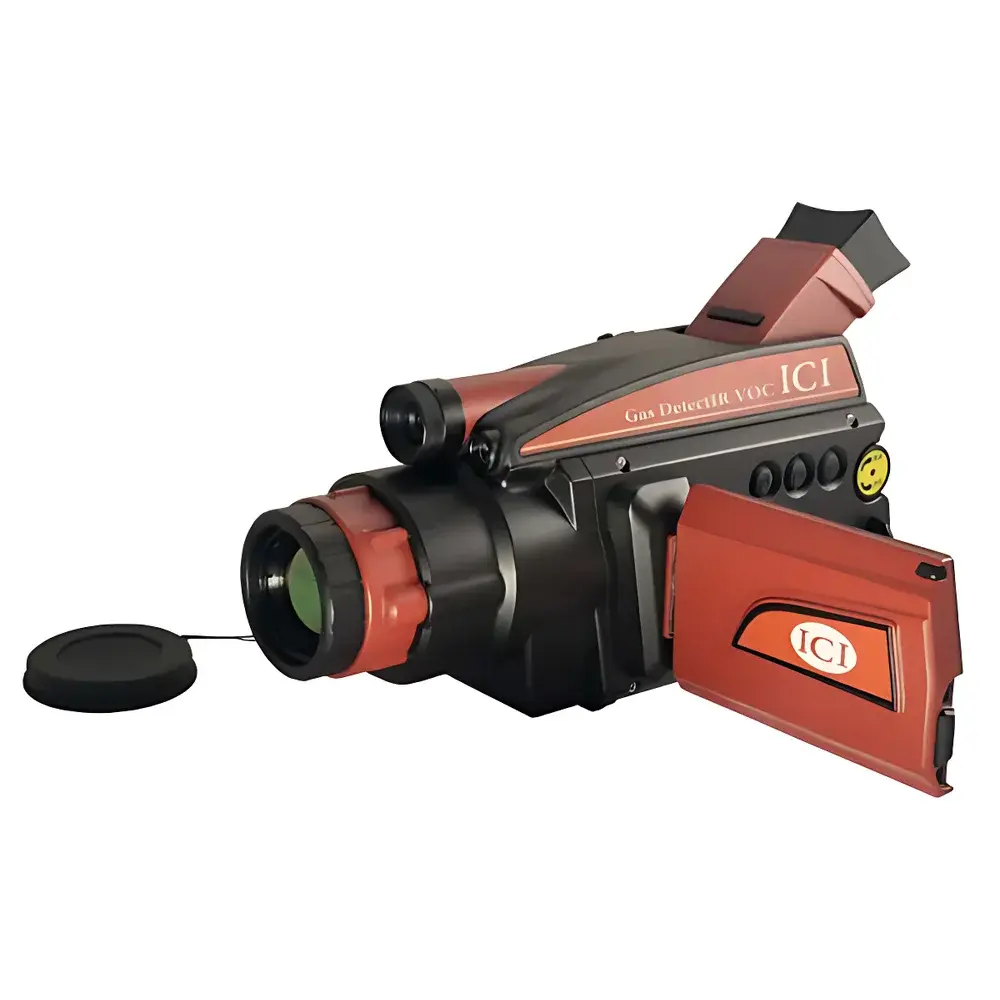
ICI Gas DetectIR VOC Handheld VOC Imaging Camera
| Brand | ICI / Infrared Cameras Inc |
|---|---|
| Origin | USA |
| Manufacturer Type | Authorized Distributor |
| Import Status | Imported |
| Model | Gas DetectIR VOC |
| Detection Wavelength | Mid-Wave Infrared (MWIR) |
| Detector Type | Staring Focal Plane Array (FPA) |
| Application Type | Surveillance & Leak Detection |
| Measurement Method | Non-Contact Passive Imaging |
| Cooling Mechanism | Integrated Stirling Cooler |
| Frame Rate | 60 Hz |
| Thermal Accuracy | ±1 °C |
| Temperature Range | −20 °C to +350 °C |
| IR Resolution | 320 × 240 pixels |
| Spectral Band | 3–5 µm |
| NETD | <0.014 °C at 30 °C |
| Display | 4.3″ LCD (640 × 480), integrated high-resolution viewfinder |
| Weight | 3.0 kg (with battery) |
| Audio Annotation | 60-second voice memo synchronized with image storage |
| Gas Detection Capability | >400 VOCs (18 common compounds pre-configured in spectral library) |
Overview
The ICI Gas DetectIR VOC Handheld VOC Imaging Camera is a purpose-engineered mid-wave infrared (MWIR) optical imaging system designed for real-time, non-contact visualization and localization of volatile organic compound (VOC) emissions in industrial, environmental, and safety-critical settings. Unlike conventional point-sampling analyzers or passive thermal cameras, the Gas DetectIR VOC leverages spectral filtering and radiometric calibration within the 3–5 µm atmospheric transmission window—where many hydrocarbons and halogenated VOCs exhibit strong fundamental absorption bands—to convert infrared radiance differences into high-contrast gas plume imagery. Its integrated Stirling-cooled indium antimonide (InSb) focal plane array ensures stable detector performance across ambient temperature fluctuations, enabling reliable detection under variable field conditions. Engineered for field portability without compromising measurement integrity, the system delivers calibrated thermal data alongside gas-specific contrast enhancement—supporting both qualitative leak mapping and semi-quantitative emission assessment per ASTM E2539 and ISO 18573 guidelines.
Key Features
- Stirling-cooled MWIR InSb detector with 320 × 240 spatial resolution and <0.014 °C NETD at 30 °C—optimized for low-contrast VOC plume discrimination against complex thermal backgrounds.
- Real-time 60 Hz imaging frame rate, ensuring smooth motion tracking during scanning of pipelines, flanges, valves, and storage tanks.
- Dual-display interface: 4.3-inch high-brightness 640 × 480 LCD screen and integrated electronic viewfinder for operation in direct sunlight or confined spaces.
- On-device 60-second voice annotation synchronized with thermal image capture—enabling auditable, context-rich reporting compliant with OSHA 1910.120 and EPA Method 21 documentation requirements.
- Built-in spectral library covering over 400 VOCs, with 18 industrially prevalent compounds (e.g., benzene, toluene, xylene, chloroform, acetone, ethylene glycol) pre-loaded and algorithmically matched via real-time spectral correlation.
- Ruggedized ergonomic housing rated IP54 for dust and water resistance; operational weight of 3.0 kg (including rechargeable Li-ion battery) supports extended handheld surveys without operator fatigue.
Sample Compatibility & Compliance
The Gas DetectIR VOC is validated for use across petrochemical, pharmaceutical, semiconductor, and wastewater treatment facilities where fugitive emission monitoring is mandated under regulatory frameworks including U.S. EPA LDAR (Leak Detection and Repair) programs, EU Industrial Emissions Directive (IED) 2010/75/EU, and California Air Resources Board (CARB) Rule 1151. It does not require sample extraction or carrier gas—operating entirely passively on naturally emitted infrared radiation. All thermal measurements are traceable to NIST standards via factory calibration certificates. The device meets electromagnetic compatibility (EMC) requirements per EN 61326-1 and safety compliance per UL 61010-1. No user-performed calibration is required between scheduled annual verifications.
Software & Data Management
Data acquisition and post-processing are supported via ICI’s proprietary GasVision™ desktop software (Windows 10/11 compatible), which enables spectral signature deconvolution, time-stamped georeferenced report generation, and batch export in CSV, PDF, and industry-standard RAS (Radiometric Analysis Standard) formats. Software supports audit-trail logging per FDA 21 CFR Part 11 requirements—including user authentication, electronic signatures, and immutable record retention—making it suitable for GLP/GMP-regulated environments. Thermal images retain full radiometric metadata (emissivity, reflected apparent temperature, atmospheric transmission parameters), allowing retrospective analysis under revised assumptions.
Applications
- Fugitive emission surveys for LDAR compliance across refineries, compressor stations, and chemical processing units.
- Pre-commissioning verification of flare stack ignition and combustion efficiency via hydrocarbon plume morphology analysis.
- Pharmaceutical facility containment validation—detecting solvent vapors (e.g., isopropanol, dichloromethane) from isolators and gloveboxes.
- Environmental site assessments identifying subsurface VOC migration through soil gas venting or groundwater seepage interfaces.
- Emergency response triage—rapid identification of uncontrolled releases during transportation incidents or storage tank over-pressurization events.
- Research applications in atmospheric chemistry, where spectral libraries support comparative studies of VOC radiative signatures under controlled laboratory conditions.
FAQ
Does the Gas DetectIR VOC require gas-specific calibration gases for operation?
No—detection relies on passive infrared absorption spectroscopy; no calibration gases or consumables are needed during routine field use.
Can the instrument quantify VOC concentration in ppm or mg/m³?
It provides qualitative and semi-quantitative plume visualization—not absolute concentration values. Quantification requires integration with reference point sensors or modeling per EPA OTM-33A protocols.
Is the system certified for use in hazardous (Class I, Div 1) locations?
The standard unit is not intrinsically safe certified; explosion-proof enclosures or remote mounting kits must be specified separately per NEC Article 500 requirements.
How often does the detector require recalibration?
Factory recalibration is recommended annually; field verification using blackbody sources at two temperature points (e.g., 0 °C and 100 °C) is advised before each survey campaign.
What file formats are supported for exporting thermal images and annotations?
Radiometric JPEG (.JPG), raw thermal data (.RTH), CSV metadata logs, and PDF inspection reports—with embedded voice memos preserved as .WAV files linked to image timestamps.



