
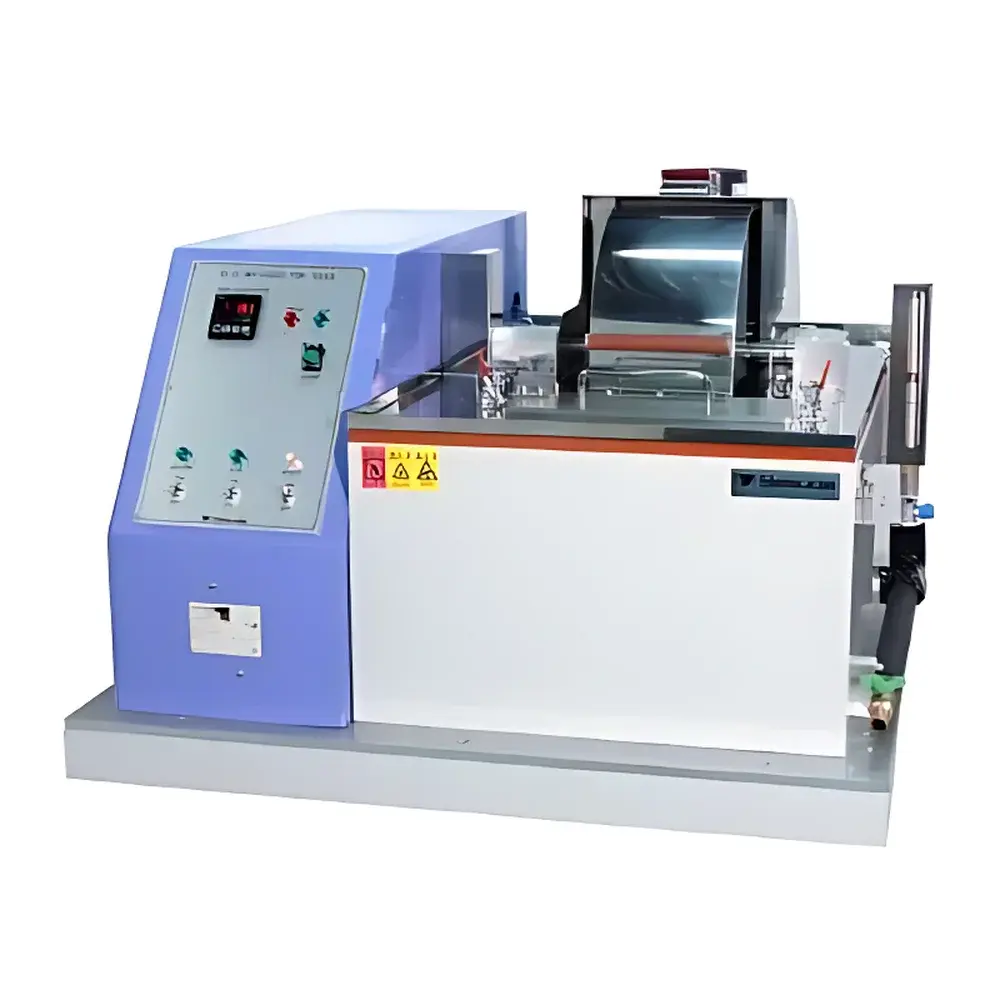
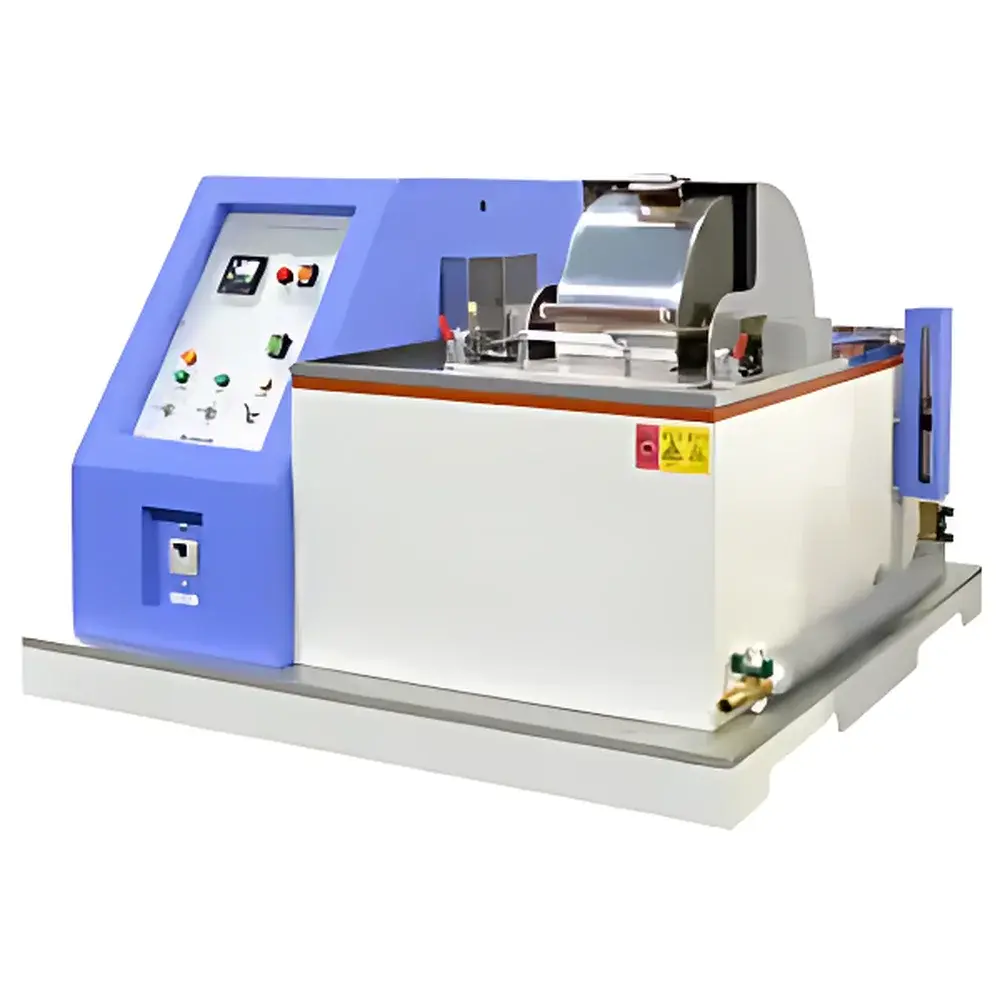
Yasuda No.121 Brittle Temperature Tester for Plastics and Elastomers
| Brand | Yasuda |
|---|---|
| Origin | Japan |
| Model | No.121 |
| Low-Temperature Range | −80 °C |
| Compliance Standards | JIS C3005, JIS K6261, JIS K6723, JIS K7216, ASTM D746, ISO 812, ISO 974 |
| Specimen Dimensions (Type A) | 38 ± 2 mm (L) × 6.0 ± 0.4 mm (W) × 2.0 ± 0.2 mm (T) |
| Impact Blade Radius | R1.6 ± 0.1 mm |
| Blade Spacing | 6.4 ± 0.2 mm |
| Distance from Clamp to Impact Point | 8.0 ± 0.2 mm |
| Impact Velocity | 2.0 ± 0.2 m/s |
| Heat Transfer Medium Volume | ~15 L |
| Power Supply | AC 100 V, 15 A, 50/60 Hz |
| Dimensions (W×D×H) | 770 × 830 × 550 mm |
| Weight | ~155 kg |
| Standard Fixture Capacity | 5 specimens per holder (single cantilever support) |
| Optional Accessories | Helical specimen holder (5 positions × 4 holders), Type B specimen holder, specimen punch die, torque screwdriver, tightening assist rod |
Overview
The Yasuda No.121 Brittle Temperature Tester is a precision-engineered instrument designed to determine the brittle temperature of polymeric materials—including thermoplastics, thermosets, elastomers, and insulated wires—under controlled low-temperature conditions. It operates on the principle of standardized impact-induced bending fracture, in accordance with internationally recognized test methods such as ASTM D746 (Standard Test Method for脆化温度 of Plastics and Elastomers by Impact), ISO 812 (Rubber—Determination of Low-Temperature Brittleness), ISO 974 (Plastics—Determination of Brittle Temperature), and multiple JIS standards (C3005, K6261, K6723, K7216). The device subjects a cantilevered specimen to a calibrated impact at progressively decreasing temperatures until 50% of tested samples exhibit visible fracture or cracking upon bending. This endpoint defines the Brittle Temperature (BT) or the Brittle Transition Temperature (BTT), a critical parameter for material selection in low-temperature service environments—including aerospace wiring harnesses, automotive seals, cryogenic gaskets, and medical tubing.
Key Features
- Stable, reproducible low-temperature operation down to −80 °C, achieved via dual cooling options: dry ice–based bath (with heat transfer medium) or integrated mechanical refrigeration unit (optional configuration).
- Cantilevered specimen mounting system compliant with Type A geometry per ASTM D746 and ISO 812—ensuring uniform stress distribution during impact.
- Precision-machined impact assembly featuring a hardened steel blade with radius R1.6 ± 0.1 mm, fixed spacing of 6.4 ± 0.2 mm between blades, and strict positional control of impact point relative to clamp (8.0 ± 0.2 mm).
- Controlled impact velocity of 2.0 ± 0.2 m/s, maintained through gravity-driven pendulum mechanics with verified kinetic energy delivery.
- Robust stainless-steel thermal bath chamber (15 L capacity) with optimized fluid circulation and temperature uniformity across specimen zone (±1.0 °C tolerance per ASTM calibration requirements).
- Modular fixture design supporting up to five specimens per test cycle; optional helical multi-holder (5 × 4) enables high-throughput screening of compound variants or aging batches.
- Comprehensive accessory set including torque-calibrated screwdriver, tightening assist rod, and precision punch die for consistent specimen preparation per dimensional tolerances (38 ± 2 mm × 6.0 ± 0.4 mm × 2.0 ± 0.2 mm).
Sample Compatibility & Compliance
The No.121 accommodates rigid and semi-crystalline plastics (e.g., PVC, ABS, PC, POM), vulcanized rubbers (NR, SBR, EPDM), thermoplastic elastomers (TPEs), and insulated electrical wires per JIS C3005. Specimen preparation strictly follows dimensional and surface finish requirements defined in each referenced standard to ensure interlaboratory comparability. All mechanical and thermal subsystems are traceably aligned to ISO/IEC 17025–compliant validation protocols. The instrument supports full audit trails for temperature setpoints, impact timing, and operator entries when integrated with validated laboratory information management systems (LIMS). It is routinely employed in GLP-regulated environments for polymer qualification under IEC 60811-1-4 and UL 758 wire testing protocols.
Software & Data Management
While the base No.121 operates via manual temperature staging and visual fracture assessment, it is fully compatible with third-party digital data acquisition modules (e.g., National Instruments DAQ systems) for automated logging of bath temperature, impact event timestamp, and pass/fail classification per specimen. Optional firmware upgrades enable CSV export of test logs—including ambient lab temperature, bath setpoint history, specimen ID, and operator code—for integration into 21 CFR Part 11–compliant electronic records. Calibration certificates for impact velocity, blade geometry, and thermal sensor accuracy are provided with NIST-traceable documentation upon installation.
Applications
- Determination of brittle point for quality control of polymer compounds prior to extrusion or molding.
- Evaluation of low-temperature performance degradation in rubber seals used in automotive powertrain systems.
- Validation of cold-flexibility compliance for UL-listed communication cables operating in arctic climates.
- Comparative study of plasticizer efficiency in PVC formulations across seasonal temperature ranges.
- Supporting ASTM F2476 (Standard Guide for Evaluating Low-Temperature Performance of Medical Polymers) in preclinical device development.
- Material screening for space-grade polymers subjected to thermal cycling between −70 °C and +85 °C.
FAQ
What standards does the Yasuda No.121 explicitly support?
It is mechanically and geometrically aligned with ASTM D746, ISO 812, ISO 974, JIS K6261, JIS K6723, JIS K7216, and JIS C3005. Full conformance requires adherence to specimen conditioning, thermal soak time, and pass/fail criteria defined in each standard.
Can the instrument operate continuously at −80 °C?
Yes—when equipped with the mechanical refrigeration option. Dry ice operation achieves −70 °C stably; extended dwell times below −70 °C require refrigerated system integration and periodic maintenance per Yasuda’s service schedule.
Is operator training included with purchase?
Yasuda-certified field engineers provide on-site installation verification, mechanical calibration, and hands-on procedural training covering specimen mounting, thermal stabilization, impact execution, and fracture evaluation per ASTM visual assessment guidelines.
How is temperature uniformity verified within the bath?
Uniformity is validated using three calibrated PT100 probes placed at top/mid/bottom positions during IQ/OQ protocols. Deviation must remain ≤ ±1.0 °C across the specimen zone at any stable setpoint between −20 °C and −80 °C.
Are replacement parts and calibration services available outside Japan?
Yes—authorized service partners in North America, Europe, and APAC maintain stocked consumables (blades, clamps, seals) and offer biannual calibration packages traceable to national metrology institutes (NMI) in respective regions.



