
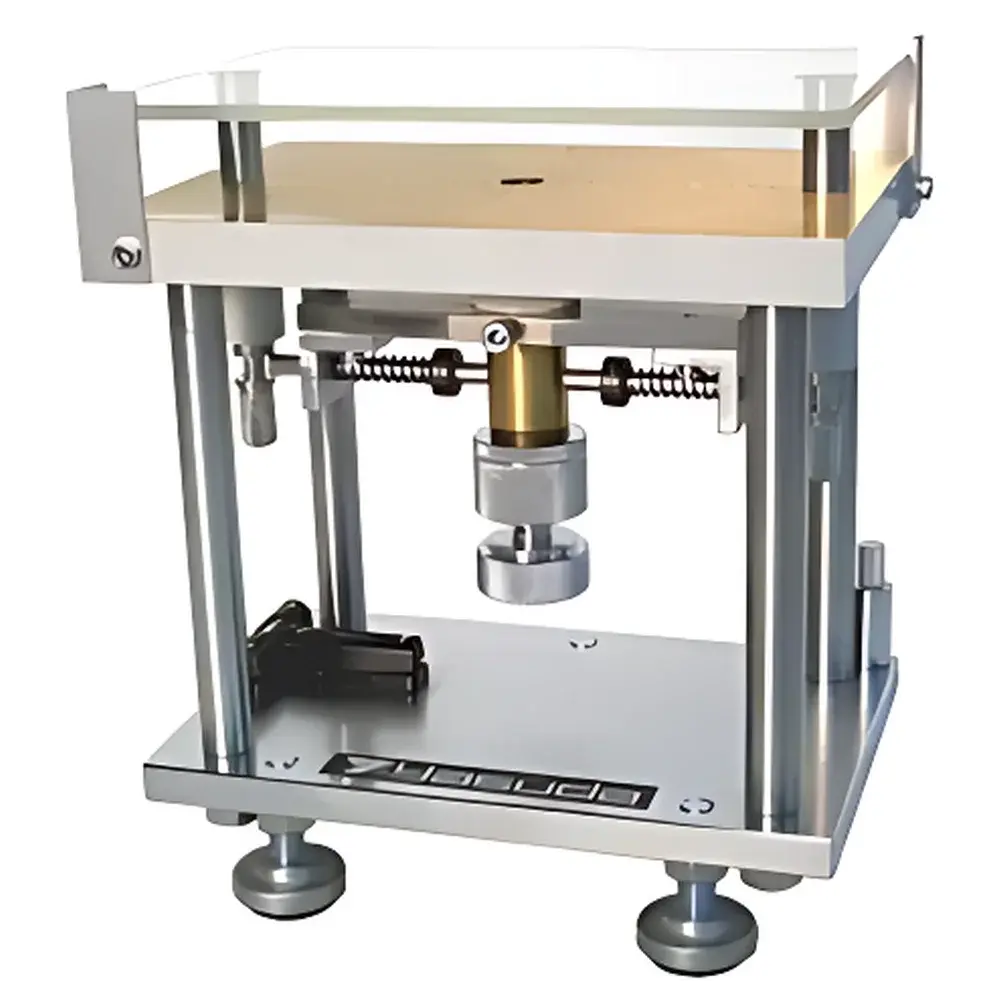
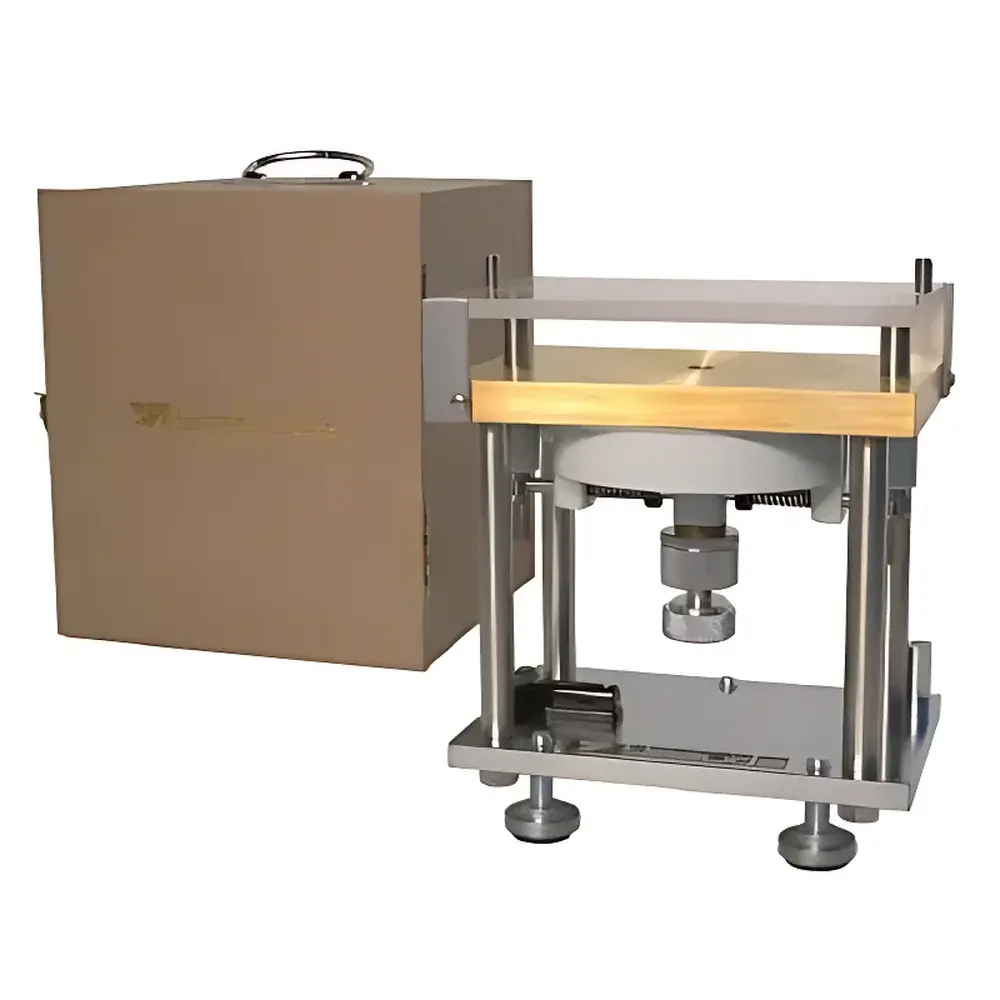
Yasuda No.506 Parallel-Plate Spread Meter
| Brand | Yasuda |
|---|---|
| Origin | Japan |
| Model | No.506 |
| Compliance | JIS K 5101, JIS K 5701-1 |
| Measurement Principle | Gravitational Radial Flow under Fixed Normal Load |
| Test Duration | 60 s |
| Output | Spread Diameter (mm) |
| Geometry | Rigid Parallel Plate Assembly with Standardized Upper Load Plate |
| Sample Volume | 0.1 mL (typical) |
Overview
The Yasuda No.506 Parallel-Plate Spread Meter is a precision mechanical instrument engineered for the standardized assessment of spreadability and low-shear rheological behavior of highly structured, non-Newtonian pastes and semi-solid formulations—including printing inks, pigment dispersions, lithographic varnishes, and thickened coatings. Unlike rotational viscometers or capillary systems, the No.506 operates on the principle of controlled gravitational radial flow: a fixed volume of sample is placed between two horizontally aligned, polished stainless-steel parallel plates; the upper plate—of defined mass and diameter—is released to rest solely under its own weight. Over a precisely timed interval of 60 seconds, the material deforms radially outward in a concentric circular pattern. The resulting spread diameter (in millimeters), measured at the end of the interval, serves as a reproducible empirical index correlated to yield stress, structural breakdown resistance, and interparticle interaction strength. This method aligns with fundamental principles of lubricated squeeze-flow rheology under negligible inertia and constant normal force—a regime well-documented in polymer processing and colloid science literature.
Key Features
- Compliant with Japanese Industrial Standards JIS K 5101 (for pigments) and JIS K 5701-1 (for printing inks), ensuring traceable, inter-laboratory comparable results in quality control environments.
- Fixed-geometry parallel-plate configuration with precision-ground, corrosion-resistant stainless-steel surfaces (Ra ≤ 0.2 µm) to minimize edge effects and ensure uniform contact pressure distribution.
- Standardized load plate (diameter: 30 mm, mass: 100 g ± 0.5 g) manufactured to JIS-certified tolerances, eliminating operator-dependent loading variability.
- Integrated timing mechanism with ±0.2 s accuracy over 60 s, synchronized with plate release via manual lever actuation—designed for repeatable start conditions across operators.
- Calibration-free operation: no transducers, electronics, or software required—relying instead on dimensional metrology and gravitational constants, minimizing drift and maintenance overhead.
- Compact benchtop footprint (W × D × H: 180 × 150 × 220 mm) with anti-vibration rubber feet, suitable for QC labs, ink formulation rooms, and regulatory testing suites without dedicated environmental controls.
Sample Compatibility & Compliance
The No.506 is optimized for materials exhibiting pronounced yield stress and time-dependent structural recovery—particularly solvent-based and UV-curable lithographic inks, organic pigment pastes, high-solids architectural coatings, and conductive screen-printing pastes. It excludes low-viscosity liquids (10 µm that may compromise plate surface integrity. All test procedures conform to documented JIS standard operating protocols, supporting audit readiness under ISO/IEC 17025-accredited laboratories. While not inherently GLP-compliant due to manual operation, full procedural documentation—including operator ID, ambient temperature/humidity logs, and raw diameter measurements—enables retrospective validation per FDA 21 CFR Part 11 data integrity guidelines when paired with controlled lab notebooks.
Software & Data Management
The Yasuda No.506 is a fully analog, hardware-only instrument with no embedded firmware, display, or digital interface. Data acquisition relies on direct visual measurement using calibrated scale rulers or digital calipers (recommended: ±0.05 mm resolution). For digital recordkeeping, users commonly integrate spreadsheets or LIMS platforms (e.g., LabWare, Thermo Fisher SampleManager) to log spread diameters alongside batch IDs, environmental conditions, and analyst signatures. Optional accessories include a backlit acrylic measurement stage with concentric reference rings (10–60 mm, 1 mm increments) to accelerate diameter reading and reduce parallax error. No proprietary software is supplied or required.
Applications
- Batch-to-batch consistency verification of offset and gravure inks in OEM manufacturing and contract printing facilities.
- Formulation screening during R&D of thixotropic pigment dispersions—correlating spread diameter trends with dispersant type, concentration, and milling time.
- Stability assessment of aging ink stocks: increasing spread diameter over storage duration indicates structural degradation or solvent evaporation.
- Supplier qualification testing per JIS-specified acceptance criteria (e.g., “spread diameter ≥ 42 mm ± 2 mm at 23 °C/50% RH”).
- Educational demonstration of yield-stress fluid behavior in polymer engineering and colloid science curricula.
FAQ
Is the No.506 suitable for measuring viscosity in centipoise (cP) or pascal-seconds (Pa·s)?
No. The instrument reports spread diameter (mm) after 60 s—not dynamic or kinematic viscosity. Empirical correlations to apparent viscosity exist only within narrow material classes and require independent calibration using rotational rheometry.
Can temperature control be added to the No.506?
Not natively. The base unit lacks thermal regulation. Users seeking temperature-dependent spread data must pre-condition samples and plates in environmental chambers prior to testing, documenting actual surface temperature at time of measurement.
What maintenance is required?
Daily cleaning of both plates with lint-free wipes and appropriate solvents (e.g., isopropanol for ink residues); periodic verification of load plate mass using Class M2 weights; annual inspection of plate flatness by certified metrology service.
Does Yasuda provide calibration certificates?
Yasuda supplies factory-verified dimensional and mass certification for each unit upon shipment. Traceable recalibration services are available through authorized Japanese metrology partners (e.g., JCSS-accredited labs), though not included with standard delivery.
How does the No.506 compare to the ICI Cone and Plate Viscometer?
The ICI measures steady-state shear viscosity at defined shear rates; the No.506 evaluates transient squeeze-flow response under constant normal stress. They address complementary material behaviors—yield initiation vs. flow curve development—and are not interchangeable per JIS or ASTM standards.
Related Products



