
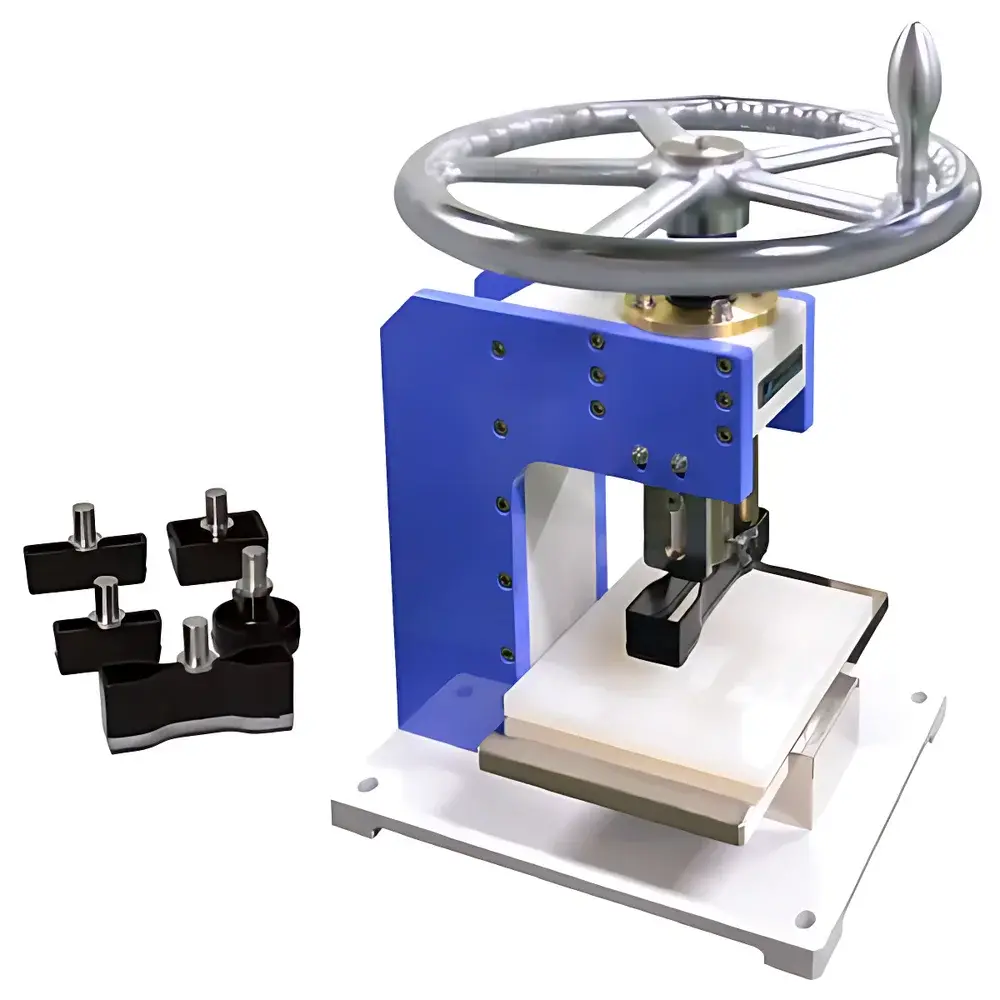
Yasuda No.115 Schobert-Type Specimen Cutting Machine
| Brand | Yasuda |
|---|---|
| Origin | Japan |
| Model | No.115 |
| Cutting Die Types | Dumbbell-shaped, Annular, and Angular |
| Handle Diameter | φ400 mm |
| Die Mounting Spigot Bore | φ16 mm |
| Stroke per Revolution | 8 mm |
| Dimensions (W×D×H) | 400 × 420 × 500 mm |
| Weight | ~71 kg |
Overview
The Yasuda No.115 Schobert-Type Specimen Cutting Machine is a precision manual die-cutting instrument engineered for standardized sample preparation in rubber and thermoplastic elastomer testing laboratories. Based on the classical Schobert principle—where rotational torque applied to a large-diameter handle drives a cam-follower mechanism to deliver controlled, repeatable linear stroke—the machine ensures consistent specimen geometry critical for mechanical property evaluation per ASTM D412, ISO 37, ISO 527, and GB/T 528. Unlike hydraulic or pneumatic cutters, the No.115 relies on purely mechanical force transmission, eliminating dependency on external power sources or compressed air systems while maintaining high reproducibility across operator shifts. Its robust cast-iron frame and hardened steel guide rails provide long-term dimensional stability, essential for maintaining alignment between die cavity and anvil surface over thousands of cutting cycles.
Key Features
- Manual cam-driven actuation with φ400 mm ergonomic handle—optimized for uniform force application and reduced operator fatigue during high-volume sample preparation.
- Dedicated die-mounting spigot (φ16 mm bore) compatible with standardized Schobert-format dies—including dumbbell types (e.g., Type I, II, IV per ASTM D412), annular rings for compression set testing, and angular blanks for tear resistance assays.
- Precise 8 mm linear stroke per full handle revolution—enabling deterministic control over cutting depth and minimizing shear-induced edge deformation in soft elastomers and low-modulus TPEs.
- Stable base platform with integrated PP backing plate (supplied) to protect die edges and prevent substrate rebound during cutting—critical for maintaining sharp, burr-free specimen profiles.
- Compact footprint (400 × 420 × 500 mm) and self-contained design—ideal for placement within fume hoods, QC benches, or ISO 17025-accredited testing environments where space and electrical safety are constrained.
Sample Compatibility & Compliance
The No.115 accommodates specimens up to 4 mm thick, including vulcanized rubber sheets, silicone elastomers, thermoplastic polyurethanes (TPU), ethylene propylene diene monomer (EPDM), nitrile butadiene rubber (NBR), and soft PVC compounds. It is not intended for rigid thermoplastics (e.g., ABS, PC) or fiber-reinforced composites. All cutting operations comply with the mechanical sample preparation requirements outlined in ISO/IEC 17025:2017 Clause 7.2.2 (Method Validation) and support traceability under GLP-regulated workflows when paired with calibrated die sets and documented SOPs. The absence of motorized components simplifies validation protocols and eliminates electromagnetic interference concerns in metrology-sensitive labs.
Software & Data Management
As a fully mechanical, non-electronic instrument, the Yasuda No.115 does not incorporate embedded firmware, connectivity interfaces, or digital data logging capabilities. This architecture aligns with laboratories operating under strict FDA 21 CFR Part 11 Annex 11 or EU GMP Annex 11 requirements where “no software” constitutes a validated state—eliminating the need for electronic record validation, audit trail configuration, or periodic cybersecurity assessments. Sample preparation records (e.g., die type, material lot, operator ID, date/time) are maintained externally via paper-based logbooks or LIMS-integrated forms, ensuring full compliance with ALCOA+ data integrity principles without introducing software-related complexity.
Applications
- Preparation of tensile test specimens for stress–strain curve derivation in R&D and incoming raw material verification.
- Cutting of ring-shaped samples for compression set (ASTM D395) and resilience (ISO 4662) measurements.
- Generation of standardized tear test blanks (e.g., Trouser Tear, Angle Tear per ASTM D624) from sheet stock.
- Production of geometrically defined samples for hardness indentation correlation studies (Shore A/D vs. modulus).
- Supporting interlaboratory comparison exercises under ISO 5725 by ensuring identical specimen geometry across participating sites.
FAQ
Is the No.115 suitable for cutting foam or sponge rubber?
Yes—provided the material density exceeds 0.25 g/cm³ and exhibits minimal recovery during dwell time; use of chilled PP backing plates is recommended for high-compliance foams.
Can custom die geometries be mounted on the No.115?
Only if they conform to JIS K 6251 / ISO 37 mounting specifications and feature a φ16 mm central spigot with flat-bottomed cavity design; Yasuda does not supply or certify third-party dies.
What maintenance is required to ensure long-term accuracy?
Monthly inspection of cam surface wear, biannual lubrication of guide rails with ISO VG 68 mineral oil, and annual verification of stroke repeatability using certified gauge blocks.
Does the machine meet CE or UKCA marking requirements?
As a manually operated, non-powered device exempt under Machinery Directive 2006/42/EC Annex I Section 1.2.3, it carries no CE marking—but full technical documentation is available upon request for internal conformity assessment.
Is calibration certification provided with shipment?
No formal calibration certificate is issued; however, a factory verification report confirming stroke linearity (±0.1 mm tolerance) and handle torque consistency (±3 N·m at 200 N load) is included with each unit.





