
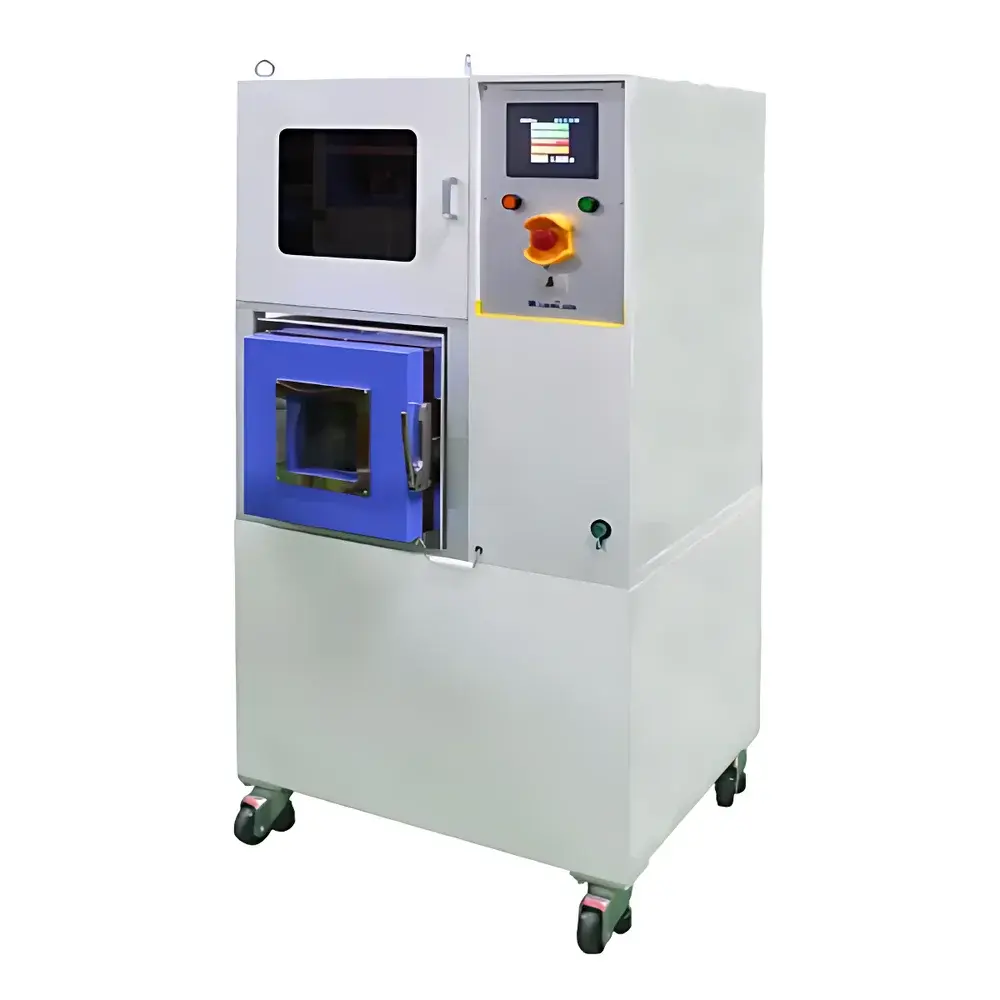
Yasuda No.283 Plastic Sliding Abrasion Tester
| Brand | Yasuda |
|---|---|
| Origin | Japan |
| Model | No.283 |
| Instrument Type | End-Face Tribological Tester |
| Test Standard | JIS K 7218 |
| Specimen Geometry | Flat plate (30 × 30 × 2–5 mm), Disc (φ40 × 2–5 mm), Hollow Cylinder (OD φ25.6 mm, ID φ20 mm, L 15 mm) |
| Applied Load Range | 50–500 N (1 N resolution, servo motor + ball screw actuation) |
| Max Operating Temperature | 130 °C |
| Friction Torque Measurement | Up to 200 N·cm (load cell-based) |
| Displacement Range | 32 mm (0.01 mm resolution) |
| Sliding Speed | 0.2–200 cm/s (JIS A-spec: 50 ± 2.5 cm/s) |
| Optional Rotational Speed | 10–1,500 rpm |
| Environmental Options | Oil bath, water bath |
| Power Supply | AC 100 V, 1φ, 15 A, 50/60 Hz |
| Dimensions (W×D×H) | ≈ 810 × 900 × 1560 mm |
| Weight | ≈ 267 kg |
Overview
The Yasuda No.283 Plastic Sliding Abrasion Tester is a precision-engineered end-face tribological testing system designed specifically for evaluating the sliding wear resistance and frictional behavior of polymeric materials under controlled mechanical and thermal conditions. It operates on the principle of reciprocating or rotational sliding contact between a standardized test specimen and a counterface—typically a hollow cylindrical mating partner—under precisely regulated normal load, sliding velocity, and environmental temperature. The instrument complies with JIS K 7218, the Japanese Industrial Standard for determination of abrasion resistance of plastics using a sliding wear method. Its architecture integrates high-stiffness mechanical framing, closed-loop servo-controlled loading, and real-time torque and displacement sensing to ensure measurement repeatability and traceability required in R&D laboratories, quality control departments, and regulatory-compliant material certification workflows.
Key Features
- End-face configuration optimized for standardized plastic wear evaluation per JIS K 7218, enabling direct correlation with industry benchmark data.
- Servo-motor-driven ball screw loading system delivering stable, programmable normal forces from 50 N to 500 N with 1 N resolution and minimal hysteresis.
- High-fidelity friction torque measurement via calibrated load cell, capable of resolving up to 200 N·cm with thermal drift compensation.
- Displacement monitoring over 32 mm travel range with 0.01 mm digital resolution, supporting both wear depth quantification and motion profile analysis.
- Thermal operation up to 130 °C, compatible with optional oil or water thermostatic baths for simulating service-relevant thermal environments.
- Modular speed control enabling sliding velocities from 0.2 cm/s to 200 cm/s; JIS A-spec condition (50 ± 2.5 cm/s) is factory-calibrated and repeatable.
- Rigid cast-iron base and vibration-damped structural design ensuring long-term stability during extended wear cycles.
Sample Compatibility & Compliance
The No.283 accommodates three standard specimen geometries: flat plates (30 × 30 × 2–5 mm), discs (φ40 × 2–5 mm), and hollow cylinders (OD φ25.6 mm, ID φ20 mm, L 15 mm), all aligned with JIS K 7218 dimensional tolerances. Counterface geometry matches specimen type to maintain consistent contact area and pressure distribution. The system supports compliance documentation for ISO/IEC 17025-accredited testing labs, and its deterministic loading and signal acquisition architecture meets foundational requirements for GLP-aligned wear studies. While not intrinsically FDA 21 CFR Part 11 compliant, raw data export formats (CSV, ASCII) and audit-ready log files facilitate integration into validated laboratory information management systems (LIMS).
Software & Data Management
Data acquisition is performed via embedded analog-to-digital conversion synchronized with motion control signals. Real-time outputs include normal load, friction torque, displacement, elapsed time, and optional temperature feedback. All parameters are timestamped at ≥100 Hz sampling rate and stored in structured binary logs convertible to open-format CSV for post-processing in MATLAB, Python (NumPy/Pandas), or Excel. The system does not include proprietary GUI software; instead, it provides documented RS-232/RS-485 and analog voltage output interfaces for integration with third-party SCADA or custom LabVIEW-based control environments. Calibration certificates for load cell and displacement sensor are supplied with each unit, traceable to JCSS (Japan Calibration Service System).
Applications
- Quantitative ranking of polymer formulations (e.g., POM, PA66, PTFE composites) for automotive interior trim, bearing surfaces, and gear applications.
- Screening of lubricant additives and filler effects (e.g., MoS₂, graphite, glass fiber) on sliding wear coefficient and mass loss rate.
- Accelerated aging studies correlating wear volume with thermal exposure history under controlled ambient or bath-immersed conditions.
- Validation of surface treatments (plasma, fluorination) against baseline untreated specimens using identical test protocols.
- Supporting ASTM D3702 and ISO 7148-1 comparative analyses when adapted with appropriate fixtures and reporting templates.
FAQ
What standards does the Yasuda No.283 explicitly support?
It is engineered and calibrated to meet JIS K 7218 for plastic sliding abrasion testing. With appropriate fixture adaptation and protocol validation, it may also support elements of ASTM D3702 (thrust washer wear) and ISO 7148-1 (tribological testing of polymers).
Can the system operate continuously for multi-hour wear tests?
Yes—the mechanical architecture and thermal management allow unattended operation for up to 72 hours at rated load and temperature, provided ambient cooling and fluid circulation (if using bath options) remain within specification.
Is the displacement sensor linear variable differential transformer (LVDT)-based or optical?
The displacement transducer is a high-linearity, contact-type potentiometric sensor with integrated temperature compensation, selected for robustness in industrial lab environments where particulate generation is common.
Does the system include wear volume calculation algorithms?
No built-in calculation engine is provided; however, wear volume is derived from measured displacement and known contact geometry using standard equations defined in JIS K 7218 Annex B, and can be automated via external scripting.
Are calibration services available outside Japan?
Yasuda-certified calibration partners exist in North America, Germany, and Singapore; full recalibration—including load cell, torque sensor, and displacement transducer—is recommended annually or after 500 operational hours.



