
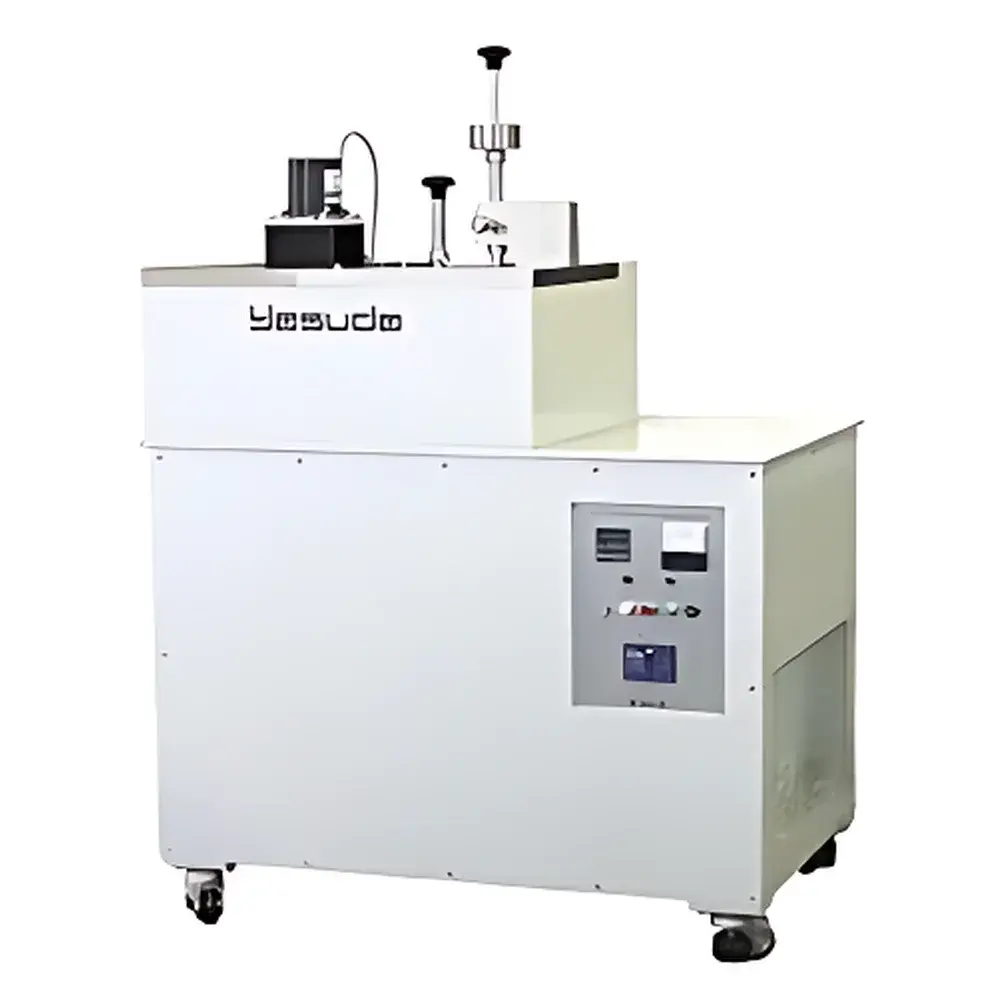
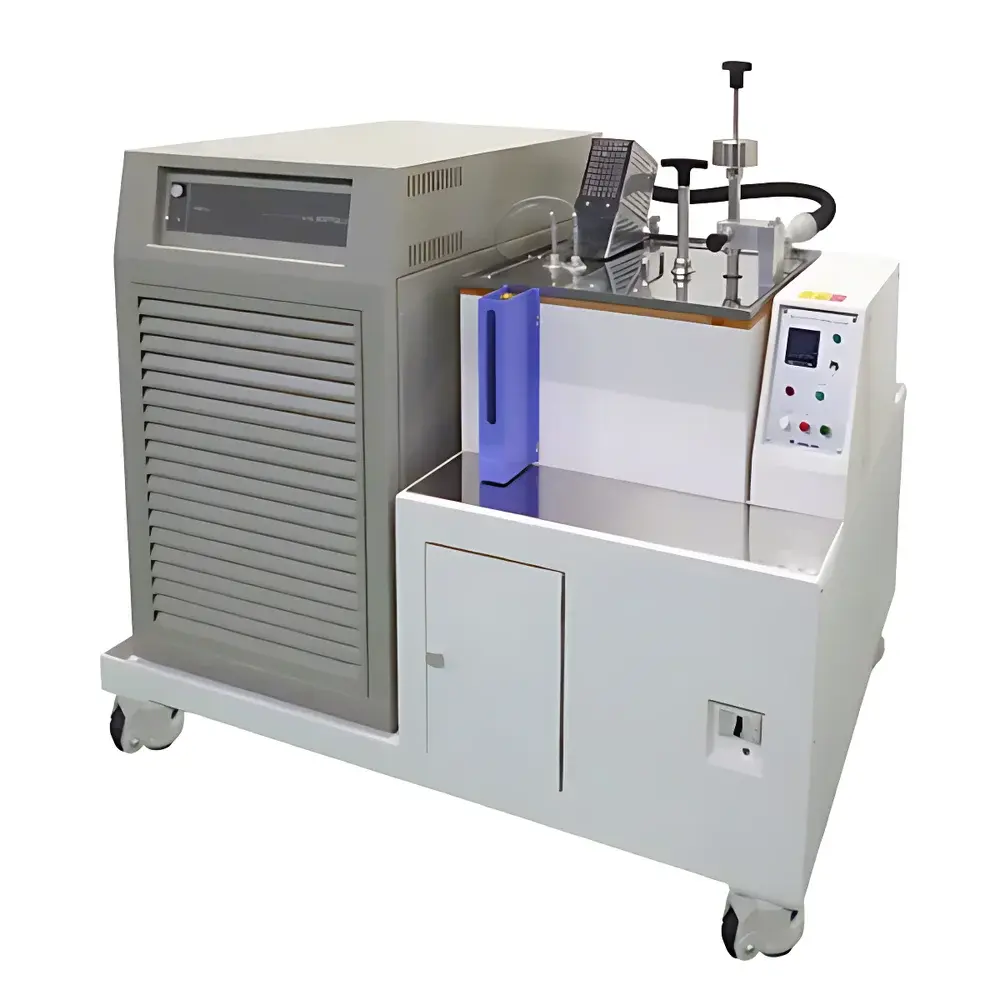
Yasuda No.201-R Cold Proof Tester for Vinyl Leather Cloth (with Integrated Refrigeration Unit)
| Brand | Yasuda |
|---|---|
| Origin | Japan |
| Model | No.201-R |
| Cooling Method | Integrated Mechanical Refrigeration System |
| Test Temperature Range | Up to –40 °C (with heat transfer medium) |
| Heat Transfer Medium Volume | ~16 L |
| Specimen Dimensions | 20 mm width × 100 mm length (folded), 20 mm spacing, 5 mm depth |
| Anvil Quantity | 6 stations |
| Impact Mass | 2.5 kg |
| Drop Height | 50 mm |
| Test Duration | 5 min pre-cooling before impact |
| Compliance Standards | JIS K6404-13, JIS K6772, ISO 4675 |
| Power Supply | AC 200 V, 3-phase, 20 A, 50/60 Hz |
| Dimensions (W×D×H) | ~1250 × 650 × 1100 mm |
| Weight | ~295 kg |
Overview
The Yasuda No.201-R Cold Proof Tester is a precision-engineered apparatus designed for evaluating low-temperature embrittlement resistance of flexible sheet materials—including synthetic leather (vinyl-coated fabrics), plastic films, rubberized textiles, and elastomeric laminates. It operates on the standardized impact-folding principle defined in JIS K6404-13, JIS K6772, and ISO 4675:1998. In this method, conditioned specimens are clamped onto chilled anvil surfaces within a thermally stabilized cold chamber, held at target temperature for precisely 5 minutes to ensure thermal equilibrium, then subjected to a controlled mechanical impact via a 2.5 kg falling mass dropped from 50 mm. Post-impact visual inspection determines crack initiation—serving as a pass/fail metric for cold-flex durability. Unlike dry-ice-based alternatives, the No.201-R integrates a dedicated refrigeration unit enabling stable, repeatable operation down to –40 °C using a circulating heat transfer medium (~16 L volume), eliminating dependency on consumable cryogens and supporting extended testing cycles under GLP-compliant laboratory conditions.
Key Features
- Integrated mechanical refrigeration system with digital temperature controller, ensuring ±1.0 °C stability across the full operational range (–40 °C to ambient)
- Six independent anvil stations mounted on a thermally uniform cold plate, each accommodating folded specimens (20 mm × 100 mm) with standardized 20 mm lateral spacing and 5 mm indentation depth
- Calibrated impact mechanism featuring gravity-driven drop of a 2.5 kg mass from fixed 50 mm height—designed per ASTM D1790 and ISO 4675 mechanical requirements
- Robust stainless-steel cold chamber housing with insulated double-wall construction and transparent acrylic viewing window for real-time observation without thermal disturbance
- Electrical safety compliance: IP54-rated enclosure, grounded 3-phase 200 V supply interface, and thermal overload protection on compressor and control circuits
- Modular design facilitates maintenance access to refrigeration components, heat exchanger, and specimen loading zone without system disassembly
Sample Compatibility & Compliance
The No.201-R accommodates flat, flexible substrates up to 2 mm thickness, including PVC- and PU-coated textiles, nitrile rubber sheets, TPU laminates, and thermoplastic elastomer films. Specimen preparation follows strict dimensional tolerances per JIS K6404-13: width 20.0 ± 0.2 mm, folded length 100.0 ± 0.5 mm, and edge alignment verified prior to clamping. The system supports full traceability for quality assurance workflows—temperature logging (via optional Pt100 probe with 0.1 °C resolution), impact timing verification, and operator ID entry align with FDA 21 CFR Part 11 data integrity expectations when paired with validated third-party LIMS integration. Routine calibration adheres to JIS Z 8401 guidelines for measurement uncertainty management.
Software & Data Management
While the base No.201-R operates via analog/digital front-panel controls, optional RS-485 or Ethernet interfaces enable connection to laboratory data acquisition systems. Temperature profiles, dwell time verification, and pass/fail annotations can be exported in CSV or XML format for audit-ready reporting. When deployed in regulated environments (e.g., automotive interior material qualification per ISO 17025-accredited labs), users may implement electronic signatures and change-controlled test method templates consistent with GMP Annex 11 and ISO/IEC 17025:2017 clause 7.7. All firmware updates undergo version-controlled release validation, with revision history archived per internal QA SOP-INST-023.
Applications
- Automotive interior suppliers verifying cold-crack resistance of door panel trim, seat upholstery, and dashboard coverings per OEM specifications (e.g., GMW14872, Ford WSS-M99P1111-A)
- Footwear manufacturers assessing winter-grade synthetic leathers used in boots and outdoor apparel
- Packaging R&D labs screening low-temperature seal integrity of laminated pouches and medical device barrier films
- Academic polymer research groups studying structure–property relationships in plasticized PVC formulations under thermal stress
- Third-party testing laboratories performing accredited conformance testing to JIS, ISO, and ASTM cold-flex standards
FAQ
What refrigerant is used in the integrated cooling unit?
R-404A or R-507A (ODP = 0, selected per current Japanese industrial refrigeration regulations), charged and sealed at factory; service requires certified refrigeration technician.
Can the No.201-R operate continuously at –40 °C?
Yes—rated for uninterrupted operation up to 8 hours at –40 °C with adequate ventilation (min. 1 m² free airflow area around rear condenser grille).
Is calibration certification included with shipment?
A factory-issued calibration report (traceable to NMIJ/AIST) covering temperature uniformity, drop height, and mass verification is provided; annual recalibration is recommended per JIS Z 8401.
Does the system meet CE or UKCA marking requirements?
The unit complies with IEC 61000-6-2 (immunity) and IEC 61000-6-4 (emissions); CE marking is available upon request with EU Representative designation and DoC submission.
How is specimen alignment verified prior to testing?
Each anvil includes engraved centerline markers and adjustable stop blocks; optional digital caliper jig (YAS-CLIP-201) ensures ±0.1 mm fold symmetry verification pre-clamp.



