
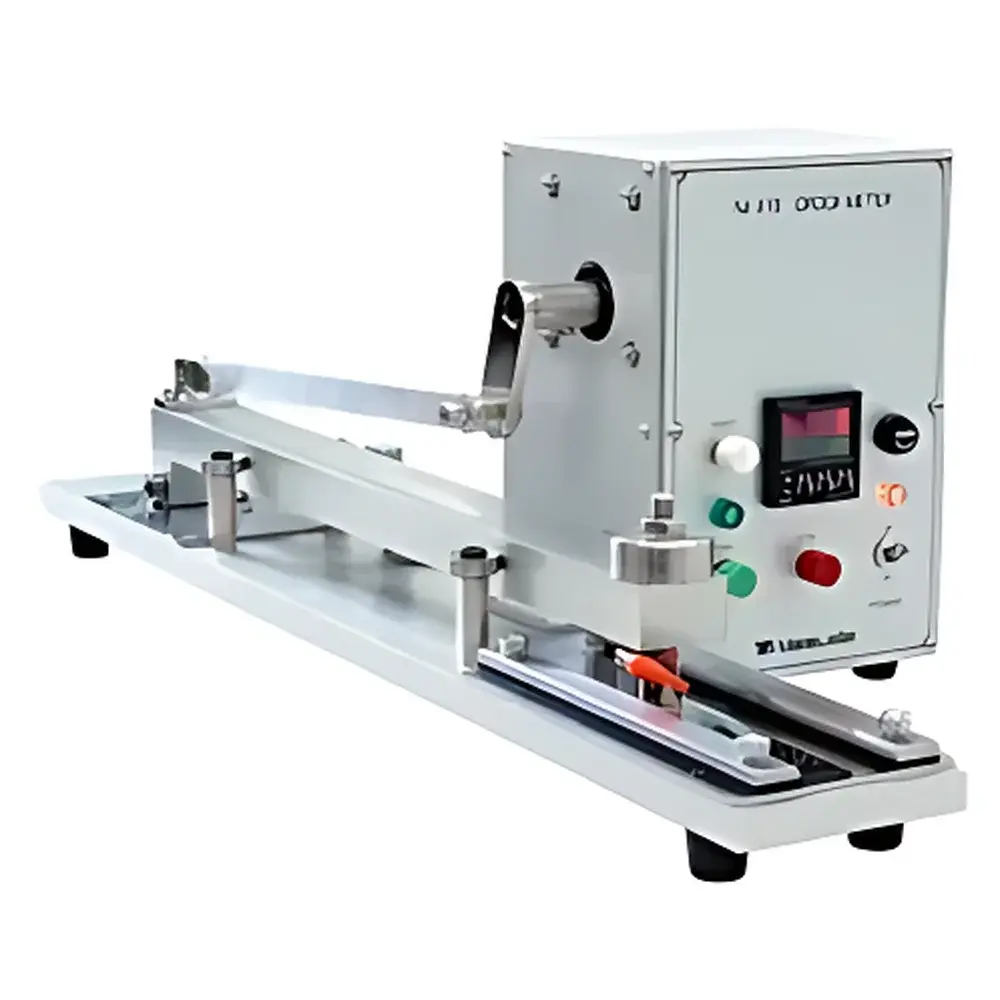
Yasuda No.416 Crock Meter for Color Fastness to Rubbing
| Brand | Yasuda |
|---|---|
| Origin | Japan |
| Model | No.416 |
| Test Standard Compliance | JIS L0849, JIS L0862, JIS K6404-16, JIS K6547, ISO 105-X12 |
| Specimen Size | 140 × 50 mm |
| Cotton Cloth Size | 50 × 50 mm |
| Applied Load | 8.83 N (900 gf) |
| Friction Element Diameter | φ16 ± 1 mm |
| Stroke Length | 100 mm |
| Cycle Rate | 60 cycles/min |
| Counter | 6-digit presettable digital counter |
| Optional Accessories | Light-load kit, safety guard |
| Power Supply | AC 100 V, single-phase, 3 A, 50/60 Hz |
| Dimensions (W×D×H) | Approx. 260 × 640 × 260 mm |
| Weight | Approx. 16 kg |
Overview
The Yasuda No.416 Crock Meter is a precision-engineered instrument designed to evaluate color fastness to dry and wet rubbing in accordance with internationally recognized textile testing standards—including JIS L0849 (dry/wet crocking), JIS L0862 (edge crocking), JIS K6404-16 (leather), JIS K6547 (rubber/plastic sheeting), and ISO 105-X12. It operates on the principle of controlled linear reciprocating motion, where a standardized white cotton cloth is brought into repeated contact with a flat specimen under a precisely regulated normal force. The degree of color transfer onto the cotton cloth is subsequently assessed visually using the Grey Scale for Staining (ISO 105-A03 or JIS L0801), enabling quantitative classification of rubbing resistance from Grade 1 (poor) to Grade 5 (excellent). This method is fundamental to quality assurance in textile dyeing, finishing, printing, leather tanning, and synthetic material manufacturing—where surface pigment adhesion directly impacts end-product durability, regulatory compliance, and consumer safety.
Key Features
- High-reproducibility mechanical drive system delivering consistent 60 cycles per minute at a fixed stroke length of 100 mm, minimizing operator-induced variability.
- Calibrated load application of 8.83 N (900 gf) via gravity-based weight mechanism—traceable to national metrological standards and compliant with JIS/ISO test protocol requirements.
- Precision-machined friction head with φ16 ± 1 mm stainless-steel plunger, ensuring uniform pressure distribution across the full 50 × 50 mm cotton cloth contact area.
- Six-digit digital preset counter with audible and visual cycle completion indication—supports unattended operation and repeatable test sequencing.
- Modular design accommodating optional light-load configurations (e.g., 2.94 N or 4.90 N) for delicate substrates such as coated synthetics or metallic-finished fabrics.
- Integrated safety guard conforming to IEC 61000-6-2 electromagnetic compatibility and basic mechanical safeguarding principles—reduces risk during routine QC laboratory use.
Sample Compatibility & Compliance
The No.416 accommodates flat, rigid, or semi-rigid specimens up to 140 × 50 mm—including woven and knitted textiles, nonwovens, dyed leather, PVC-coated fabrics, rubber sheets, and thermoplastic elastomer films. Its mechanical architecture ensures stable clamping without edge deformation, critical for edge-crocking assessments per JIS L0862. All test procedures align with GLP-aligned laboratory practices: documentation of calibration records (load verification, cycle timing), environmental condition logging (temperature/humidity per JIS L0801), and traceable reference material usage (ISO Grey Scale, certified cotton cloth per JIS L1096 Annex B). The instrument supports audit readiness for ISO/IEC 17025-accredited textile testing laboratories and fulfills pre-shipment validation requirements for OEKO-TEX® Standard 100 and ZDHC MRSL Level 3 conformity assessments.
Software & Data Management
While the No.416 operates as a standalone electromechanical tester without embedded firmware or connectivity, its operational parameters are fully compatible with external laboratory information management systems (LIMS) via manual data entry or barcode-assisted test record linkage. Users may integrate test logs—including specimen ID, lot number, operator initials, ambient conditions, and Grey Scale evaluation—into structured Excel templates or validated electronic notebooks compliant with FDA 21 CFR Part 11 when paired with appropriate audit-trail-enabled software platforms. Calibration certificates for applied load and cycle timing are issued annually by accredited third-party metrology providers in Japan, supporting GMP-aligned documentation packages for medical textile manufacturers and automotive interior suppliers.
Applications
- Quality control of reactive-dyed cotton fabrics in apparel manufacturing.
- Validation of pigment fixation in digital textile printing processes (e.g., inkjet, sublimation).
- Assessment of coating integrity on technical textiles used in protective workwear and military uniforms.
- Comparative evaluation of anti-migration additives in leather finishing formulations.
- Routine screening of color bleed risk in composite materials for automotive seating and interior trim.
- Supporting R&D efforts in sustainable dye chemistry development—quantifying fastness improvements in low-impact natural dye systems.
FAQ
What standards does the Yasuda No.416 officially support?
It is mechanically and dimensionally aligned with JIS L0849, JIS L0862, JIS K6404-16, JIS K6547, and ISO 105-X12. Full compliance requires use of certified reference materials and documented calibration.
Can it perform both dry and wet crocking tests?
Yes—wet testing is enabled by pre-saturating the standard cotton cloth per JIS L0849 Method I (distilled water) or Method II (simulated perspiration solution), with no hardware modification required.
Is the 100 mm stroke adjustable?
No—the stroke is fixed at 100 mm to ensure strict adherence to standard-defined friction path geometry; deviation would invalidate conformance to cited methods.
How often should load calibration be performed?
Annually, or after any mechanical impact or maintenance event affecting the weight suspension system—per JIS Z 8000-2 and ISO/IEC 17025 Clause 6.5.2.
Does the device include Grey Scale references?
No—ISO 105-A03 or JIS L0801 Grey Scale charts must be sourced separately as consumables and verified for photometric stability prior to each test series.





