
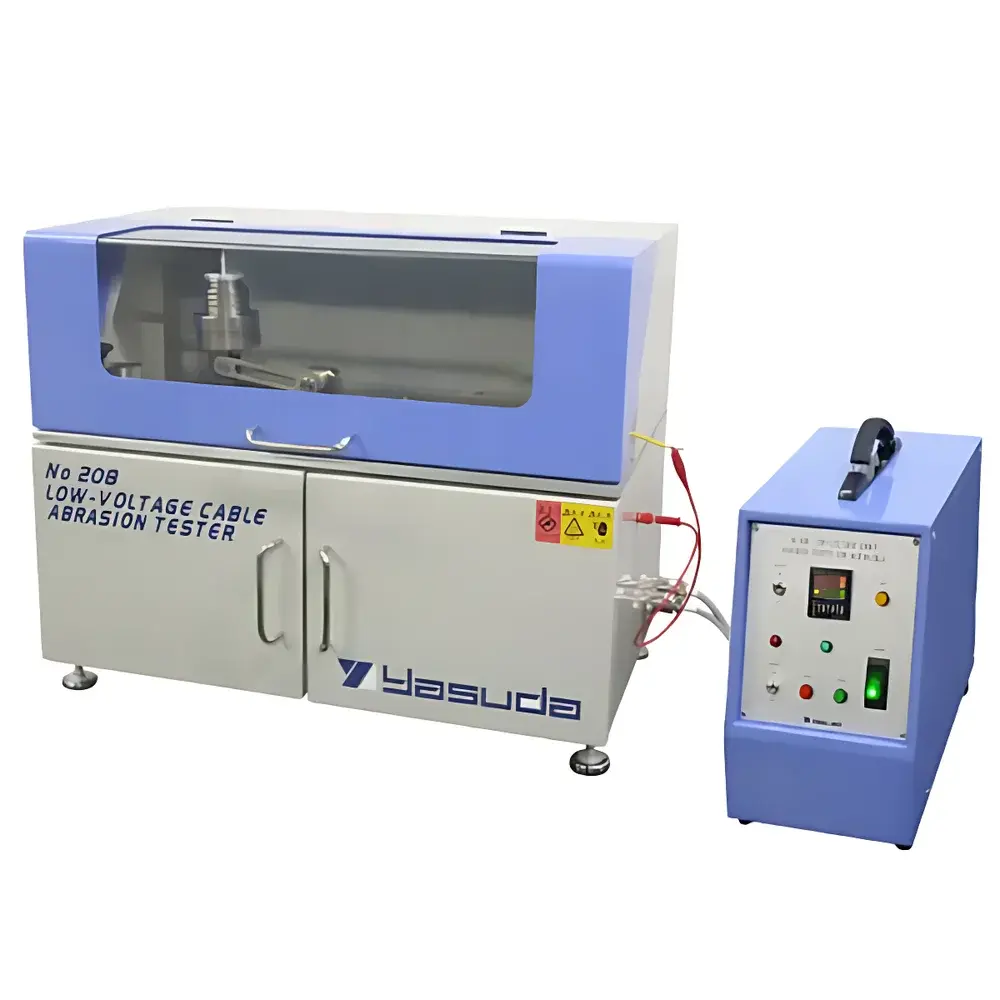
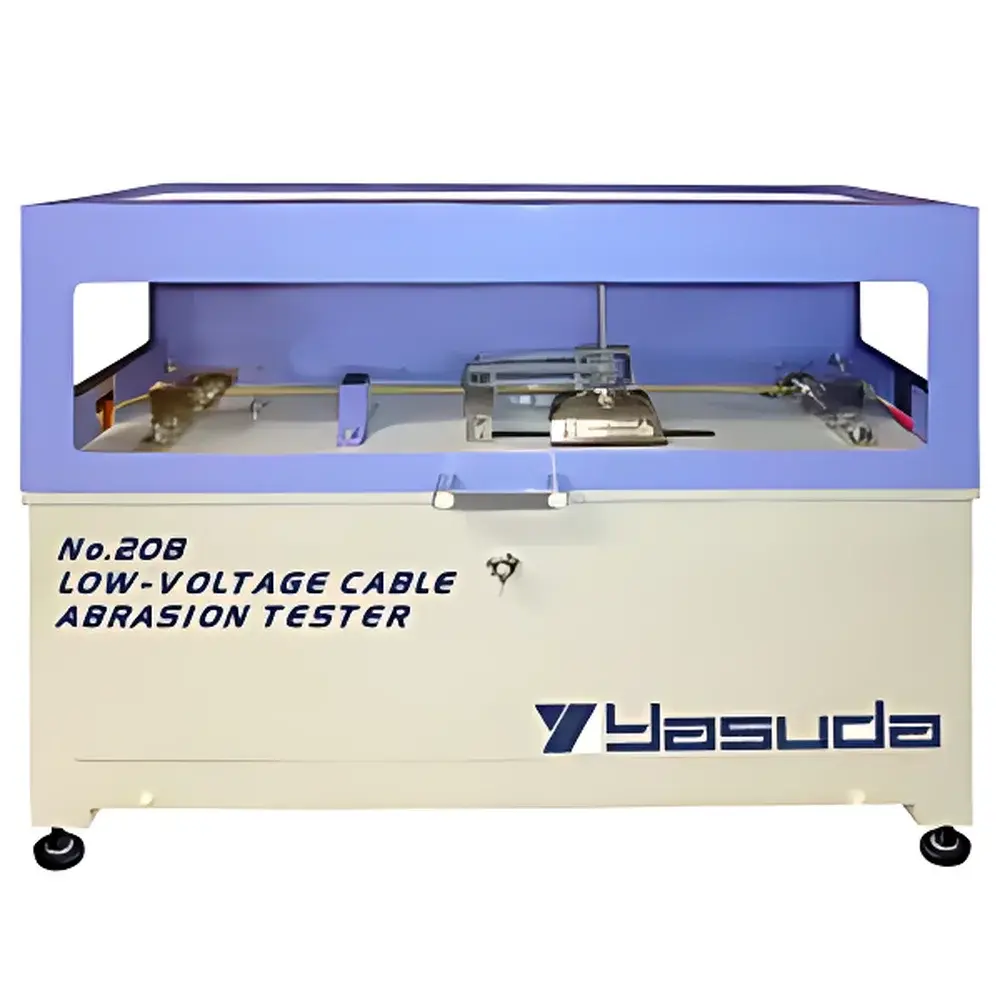
Yasuda No.208 Low-Voltage Automotive Cable Abrasion Tester
| Brand | Yasuda |
|---|---|
| Origin | Japan |
| Model | No.208 |
| Standards | JIS C 3406, JASO D 611, ISO 6722 |
| Specimen Length | 900 mm (JIS) / 1000 mm (JASO/ISO) |
| Indenter Tip Radius | R114 mm |
| Initial Load | 450 g / 0.63 ± 0.05 N |
| Adjustable Load Range | 50–1500 g |
| Conductor Support Shaft Diameter | φ7 mm (JIS) / φ6.9 mm (JASO/ISO) |
| Abrasive Tape Material | Type A, Grit #J180, Spacing: 150 mm (JIS/JASO) / 75 mm (ISO) |
| Contact Width | 10 mm |
| Tape Traverse Speed | 1500 mm/min (±75 mm/min for JASO/ISO) |
| Specimen Rotation Angles | 0°, 90°, 180°, 270° (JASO/ISO only) |
| Counter | 6-digit presettable digital counter |
| Power Supply | AC 100 V, 1-phase, 5 A, 50/60 Hz |
| Host Dimensions/Weight | ≈ W620 × D400 × H510 mm / ≈ 50 kg |
| Control Panel | ≈ W200 × D420 × H315 mm / ≈ 10 kg |
| Total System (incl. LT base) | ≈ W620 × D300 × H500 mm / ≈ 70 kg |
| Included | 5 abrasive tapes |
| Optional | Safety guard |
Overview
The Yasuda No.208 Low-Voltage Automotive Cable Abrasion Tester is a precision-engineered tribological testing system designed to evaluate the mechanical durability of low-voltage automotive wiring harnesses under standardized abrasive wear conditions. It operates on the principle of controlled linear abrasion using calibrated abrasive tape—driven at constant velocity—against a stationary or angularly indexed cable specimen under defined normal load and geometric constraints. The instrument quantifies abrasion resistance by measuring the tape travel distance at the point of electrical continuity loss between conductor and tape, thereby providing a repeatable, traceable metric for insulation integrity degradation. Its architecture complies with three major international standards: JIS C 3406 (Japanese Industrial Standard), JASO D 611 (Japan Automobile Standards Organization), and ISO 6722 (Road vehicles — 60 V and 600 V single-core cables). This multi-standard capability enables global Tier-1 suppliers and OEM validation labs to perform harmonized qualification testing across regional regulatory frameworks without equipment duplication.
Key Features
- Triple-standard configuration support: JIS, JASO, and ISO 6722 modes selectable via mechanical setup adjustments—no firmware reconfiguration required.
- High-reproducibility loading system featuring precision-machined R114 mm indenter tips and calibrated dead-weight masses (450 g base load; 50–1500 g adjustable range), ensuring compliance with force tolerance requirements per JASO D 611 (±0.05 N) and ISO 6722.
- Dual-axis specimen mounting: Fixed-axis support (φ7 mm for JIS; φ6.9 mm for JASO/ISO) with optional 0°/90°/180°/270° rotational indexing—enabling evaluation of anisotropic wear behavior in extruded insulation layers.
- Linear tape drive mechanism delivering stable 1500 mm/min traverse speed (±75 mm/min tolerance for JASO/ISO variants), powered by a brushless DC motor with closed-loop speed regulation.
- 6-digit presettable digital counter with automatic stop-on-conductivity detection—triggered when tape contact completes circuit between conductor and grounded tape backing, eliminating subjective endpoint interpretation.
- Modular mechanical design: Separated host unit (test station) and control panel allow flexible lab integration; optional safety guard meets IEC 61496-1 Category 3 PLd requirements for operator protection during operation.
Sample Compatibility & Compliance
The No.208 accommodates low-voltage automotive cables up to 1 m in length (JASO/ISO) or 900 mm (JIS), with outer diameters compatible with standard conductor support shafts. Insulation materials—including PVC, cross-linked polyethylene (XLPE), and thermoplastic elastomers (TPE)—are validated under all three standards. Test parameters—including abrasive tape specification (Type A, #J180 grit), spacing (150 mm for JIS/JASO; 75 mm for ISO), and contact width (10 mm)—are strictly aligned with clause-specified values in each referenced standard. The system supports full auditability for GLP and IATF 16949-compliant laboratories: mechanical calibration records, load verification certificates, and tape lot traceability documentation are maintained per ISO/IEC 17025 requirements. All test reports generated include embedded metadata (standard mode, load value, tape batch ID, ambient temperature/humidity) to satisfy FDA 21 CFR Part 11 electronic record integrity expectations where applicable.
Software & Data Management
The No.208 operates as a standalone electromechanical tester with no embedded software or touchscreen interface—ensuring long-term operational stability and minimizing cybersecurity exposure in regulated environments. All test parameters are set manually via calibrated mechanical components (weights, spacers, positioning jigs), and results are recorded directly into laboratory notebooks or LIMS-integrated spreadsheets. Digital counter output is TTL-compatible for optional external data acquisition (e.g., via National Instruments DAQ systems). For laboratories requiring automated reporting, third-party SCADA integration is supported through dry-contact relay outputs (start/stop/status signals) and analog voltage feedback (tape speed monitoring). Calibration intervals and maintenance logs are managed externally per ISO 17025 Clause 6.4.10, with traceable documentation retained for ≥5 years.
Applications
- Pre-production validation of new insulation formulations for automotive wiring harnesses.
- Comparative wear resistance screening of supplier-sourced cables against OEM technical specifications.
- Root-cause analysis of field failures linked to chafing-induced short circuits in engine bay or door hinge zones.
- Supporting PPAP submissions with test evidence compliant with AIAG CQI-17 (Electrical Systems Special Process Assessment).
- Accelerated aging correlation studies when combined with thermal cycling (per SAE J1211) or fluid immersion preconditioning.
- Internal quality assurance audits verifying conformance to JIS C 3406 Clause 6.4 (abrasion resistance) and ISO 6722 Annex B (abrasion test method).
FAQ
What standards does the No.208 explicitly support?
The instrument is mechanically configured to meet JIS C 3406 (Japan), JASO D 611 (Japan Automobile Standards Organization), and ISO 6722 (international road vehicle cable standard). Each mode requires specific hardware setup—no software switching is involved.
Is electrical continuity detection automated?
Yes. The system uses a low-voltage (<5 V DC), current-limited circuit to detect conductor-to-tape contact. Upon continuity, the counter halts and retains the tape travel distance reading—eliminating manual stopwatch timing errors.
Can the tester accommodate non-standard cable geometries?
Standard fixtures support round-section cables with outer diameters from 2.0 to 8.0 mm. Custom mandrels and clamping adapters are available upon request for flat or oval-profile conductors, subject to mechanical feasibility review.
What maintenance is required for long-term accuracy?
Monthly verification of tape drive speed (using certified tachometer), biannual load calibration using Class M1 weights (per ISO/IEC 17025), and quarterly inspection of indenter tip radius (via optical profilometry) are recommended. Abrasive tape batches must be logged and discarded after 10 test cycles per ISO 6722 Annex B.
Does the system comply with functional safety requirements?
When equipped with the optional CE-certified safety guard (IP54 enclosure with interlocked access doors), the full system meets PLd (Performance Level d) per ISO 13849-1 and Category 3 per IEC 61496-1, enabling integration into automated production line test cells.



