
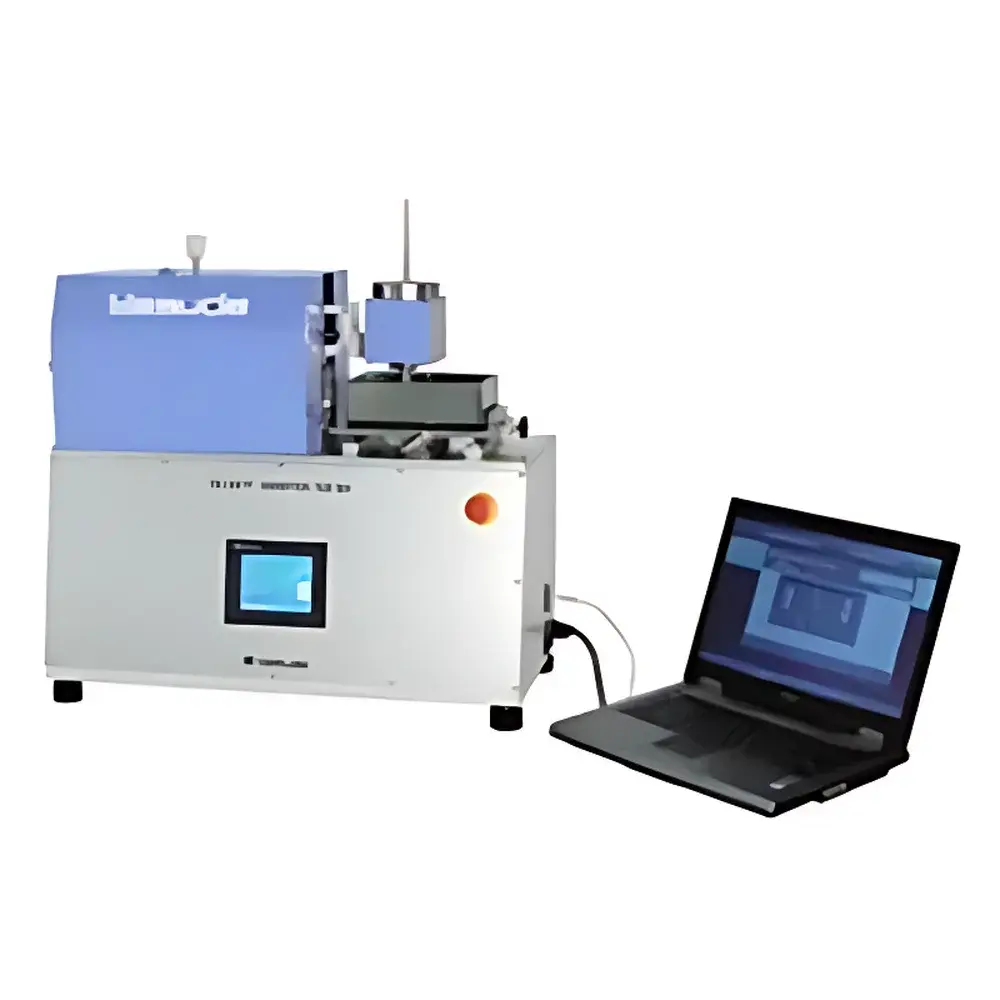
Yasuda No.650-F Reciprocating Tribological Tester
| Brand | Yasuda |
|---|---|
| Origin | Japan |
| Model | No.650-F |
| Test Motion | Reciprocating or Unidirectional |
| Load Application | Counterweight-based Dead-Weight Loading |
| Friction Force Measurement | Static and Kinetic Friction Separately |
| Sample Compatibility | Rigid and Semi-Rigid Flat Specimens (e.g., Plastics, Glass, Polymer Films) |
| Software | Dedicated Data Acquisition and Post-Processing Suite |
| Compliance Context | Designed for ASTM D1894, ISO 8295, JIS K 7124-1, and internal QC/QA protocols requiring traceable friction coefficient reporting |
Overview
The Yasuda No.650-F Reciprocating Tribological Tester is an electromechanically controlled benchtop instrument engineered for quantitative evaluation of surface resistance to abrasive wear and sliding friction under standardized mechanical loading conditions. It operates on the principle of controlled relative motion between a stationary test specimen and a reciprocating or unidirectionally moving counterface—typically a standardized pin, block, or stylus—under precisely regulated normal force, stroke length, frequency, and cycle count. The system captures real-time analog signals from high-stability load cells to resolve both static (breakaway) and kinetic (sliding) coefficients of friction with sub-millisecond temporal resolution. Its core architecture reflects decades of Japanese precision engineering in tribology instrumentation, emphasizing mechanical rigidity, thermal stability, and repeatability across extended test durations—critical for comparative material screening, formulation validation, and regulatory documentation in polymer, packaging, and optical coating development.
Key Features
- Reciprocating or continuous unidirectional motion modes, programmable via front-panel interface or PC-based control software
- Counterweight-based dead-load application system enabling rapid interchange of test fixtures (e.g., 100 g–2 kg range) without recalibration; eliminates spring hysteresis and pneumatic drift
- Dual-range friction transducer calibrated for both low-force (0–5 N) and high-force (0–20 N) regimes, supporting ASTM D1894-compliant COF measurement across diverse substrate hardnesses
- Adjustable stroke length (1–100 mm) and oscillation frequency (0.1–5 Hz), facilitating simulation of real-world contact kinematics—from packaging film handling to automotive interior sliding interfaces
- Integrated environmental guard housing minimizes air turbulence and particulate interference during low-load testing, improving signal-to-noise ratio for thin-film and low-modulus specimens
- Modular fixture design accommodates flat-sheet specimens up to 100 × 100 mm, with optional vacuum clamping and temperature-controlled platen (−10 °C to +80 °C) available as factory-configured options
Sample Compatibility & Compliance
The No.650-F is validated for use with rigid and semi-rigid planar materials including thermoplastics (e.g., PET, PP, PC), tempered glass substrates, metallized polymer films, and coated optical lenses. Specimen thickness range: 0.1–10 mm. Surface roughness (Ra) tolerance: ≤3.2 µm to ensure consistent contact geometry. The system supports full compliance workflows aligned with ASTM D1894 (Coefficient of Friction of Plastic Film and Sheeting), ISO 8295 (Plastics — Determination of the Coefficient of Friction), and JIS K 7124-1 (Plastics — Determination of Coefficient of Friction). Raw friction vs. time datasets are timestamped and stored with metadata (load, speed, ambient T/RH), satisfying GLP audit requirements for pharmaceutical packaging qualification and ISO 17025-accredited laboratories.
Software & Data Management
Yasuda’s proprietary TriboView™ software provides synchronized acquisition of friction force, displacement, and cycle count at 1 kHz sampling rate. It enables automated calculation of static COF (peak force / normal load), kinetic COF (mean sliding force / normal load), and wear index (cumulative energy dissipation per unit distance). All data files conform to HDF5 format with embedded calibration certificates and operator ID tagging. Export options include CSV, PDF reports with annotated waveform overlays, and XML for LIMS integration. Audit trail functionality complies with FDA 21 CFR Part 11 requirements when deployed on validated Windows OS environments with user role management.
Applications
- Quality control of anti-scratch coatings on display cover glasses and touch panels
- Comparative assessment of slip agents (e.g., erucamide, oleamide) in food-grade polyolefin films
- Development of low-friction medical device housings (e.g., syringe barrels, IV pump components)
- Validation of tribological performance of biodegradable packaging films under accelerated aging conditions
- Research into boundary lubrication behavior of solid-lubricant composites in microelectromechanical systems (MEMS)
FAQ
What types of counterfaces are supported?
Standard configurations include hardened steel pins (Ø3 mm, Ø6 mm), alumina blocks (10 × 10 × 10 mm), and custom-ground sapphire tips. Fixture adapters allow third-party stylus integration.
Can the system measure wear volume or mass loss?
No—the No.650-F is optimized for friction dynamics, not volumetric wear quantification. For gravimetric or profilometric wear analysis, Yasuda recommends coupling with complementary instruments such as micro-scale profilometers or analytical balances compliant with ISO 20808.
Is remote operation possible?
Yes—TriboView™ supports Ethernet-based remote monitoring and parameter adjustment via secure TCP/IP connection, with optional VNC-enabled diagnostics for OEM support.
Does the system require annual recalibration?
Per Yasuda’s maintenance protocol, load cell and position encoder calibration is recommended every 12 months or after 5,000 operational cycles—certified by authorized service centers using NIST-traceable standards.
What safety certifications does the unit carry?
CE marking (EMC Directive 2014/30/EU, Low Voltage Directive 2014/35/EU), PSE certification for Japan market, and RoHS 3 compliance for restricted substances.



