
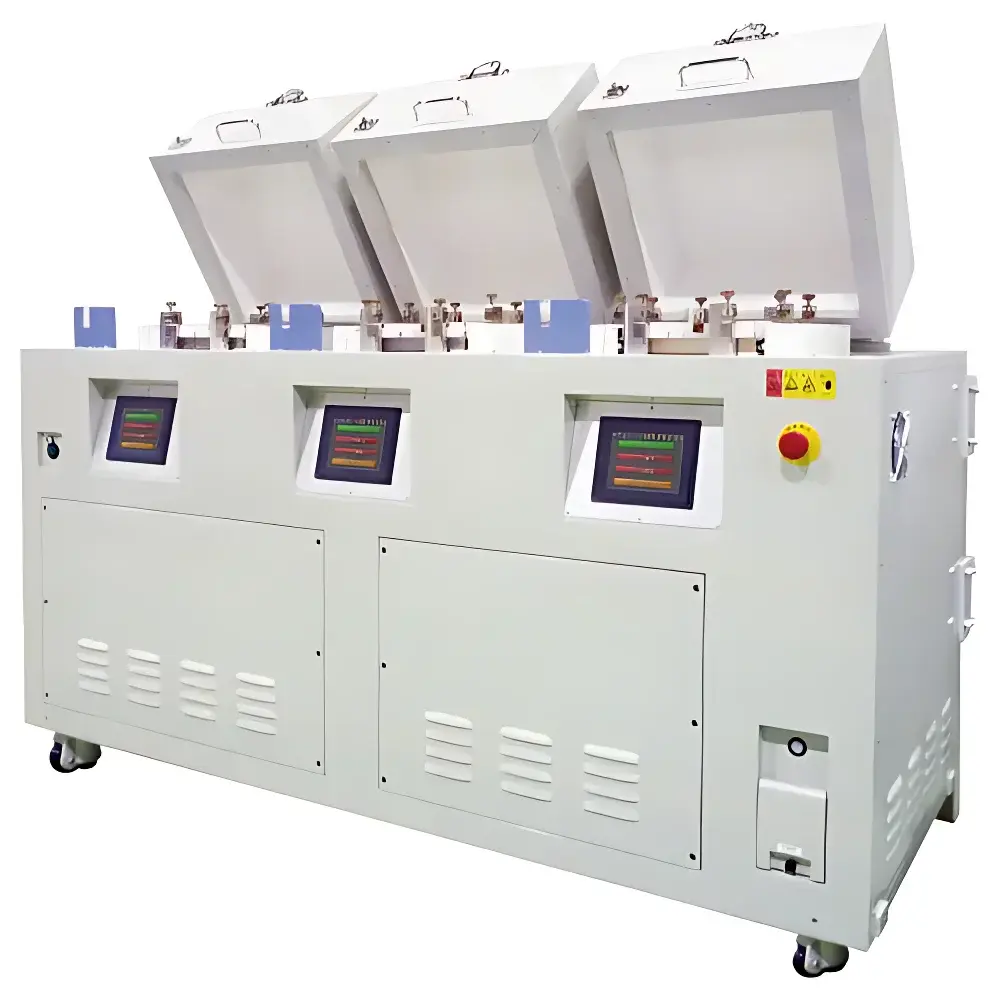
Yasuda No.173-S Enamel Wire Softening Point Tester (Cross-Method Cut-Through Tester)
| Brand | Yasuda |
|---|---|
| Origin | Japan |
| Model | No.173-S |
| Max. Temperature | 500 °C |
| Heating Rate | 2 °C/min |
| Load Range | 100 g to 2,600 g |
| Short-Circuit Detection Current | 5 ± 1 mA (max 50 mA) |
| Sample Holder Capacity | Up to 12 specimens (1 heated block × 4 positions × 3 channels) |
| Power Supply (Main Unit) | AC 200 V, 3-phase, 50 A, 50/60 Hz |
| Power Supply (PC) | AC 100 V, single-phase, ≤15 A, 50/60 Hz |
| Dimensions (W×D×H) | Approx. 1800 × 750 × 2000 mm |
| Weight | Approx. 550 kg |
| Compliance Standards | GB/T 4074.6, IEC 60851-6, JIS C3216-6:2011 |
Overview
The Yasuda No.173-S Enamel Wire Softening Point Tester is a precision thermal integrity evaluation system engineered for the quantitative determination of the softening and dielectric breakdown temperature of magnet wire insulation coatings. It operates on the standardized cross-method (cut-through) principle defined in IEC 60851-6, GB/T 4074.6, and JIS C3216-6:2011. In this method, two insulated wire specimens are orthogonally crossed at a defined contact point and immersed into a thermally stabilized metal heating block. A calibrated mechanical load is applied at the intersection while temperature is ramped at a controlled rate of 2 °C/min. The onset of electrical short-circuit—detected via a stable 5 ± 1 mA monitoring current—corresponds to localized insulation softening, flow, and loss of dielectric integrity. This measured temperature serves as a critical indicator of polymer thermal stability, crosslink density, and resistance to thermal degradation under mechanical stress—parameters directly relevant to motor winding reliability, transformer design margins, and high-temperature coil manufacturing process validation.
Key Features
- Thermally uniform heated block construction with PID-controlled temperature regulation up to 500 °C, ensuring high reproducibility across repeated trials.
- Dual-mode sample support: accommodates round wires using the cross-method and flat/rectangular wires via the tennis-ball method (per JIS C3216-6 Annex B), with up to 12 independent test positions distributed across three parallel channels (4 positions per channel).
- Programmable mechanical loading system with fine-adjustable dead-weight loads ranging from 100 g to 2,600 g, enabling evaluation across multiple insulation thicknesses and material stiffness classes.
- Integrated low-voltage short-circuit detection circuit (5 ± 1 mA nominal; max 50 mA) with galvanically isolated signal path to eliminate false triggers from thermal EMF or grounding noise.
- Triple-layer safety architecture: includes main unit earth-leakage circuit breaker, independent over-temperature cutoff relay, and a thermally insulated safety shroud with finger-protection geometry to prevent operator contact during operation.
- Modular power distribution: dedicated 3-phase 200 V supply for the heating and actuation subsystems, and separate 100 V single-phase feed for the control PC—minimizing electromagnetic interference and supporting stable data acquisition.
Sample Compatibility & Compliance
The No.173-S supports copper and aluminum enamel-coated conductors with nominal diameters from 0.05 mm to 3.00 mm, including polyester (PE), polyamide-imide (PAI), polyetherimide (PEI), and heavy-build solderable grades. It is validated for conformance to international standard test protocols: IEC 60851-6 (Methods for testing enamelled wires — Part 6: Determination of softening point), GB/T 4074.6 (Chinese national standard equivalent), and JIS C3216-6:2011 (Japanese Industrial Standard). All hardware and software components are designed to support GLP-compliant documentation workflows, including timestamped test logs, operator ID tagging, and audit-ready calibration history tracking.
Software & Data Management
The system integrates with a Windows 10-based desktop workstation equipped with proprietary test control and analysis software. The application provides real-time temperature/load/short-circuit status visualization, automated endpoint detection based on current threshold crossing, and export of structured CSV reports containing test ID, specimen ID, start/end temperatures, load value, channel assignment, and pass/fail flags. Data files are stored with SHA-256 checksums and support optional integration with laboratory information management systems (LIMS) via OPC UA or REST API interfaces. Audit trail functionality complies with FDA 21 CFR Part 11 requirements when configured with electronic signatures and role-based access controls.
Applications
- Quality assurance laboratories in magnet wire manufacturing facilities verifying batch-to-batch consistency of thermal endurance performance.
- R&D departments evaluating new insulation resin formulations for elevated-temperature motor applications (e.g., EV traction motors, aerospace actuators).
- Third-party certification bodies performing accredited testing per IEC/GB/JIS standards for UL, CSA, or VDE listing submissions.
- Failure analysis labs investigating premature winding failures by correlating softening point shifts with aging conditions (thermal cycling, humidity exposure, chemical contamination).
- Process engineers optimizing curing profiles in enamel coating ovens by linking softening temperature to crosslinking degree and post-cure residual stress.
FAQ
What insulation materials can be tested with the No.173-S?
The instrument is validated for common magnet wire enamels including polyester, polyurethane, polyamide-imide, polyetherimide, and silicone-modified variants—provided they meet dimensional and thermal stability criteria outlined in IEC 60851-6.
Is calibration traceable to national standards?
Yes. Temperature sensors are calibrated against NIST-traceable reference thermocouples; load cells are verified using certified deadweight standards. Full calibration certificates are provided with each unit and annual recalibration services are available through Yasuda-authorized service centers.
Can test data be exported for statistical process control (SPC)?
Yes. Raw and summary data export to CSV, Excel, and XML formats enables direct import into SPC platforms such as Minitab, JMP, or custom MES dashboards.
Does the system support unattended overnight testing?
Yes. With proper thermal enclosure setup and ambient temperature stabilization, the No.173-S supports scheduled multi-cycle testing with automatic shutdown upon completion or fault detection.
What maintenance is required for long-term accuracy?
Routine maintenance includes quarterly verification of heating block uniformity, biannual cleaning of load-bearing surfaces and electrical contacts, and annual full-system calibration—documented in the included maintenance logbook and supported by remote diagnostics via embedded Ethernet interface.







