
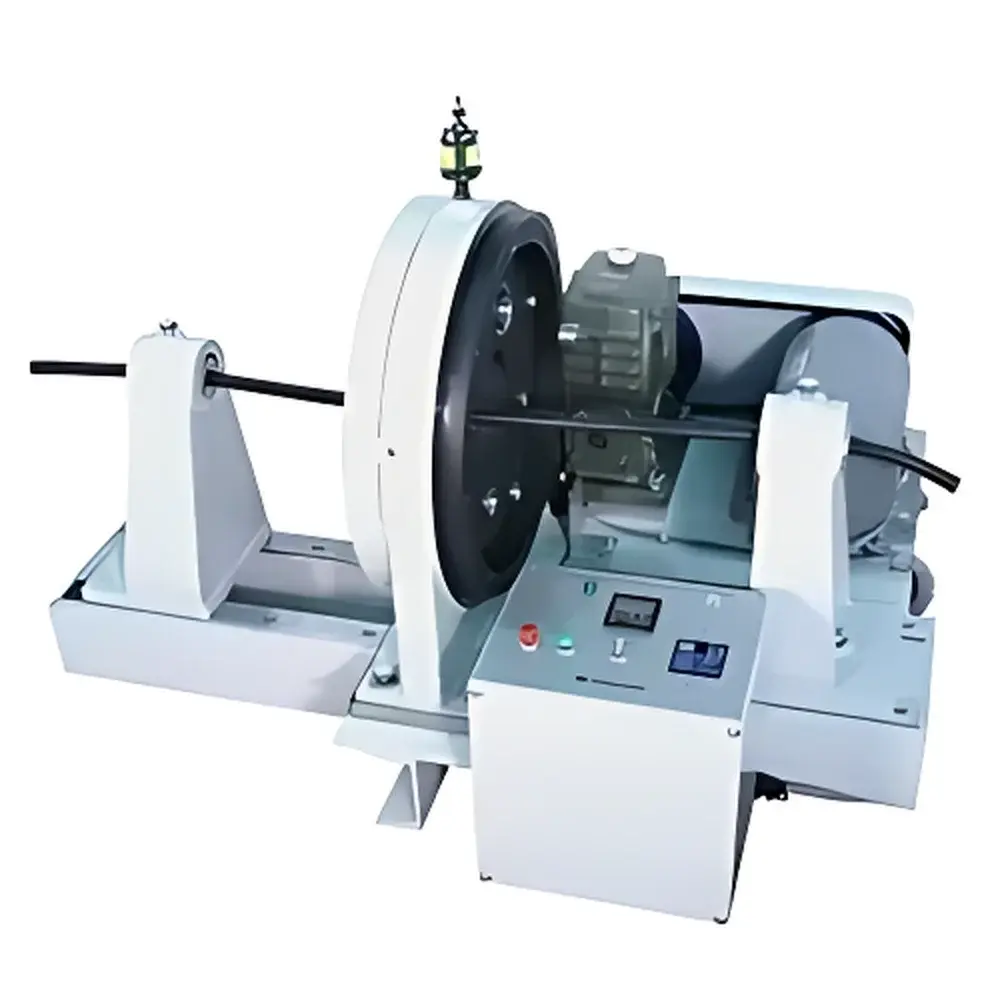
Yasuda No.125 CABTYRE Cable Flexing Tester
| Brand | Yasuda |
|---|---|
| Origin | Japan |
| Model | No.125 |
| Compliance Standard | JIS C 3005 |
| Test Speed | 200 rpm |
| Sample Fixation | Through-hole rotor mounting with dual-end clamping |
| Failure Assessment | Insulation cracking, sheath rupture, and conductor breakage count |
Overview
The Yasuda No.125 CABTYRE Cable Flexing Tester is a precision-engineered mechanical endurance testing instrument designed specifically for evaluating the flexural durability of rubber- and plastic-insulated flexible cables and cords. It operates on the principle of controlled cyclic bending under defined mechanical constraints, simulating real-world service conditions where cables undergo repeated flexing during installation, routing, or dynamic motion applications (e.g., robotics, portable equipment, and automated machinery). The device implements a standardized rotary flexing mechanism per JIS C 3005 — the Japanese Industrial Standard governing “Test Methods for Flexible Cables and Cords”, which specifies requirements for conductor integrity, insulation adhesion, and outer sheath resistance to microcracking after prescribed numbers of bending cycles. Unlike generic bending rigs, the No.125 integrates a rigid, kinematically constrained rotor assembly that passes through a pre-punched hole in the specimen, ensuring reproducible bending geometry and consistent stress distribution across the insulation–conductor interface.
Key Features
- Compliant mechanical architecture engineered to meet JIS C 3005 test protocol specifications, including precise angular displacement control and fixed pivot geometry.
- High-stiffness aluminum frame with vibration-damped base, minimizing parasitic oscillations during high-cycle operation at 200 rpm.
- Adjustable specimen mounting system accommodating cables with outer diameters from 4 mm to 16 mm; rotor shaft diameter and hole alignment tolerances maintained within ±0.1 mm.
- Dual-end clamping mechanism ensures axial stability while permitting free rotational flexing at the central perforation point — critical for isolating localized strain effects on insulation layers.
- Integrated cycle counter with non-volatile memory, capable of logging up to 999,999 bending cycles with manual reset functionality for multi-stage testing protocols.
- No electronic drive or programmable controller — mechanical simplicity enhances long-term reliability, reduces calibration drift, and supports GLP-compliant manual test documentation.
Sample Compatibility & Compliance
The No.125 tester accommodates single-core and multi-core flexible cables with thermoplastic (PVC, TPE) or elastomeric (EPDM, CR, silicone) insulation systems. Specimens must be prepared with a centrally located 3.2 mm diameter through-hole (per JIS C 3005 Clause 6.2), enabling secure rotor insertion without deformation. The device supports evaluation of both insulated conductors and fully sheathed cables, with failure criteria explicitly defined in the standard: visual detection of insulation cracks ≥0.1 mm length, sheath ruptures exposing underlying layers, or discontinuity in conductor continuity verified via continuity tester post-test. As an import-grade instrument manufactured in Japan and distributed under Yasuda’s quality assurance framework, it conforms to JIS Q 9001 design control requirements and supports traceability documentation for ISO/IEC 17025-accredited laboratories conducting third-party certification testing.
Software & Data Management
The Yasuda No.125 is a purely electromechanical instrument with no embedded firmware, touchscreen interface, or digital data output. All operational parameters — including cycle count, rotational speed (mechanically fixed at 200 rpm), and specimen identification — are recorded manually in laboratory notebooks or LIMS-integrated test forms. This analog design eliminates cybersecurity risks, avoids software validation burdens under FDA 21 CFR Part 11, and simplifies audit readiness for GMP/QSR-regulated environments where paper-based records remain acceptable. Users may integrate external digital tools — such as barcode-scanned specimen logs or time-stamped photographic evidence of pre- and post-test condition — to augment raw data integrity without modifying the core hardware.
Applications
- Qualification testing of automotive wiring harnesses subjected to chassis vibration and door hinge motion.
- Pre-certification validation for UL 62 and IEC 60227-rated flexible cords prior to submission to NRTLs.
- R&D evaluation of novel polymer blends intended for enhanced fatigue resistance in industrial robot cables.
- Quality conformance screening in cable manufacturing QA labs performing lot-release testing per JIS C 3005 Clause 7.
- Comparative analysis of insulation aging effects after thermal preconditioning (e.g., 70 °C × 168 h per IEC 60811-1-2) followed by flexing.
FAQ
Does the No.125 support variable test speeds?
No. The unit operates exclusively at 200 rpm as mandated by JIS C 3005 Section 5.2; speed adjustment is not mechanically feasible or standard-compliant.
Can it test flat or ribbon-type cables?
No. The through-hole rotor mounting method requires cylindrical symmetry; flat cables cannot be reliably centered or uniformly stressed.
Is calibration certification provided with shipment?
Yes — each unit ships with a factory-issued dimensional verification report covering rotor concentricity, clamping force consistency (measured via load cell), and rotational speed validation using optical tachometry.
What maintenance intervals are recommended?
Lubrication of the main drive bearing and inspection of clamp jaw surfaces are advised every 50,000 cycles or annually, whichever occurs first; no recalibration is required between verifications.
Is the device compatible with ASTM D4272 or IEC 60227-2 test methods?
It is not directly compliant with ASTM D4272 (which uses a different pendulum-based flexing geometry) or IEC 60227-2 (which references alternative jig configurations); its sole validated compliance is with JIS C 3005.



