
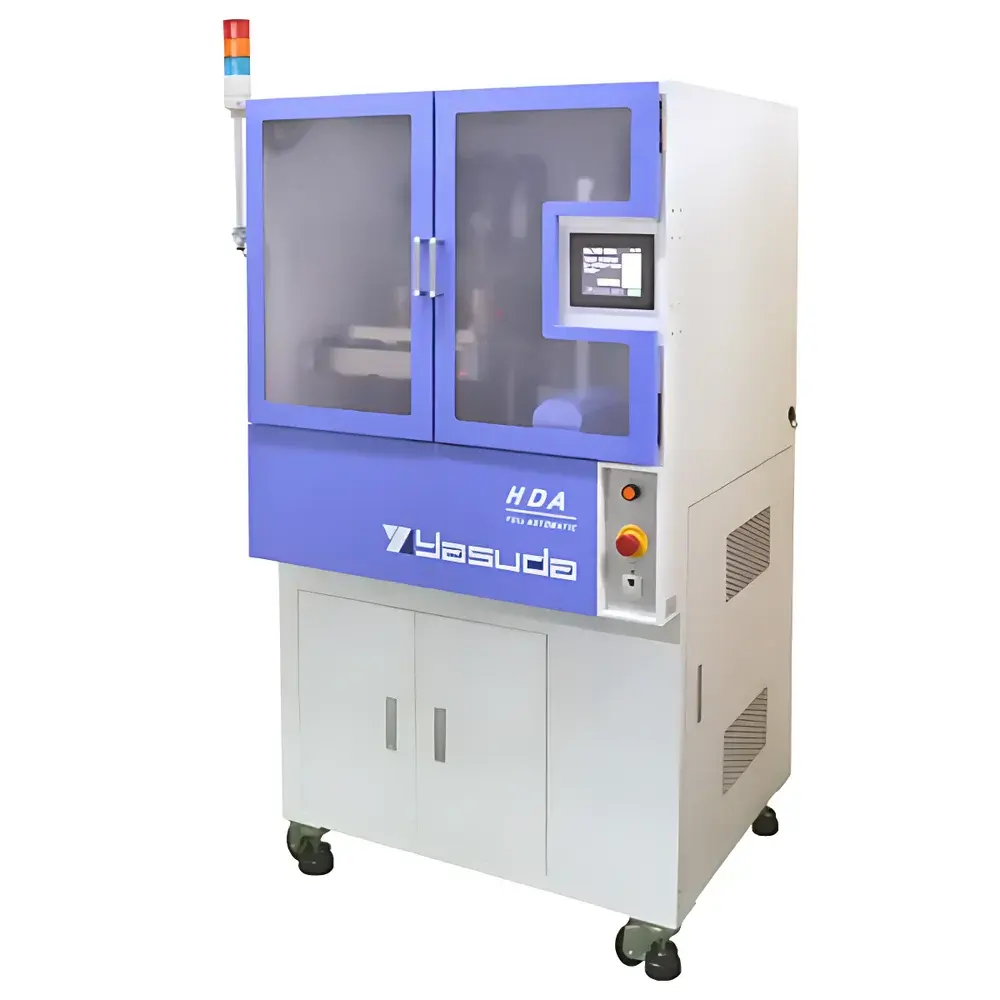
Yasuda No.148-HDA Fully Automated Heat Deflection Temperature (HDT) and Vicat Softening Point Tester
| Brand | Yasuda |
|---|---|
| Origin | Japan |
| Model | No.148-HDA |
| Standards Compliance | JIS K7191-1, K7206 |
| Max Temperature | 300 °C (oil bath) |
| Heating Rate | 120 ± 10 °C/hr (HDT/Vicat), 50 ± 5 °C/hr (Vicat optional) |
| Bending Stress Options | 0.45 MPa (ISO B), 1.80 MPa (ISO A), 8.00 MPa (ISO C), 0.455 MPa / 1.82 MPa (ASTM) |
| Load Range | DTUL: 76.5–3,210 gf (2 selectable) |
| Vicat | 10 ± 0.2 N or 50 ± 1 N |
| BP | 19.6–20 N |
| Penetrator Tip Geometry | DTUL: R3.0 ± 0.2 mm |
| Vicat | 1.000 ± 0.015 mm² flat-ended |
| BP | Ø5 mm spherical |
| Deflection Resolution | 0.001 mm (differential sensor, 4 mm stroke) |
| Span Lengths | 64 ± 1 mm, 100 ± 1 mm (standard), 101.6 ± 0.5 mm (optional) |
| Sample Capacity | Up to 120 specimens (40 × 3 trays) |
| Oil Volume | ~10 L (3/4-station), ~17 L (6-station) |
| Cooling | Integrated refrigerated chiller (standard on HDA variant) |
| Stirring | Paddle-type agitator (2 units for 3/4 stations |
| Power Supply | With chiller — 3-phase AC200/220 V, 20 A / 30 A, 50/60 Hz |
| Air Supply | ≥0.5 MPa |
| Dimensions (W×D×H) | ~1460 × 900 × 1715 mm |
| Weight | 450–550 kg |
Overview
The Yasuda No.148-HDA is a fully automated benchtop thermal analysis system engineered for precise, high-throughput determination of Heat Deflection Temperature (HDT) and Vicat Softening Point (VSP) in thermoplastic and thermosetting polymers. It operates on the principle of controlled thermal ramping under defined mechanical load, measuring the temperature at which standardized test specimens undergo specified deformation under axial penetration (Vicat) or three-point bending (HDT). Designed to meet stringent international testing protocols—including JIS K7191-1/K7206, ASTM D648/D1525, ISO 75-1/306, and IEC 60335-1—the instrument delivers traceable, repeatable results essential for material qualification, quality control, and regulatory submissions in automotive, electronics, and medical device manufacturing.
Key Features
- Fully automated operation via robotic sample handling: pre-loaded specimen trays (up to 120 samples across three 40-slot cassettes) enable unattended sequential testing without manual intervention.
- Dual-mode thermal control architecture: oil-bath heating system with integrated refrigerated chiller (standard on HDA configuration) ensures rapid, stable temperature ramping from ambient to 300 °C with minimal overshoot and high thermal uniformity.
- High-resolution displacement sensing: differential linear sensors with 1 µm resolution and 4 mm full-scale stroke provide sub-micron tracking of probe penetration depth or beam deflection.
- Modular load application system: interchangeable penetrators and bending fixtures support all major standard configurations—ISO Method A/B/C, ASTM 1.82/0.455 MPa, and BP (Ball Pressure) testing per IEC 60335-1.
- Programmable heating profiles: user-selectable ramp rates (120 ±10 °C/hr for HDT/Vicat; 50 ±5 °C/hr for low-rate Vicat) with automatic dwell and endpoint detection based on preset deflection thresholds.
- Robust mechanical design: precision-ground span supports (64 ±1 mm, 100 ±1 mm, or optional 101.6 ±0.5 mm), hardened steel penetrators, and oil-circulated agitation ensure long-term dimensional stability and inter-laboratory reproducibility.
Sample Compatibility & Compliance
The No.148-HDA accommodates standard rectangular polymer specimens (typically 80–120 mm × 10 mm × 4 mm) as defined in ISO 75 and ASTM D648. Specimen holders are configurable for 3-, 4-, or 6-position testing stations, each equipped with independent stirrers and calibrated thermal sensors. All mechanical components—including penetrator tips (R3.0 ±0.2 mm for HDT; 1.000 ±0.015 mm² flat for Vicat), support spans, and load arms—are manufactured and verified against metrological requirements of ISO/IEC 17025-accredited calibration practices. The system supports full audit trails and electronic signatures compliant with FDA 21 CFR Part 11 when used with validated software configurations, making it suitable for GLP and GMP environments.
Software & Data Management
Controlled via Windows 10–compatible proprietary software (standard), the No.148-HDA provides intuitive test method setup, real-time thermal/deflection curve visualization, and automated pass/fail evaluation per selected standard criteria. Raw data—including time-temperature-deflection logs, load history, and environmental parameters—is stored in structured CSV and XML formats. The software supports batch reporting, statistical summary generation (mean, SD, CV%), and export to LIMS or ERP systems. Optional modules include electronic signature workflows, multi-user role-based access control, and integration with enterprise digital QA platforms for seamless traceability across the product lifecycle.
Applications
- Thermal performance validation of engineering plastics (e.g., PEEK, PSU, PPS) for aerospace structural components.
- Batch release testing of polypropylene (PP), polyethylene (PE), and ABS compounds in automotive interior trim applications.
- Regulatory submission support for medical-grade polymers requiring ISO 10993-12 biocompatibility assessment.
- Comparative heat resistance screening during polymer formulation development and supplier qualification.
- Failure analysis of thermally degraded parts through correlation of HDT/VSP shifts with aging conditions.
FAQ
What standards does the No.148-HDA support out of the box?
It natively supports JIS K7191-1, K7206; ASTM D648 and D1525; ISO 75-1 and ISO 306; and IEC 60335-1. Custom method templates can be configured for internal or regional specifications.
Is the refrigerated chiller included as standard equipment?
Yes—the integrated chiller is standard on the HDA variant, enabling rapid cooling between tests and consistent start-at-ambient (20–23 °C) conditions.
Can the system operate without Windows 10?
No—the control software requires Windows 10 (64-bit) and is not compatible with Linux, macOS, or earlier Windows versions.
What is the maximum number of specimens that can be tested consecutively?
Up to 120 specimens using three 40-position trays, with full automation including loading, thermal conditioning, measurement, and tray ejection.
Does the system support remote monitoring or network connectivity?
Yes—Ethernet interface enables remote status viewing, log retrieval, and limited parameter adjustment via secure LAN connection; full remote control requires additional IT infrastructure validation.




