
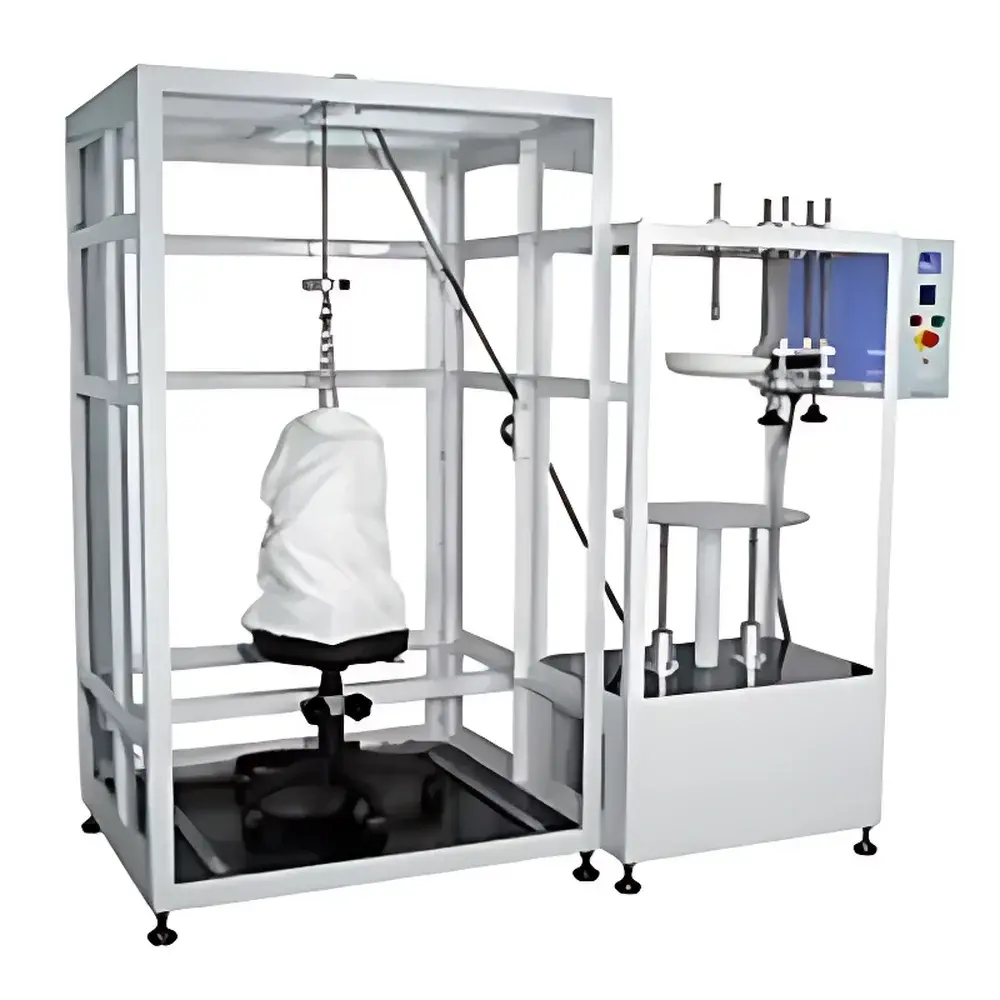
Yasuda No.663 Furniture Repeated Strength Tester
| Brand | Yasuda |
|---|---|
| Origin | Japan |
| Model | No.663 |
| Compliance Standard | JIS S 1203 |
| Application Scope | Chairs, Stools, Luggage Handles, Backpack Straps, Cookware Handles |
| Load Application Method | Controlled Cyclic Vertical Force |
| Test Mode | Repetitive Load-Displacement Monitoring |
| Configuration | Floor-Standing Electromechanical Testing System |
| Control Type | Manual or Optional Programmable Controller |
Overview
The Yasuda No.663 Furniture Repeated Strength Tester is an electromechanical fatigue testing system engineered for standardized mechanical durability assessment of seating furniture and load-bearing components in accordance with JIS S 1203 (Japanese Industrial Standard for “Test Methods for Strength and Durability of Chairs and Stools”). It operates on a controlled cyclic loading principle: a vertically actuated load frame applies repeated, quantifiable downward force to the seat surface—typically via a flat indenter with defined contact geometry—while displacement sensors monitor deflection magnitude and progression over thousands of cycles. Unlike static compressive testers, the No.663 is specifically configured to replicate real-world usage patterns, including intermittent loading, dwell periods, and progressive deformation tracking under sustained repetition. Its robust architecture ensures mechanical stability during long-duration tests (e.g., 100,000+ cycles), minimizing frame resonance and thermal drift that could compromise measurement repeatability. Designed for laboratory and quality assurance environments, the system supports both pass/fail verification and quantitative trend analysis of structural degradation.
Key Features
- Compliance-certified test configuration aligned with JIS S 1203 Clause 5.2 (repeated load test for chairs) and Clause 6.2 (stool durability evaluation)
- Adjustable vertical stroke range and programmable cycle count (standard manual operation; optional digital controller enables preset load profiles, dwell timing, and cycle termination logic)
- Load application via calibrated deadweight stacks or optional motor-driven actuator (depending on configuration), ensuring traceable force application without hydraulic complexity
- Dual-point displacement monitoring: simultaneous measurement at seat center and front edge to assess differential flexure and potential hinge-point failure
- Modular fixture interface accommodating standardized chair clamping jigs, stool base restraints, and auxiliary adapters for non-furniture specimens (e.g., luggage handle mounts, backpack webbing anchor plates)
- Structural frame constructed from high-rigidity steel with vibration-damped base, minimizing parasitic motion during high-cycle testing
Sample Compatibility & Compliance
The No.663 accommodates a defined range of seated furniture geometries per JIS S 1203 dimensional limits: chairs with seat heights between 400–480 mm and stool seat diameters up to 350 mm. It also accepts non-standardized items—including carry-on luggage handles (tested per ISO 11679 Annex B principles), backpack shoulder strap attachment points, and cookware handle assemblies—using custom mounting brackets validated for load path fidelity. All test procedures support documentation required for internal QA audits and third-party certification. While not inherently GLP- or GMP-compliant, the system’s mechanical determinism and repeatable setup enable full traceability when integrated into controlled test protocols meeting ISO/IEC 17025 clause 7.2 (method validation) and ASTM D7320 (standard guide for mechanical testing of consumer products).
Software & Data Management
The base No.663 model operates without embedded software, relying on manual cycle counting and analog displacement readouts (dial gauges or digital calipers). However, Yasuda offers an optional digital control module featuring RS-232 or USB output for external data logging. When paired with compliant acquisition software, this module records timestamped load cycle number, peak applied force (N), maximum seat deflection (mm), and cumulative plastic deformation. Data export formats include CSV and Excel-compatible .xlsx, facilitating integration into LIMS environments. For regulated industries, the optional controller supports audit-trail-enabling features—including user login tracking, parameter change logs, and electronic signature prompts—aligning with FDA 21 CFR Part 11 requirements when deployed within validated workflows.
Applications
- Verification of chair and stool compliance with JIS S 1203 Class I (residential) and Class II (commercial/institutional) durability tiers
- Comparative fatigue life assessment across material variants (e.g., molded plywood vs. polypropylene seat shells)
- Root-cause analysis of joint failure in folding furniture mechanisms under cyclic shear stress
- Pre-shipment durability screening for OEM furniture suppliers serving Japanese and ASEAN markets
- Mechanical validation of ergonomic product claims—e.g., “100,000-cycle seat integrity” stated in technical datasheets
- Component-level qualification of polymer-based handles subjected to torsional and bending loads during transport simulation
FAQ
Does the No.663 comply with international standards beyond JIS S 1203?
Yes—its mechanical configuration permits adaptation to ASTM F2057 (Standard Consumer Safety Specification for Chests, Dressers, and Other Furniture), EN 12520 (Furniture — Strength, Durability and Safety — Requirements for Domestic Seating), and ISO 7173 (Furniture — Chairs — Determination of Strength and Durability), provided fixture geometry and loading protocols are modified accordingly.
Can test parameters be automated for unattended operation?
The standard unit requires manual cycle initiation; however, the optional programmable controller enables fully autonomous execution of multi-stage tests—including variable load ramps, dwell intervals, and automatic shutdown upon reaching target cycles or deflection thresholds.
Is calibration certification included with shipment?
Yasuda provides factory calibration documentation traceable to JCSS (Japanese Calibration Service System) for the load application mechanism and displacement transducers. On-site recalibration services are available through authorized distributors.
What maintenance is required to ensure long-term measurement accuracy?
Biannual inspection of linear guide rails, load train alignment verification, and periodic verification of indenter flatness and parallelism per JIS B 7513 are recommended. Lubrication intervals follow Yasuda’s Maintenance Schedule MS-NO663 Rev. 4.



