
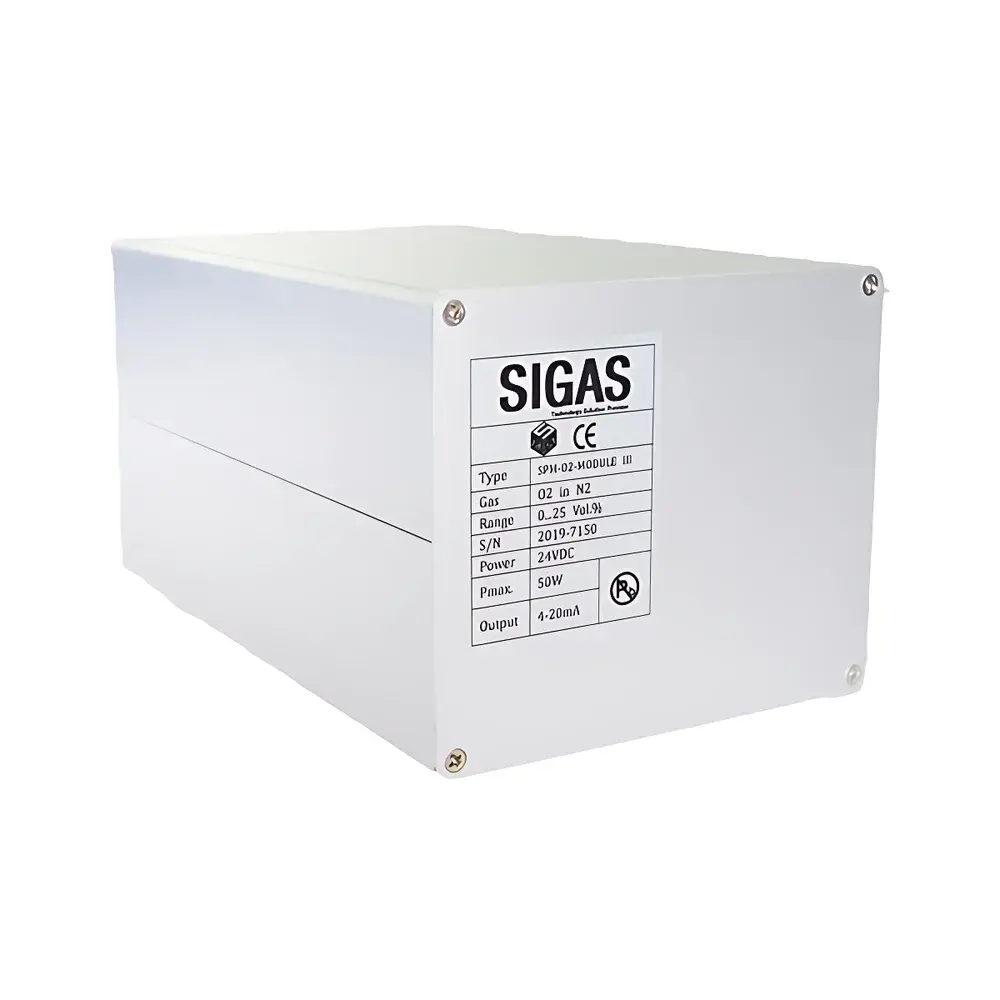
SIGAS SPM-O2-MODULE III High-Stability Paramagnetic Oxygen Sensor
| Brand | SIGAS |
|---|---|
| Model | SPM-O2-MODULE III |
| Detection Principle | Paramagnetic Oxygen Sensing |
| Measurement Range | 0–3 / 0–10 / 0–25 / 0–100 vol.% O₂ |
| Response Time (t₉₀) | ≤3 s |
| Zero Drift | <±0.1 % O₂/week |
| Span Drift | <±1 % O₂/week |
| Linearity Error | <±1 % FS |
| Detection Limit (3σ) | <1 % FS |
| Temperature Drift (Zero) | <±0.05 % O₂/°C |
| Flow Rate Dependence | <±0.2 % O₂ (20–100 mL/min) |
| Tilt Sensitivity | <±0.02 % O₂/degree |
| Humidity Influence | <0.5 % O₂ @ 20°C |
| Analog Output | 4–20 mA |
| Supply Voltage | 24 VDC |
| Inlet Flow Rate | 100 mL/min (optimal), max. 250 mL/min |
| Inlet Pressure Drop | ≤±300 hPa |
| Operating Temperature | 5–45 °C |
| Inlet Gas Dew Point | ≥5 °C |
| Particulate Limit | ≤100 µg/m³, particle size ≤1 µm (dust filter required) |
| Zero Calibration Gas | 99.999% N₂ |
| Span Calibration Gas | 85–110% of full scale (e.g., dry air for 0–25% range) |
Overview
The SIGAS SPM-O2-MODULE III is a high-stability paramagnetic oxygen sensor engineered for continuous, precision oxygen concentration measurement in demanding environmental and industrial process monitoring applications. Unlike electrochemical or zirconia-based sensors, it exploits the intrinsic paramagnetism of molecular oxygen—a fundamental physical property that renders O₂ uniquely responsive to magnetic fields among common gases. Within the sensor’s precision-machined measuring cell, two nitrogen-filled glass spheres (“dumbbells”) are suspended on a torsionally sensitive quartz fiber within a non-uniform magnetic field. When oxygen enters the chamber, its paramagnetic susceptibility generates a measurable torque on the dumbbell assembly, proportional to local O₂ partial pressure. This magnetomechanical transduction mechanism delivers inherently linear output, zero consumption of sensing material, and immunity to catalytic poisoning—making the SPM-O₂-MODULE III especially suitable for long-term unattended operation in stack emissions, inerting systems, fermentation control, and cleanroom ambient monitoring.
Key Features
- True paramagnetic detection principle with no chemical consumption or electrode degradation
- Response time t₉₀ ≤ 3 seconds across all configured ranges (0–3%, 0–10%, 0–25%, or 0–100% vol. O₂)
- Configurable full-scale calibration range from 85% to 110% FS, enabling optimized linearity and reduced span error in application-specific deployments
- Negligible cross-sensitivity to CO₂, CO, CH₄, N₂, Ar, He, and most hydrocarbons—validated per ISO 14644-3 and ASTM D6257 test protocols
- Zero drift < ±0.1 % O₂/week and span drift < ±1 % O₂/week under controlled lab conditions, supporting extended calibration intervals in GLP-compliant environments
- Robust mechanical architecture with quartz suspension and hermetically sealed optical detection path—no moving parts subject to wear
- Integrated temperature compensation and flow stabilization circuitry, minimizing dependence on inlet flow rate (20–100 mL/min) and ambient thermal gradients
Sample Compatibility & Compliance
The SPM-O2-MODULE III is designed for use with dry, non-condensing gas streams containing particulate loading ≤100 µg/m³ (particles ≤1 µm). A certified sintered stainless-steel dust filter (optional, part #FIL-SS-1) is mandatory upstream when sampling from flue gas or compressed air systems. The sensor requires inlet dew point ≥5 °C to prevent condensation-induced signal hysteresis or mechanical stress on the dumbbell assembly. It complies with IEC 61000-6-2 (EMC immunity) and IEC 61000-6-4 (EMC emission) standards. While not intrinsically safe, it may be deployed in Zone 2 hazardous areas when housed in an approved ATEX/IECEx-certified enclosure (e.g., Ex d IIB T4). Calibration traceability aligns with NIST-traceable nitrogen and certified reference gas mixtures conforming to ISO 6141 and ISO 6142.
Software & Data Management
The module outputs a standard 4–20 mA analog signal, compatible with PLCs, DCS systems, and SCADA platforms without additional signal conditioning. For integration into digital workflows, SIGAS provides optional RS-485 Modbus RTU firmware (v2.1+) supporting real-time diagnostics—including internal temperature, flow status flag, and self-test pass/fail indicators. All calibration events (zero and span) are timestamped and stored in non-volatile memory with audit trail capability, satisfying FDA 21 CFR Part 11 requirements when paired with validated host software. Firmware updates and configuration adjustments are performed via dedicated configuration tool (SIGAS ConfigSuite v3.4), which enforces password-protected access levels for operator, technician, and administrator roles.
Applications
- Continuous emissions monitoring systems (CEMS) for thermal power plants and waste incinerators
- Oxygen control in pharmaceutical fluidized-bed dryers and lyophilizers per USP and EU GMP Annex 15
- Inert gas blanketing verification in petrochemical storage tanks and reactor purging sequences
- Bioreactor dissolved oxygen (DO) off-gas analysis in upstream bioprocessing
- Ambient air quality stations measuring background O₂ as a tracer for combustion efficiency and atmospheric mixing models
- Calibration transfer standards in metrology labs validating electrochemical O₂ analyzers per ISO/IEC 17025
FAQ
What calibration gases are required for routine maintenance?
Zero calibration requires ultra-high-purity nitrogen (99.999% N₂); span calibration uses a certified gas mixture at 85–110% of the selected full scale—dry air is acceptable for 0–25% range per ISO 8573-1 Class 4.
Can the sensor operate in high-humidity or corrosive gas streams?
No. Inlet gas must be non-condensing (dew point ≥5 °C) and free of SO₂, HCl, or NH₃ above 1 ppm; acidic or alkaline vapors cause irreversible damage to the quartz suspension and glass spheres.
Is flow rate critical to measurement accuracy?
Yes. Optimal performance is achieved at 100 mL/min ±2%. Flow fluctuations >±20 mL/min induce measurable pressure-dependent torque artifacts; a laminar flow controller is recommended for critical applications.
How often does the sensor require recalibration?
Under stable operating conditions and proper filtration, quarterly zero/span verification is sufficient; annual full recalibration is recommended for ISO 17025-accredited labs.
Does the module support digital communication protocols?
Yes—optional Modbus RTU over RS-485 enables remote diagnostics, firmware updates, and multi-point data logging in distributed monitoring networks.







