
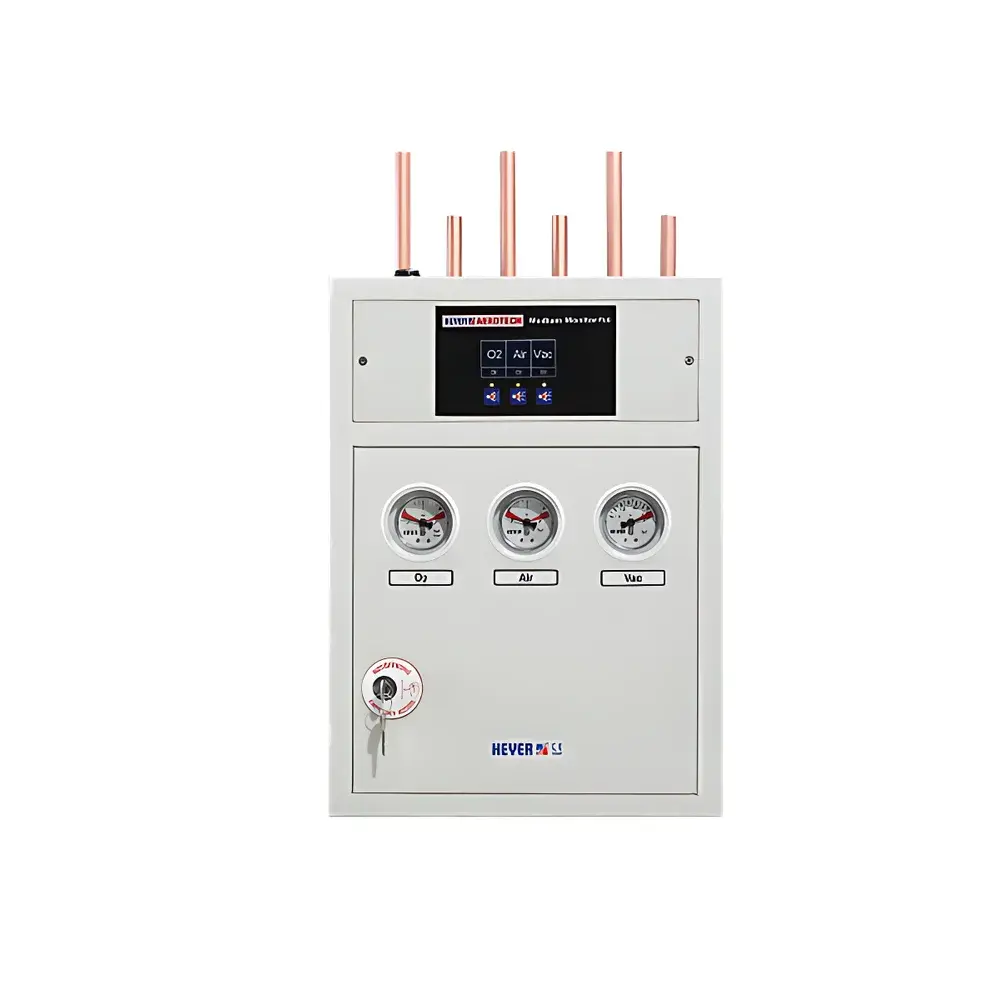
Medical Area Alarm Valve Box System by SIGAS (Schütz Measuring & Control)
| Brand | SIGAS (Schütz Measuring & Control) |
|---|---|
| Origin | Germany |
| Manufacturer Type | Authorized Distributor |
| Origin Category | Imported |
| Model | Medical Area Alarm Valve Box System |
| Pricing | Upon Request |
| Gas Integration Capacity | 1–6 medical gases per unit |
| Alarm Threshold | ±20% of setpoint pressure |
| Audible Alarm Level | ≥60 dBA at 1 m |
| Flow Rate | >20 m³/h |
| Inlet/Outlet Pressure | 0.5 MPa |
| Pipe Diameter Options | Φ15 mm or Φ22 mm |
| Tubing Material | Oxygen-cleaned, de-greased copper |
| Enclosure Door | Emergency quick-release mechanism |
| Display Panel | Concealed parameter configuration interface |
| Pressure Monitoring | Real-time comparison against user-defined high/low limits |
| Alarm Output | Local audible/visual + remote dry-contact signal |
| Internal Relay Module | For circuit protection, automatic switching, and control logic execution |
| Compliance | Designed in accordance with ISO 8573-1 (compressed air purity), ISO 7396-1 (medical gas pipeline systems), and EN ISO 7396-1:2016 |
Overview
The SIGAS Medical Area Alarm Valve Box System is an engineered safety-critical component for centralized medical gas pipeline installations in hospitals and clinical facilities. It functions as a zone-specific isolation, monitoring, and alarm node within the broader medical gas distribution infrastructure—compliant with EN ISO 7396-1:2016 and aligned with ISO 8573-1 purity classification requirements for breathable gases. Each unit serves a defined functional area (e.g., general wards, operating theatres, ICU zones) and integrates mechanical shut-off capability with real-time pressure surveillance. The system operates on a dual-principle architecture: physical gas flow control via precision ball valves and certified physical isolation barriers, coupled with electronic pressure sensing and threshold-based event triggering. Unlike generic industrial valve assemblies, this system incorporates medical-grade oxygen compatibility, mandatory de-greased copper tubing (Φ15 mm or Φ22 mm), and fail-safe emergency door release mechanisms—ensuring immediate manual intervention during critical incidents without tools.
Key Features
- Modular multi-gas integration: Supports concurrent installation and independent monitoring of up to six medical gases—including oxygen, nitrous oxide, medical air, vacuum, nitrogen, and CO₂—within a single enclosure.
- Integrated alarm and isolation: Pressure sensors, visual indicators, audible alarms (≥60 dBA at 1 m), and electromechanical relays are co-located with isolation valves—eliminating signal latency and reducing point-of-failure risk.
- Oxygen-cleaned construction: All wetted components—including copper piping, valve bodies, and pressure ports—are rigorously de-greased and certified for oxygen service per CGA G-4.1 standards.
- Configurable pressure thresholds: Clinicians access a concealed touchscreen interface to define upper and lower pressure limits; the system continuously compares live sensor data against these values.
- Emergency access design: Front panel door features a tool-free, rapid-release latch compliant with hospital emergency response protocols—enabling immediate manual override under time-critical conditions.
- Intelligent relay management: Built-in relay module provides galvanically isolated dry-contact outputs for integration with BMS, nurse call systems, or central alarm panels—supporting both latching and momentary alarm signaling modes.
Sample Compatibility & Compliance
The SIGAS Medical Area Alarm Valve Box System is validated for use with all gases specified in ISO 8573-1 Class 1–3 purity bands, including oxygen (O₂), medical air (ISO 8573-1:2010 Class 1), nitrous oxide (N₂O), and suction vacuum (≤ −0.08 MPa). Its copper tubing assembly meets ASTM B88 and DIN EN 13348 specifications for medical gas applications. The unit conforms to EN ISO 7396-1:2016 Annex D (zone valve performance), IEC 60601-1 (medical electrical equipment safety), and carries CE marking under the EU Medical Device Regulation (MDR 2017/745) as a Class I non-invasive accessory. Documentation includes full traceability of material certifications, pressure test reports (1.5× working pressure, hydrostatic), and factory calibration records per ISO/IEC 17025-accredited procedures.
Software & Data Management
While the core unit operates as a standalone hardware controller, optional digital integration is supported via Modbus RTU (RS-485) or BACnet MS/TP protocols. Configuration parameters—including pressure setpoints, alarm hysteresis, relay behavior, and silencing duration—are stored in non-volatile memory with write-protection. Audit trails for parameter changes, alarm events, and manual overrides are timestamped and exportable in CSV format. When deployed in networked environments, the system supports FDA 21 CFR Part 11-compliant electronic signatures and role-based access control (RBAC) through compatible hospital IT platforms—ensuring GLP/GMP-aligned documentation integrity for quality assurance departments.
Applications
This system is deployed in acute care hospitals, surgical centers, and tertiary referral institutions where redundancy, regulatory compliance, and rapid fault localization are mission-critical. Typical use cases include: zoning of oxygen supply to ICU pods with independent pressure verification; isolating anaesthesia gas lines in OR clusters during maintenance; enabling staged commissioning of new wing expansions without disrupting active clinical zones; and supporting Joint Commission (TJC) and HTM 02-01 audit requirements for documented gas pressure continuity and alarm response validation. Its modular footprint allows retrofit into legacy piping systems without requiring full pipeline replacement.
FAQ
What pressure accuracy does the integrated sensor provide?
The pressure transducer delivers ±1.0% full-scale accuracy across its operational range (0–1.0 MPa), calibrated and verified at time of shipment.
Can the system be retrofitted into existing copper pipelines?
Yes—standardized ISO 8434-1 (DIN 2353) compression fittings and compatible flange interfaces allow direct integration with pre-installed de-greased copper networks.
Is remote alarm acknowledgement possible?
Local touch-silence functionality is standard; remote acknowledgment requires integration with a BMS or central alarm server using dry-contact or Modbus command signals.
Does the unit support redundant power input?
It operates from a single 24 VDC supply (IEC 61000-4-5 surge-protected); optional dual-supply modules with automatic switchover are available upon request.
How frequently must the pressure sensors be recalibrated?
Annual calibration is recommended per ISO/IEC 17025 guidelines; calibration intervals may be extended based on internal QA review and historical stability data.






