
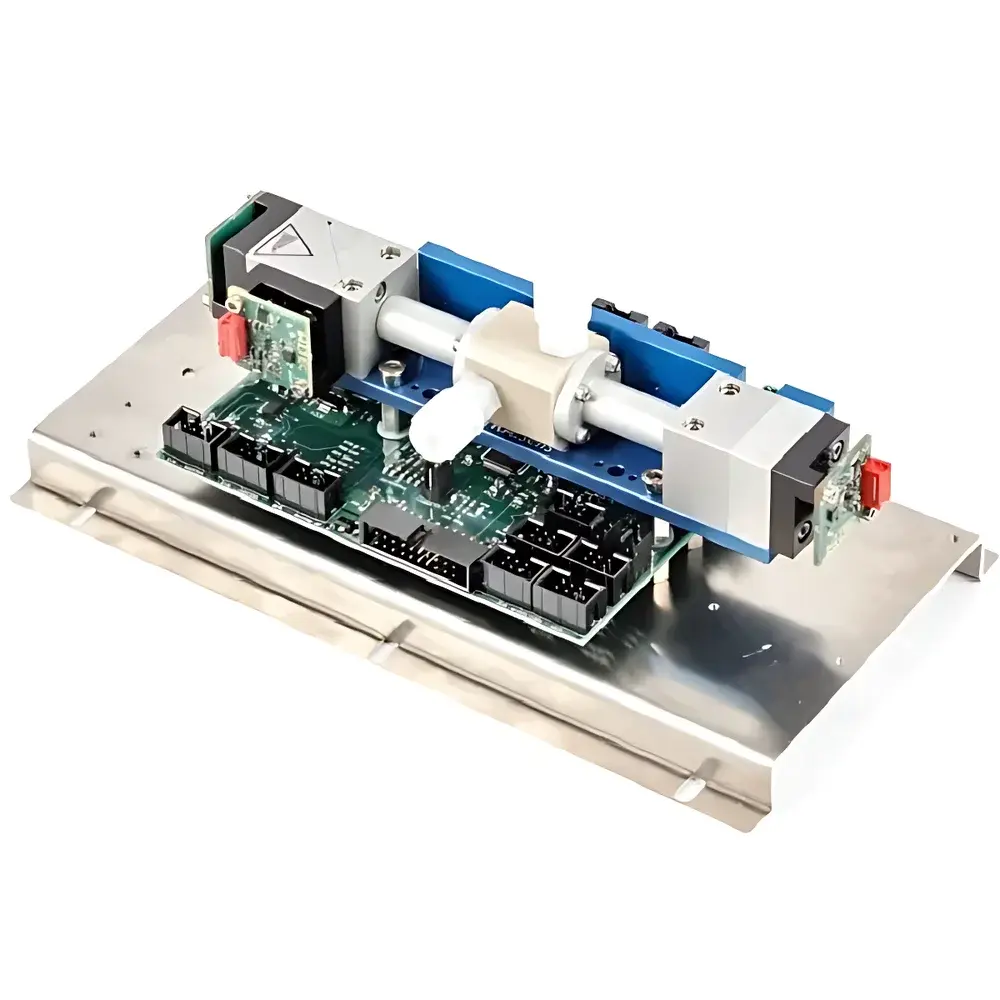
SIGAS S-UltraSense Industrial-Grade NDUV Gas Sensor
| Brand | SIGAS |
|---|---|
| Model | S-UltraSense |
| Origin | Germany |
| Detection Principle | Non-Dispersive Ultraviolet (NDUV) Absorption |
| Measurable Gases | NO, NO₂, SO₂, O₃, H₂S, N₂O, CnHm |
| Detection Range Options | 0–100 ppm to 0–30,000 ppm (gas-specific) |
| LOD | 1 ppm (typical, 3σ) |
| T₉₀ Response Time | <3 s @ 1 L/min |
| Operating Temperature | 10–40 °C |
| Power Supply | 24 VDC ±0.3 V |
| Average Power Consumption | 4 W (55 W max during warm-up) |
| Digital Resolution | 1 ppm – 0.1 vol.% |
| Zero Stability | ±1% FS |
| Span Stability | ±1% FS |
| Linearity | ±1% FS |
| Repeatability | ±1% FS |
| Temperature Drift | ±1% FS / 10 K (typ.) |
| Pressure Sensitivity | ±0.015% / mbar |
| Inlet Gas Temp. | −2–40 °C |
| Inlet Humidity Limit | dew point ≤10 °C (non-condensing) |
| Flow Rate | 0.2–1 L/min |
| Output Interfaces | RS232 (9-pin Sub-D), CANopen (2×5-pin, 2.45 mm pitch) |
| Heater Setpoint | 42 °C |
| Warm-up Time | <60 min (environment-dependent), <30 min @ 20 °C ambient |
| Ready Time after Power-On | <2 min (post-warm-up) |
| Housing Material | Stainless Steel with Protective Coating |
| Optical Path Length | 100 mm |
| Light Source | AlGaN-based UV LED (230–360 nm) with Active Thermal & Current Control |
| Lifetime | >3 years (LED source) |
| Sealing | O-ring interconnection between modular components |
| Cross-Interference Immunity | H₂O-free baseline stability |
| Power Dissipation | <1 W (sensor core only) |
Overview
The SIGAS S-UltraSense is an industrial-grade, non-dispersive ultraviolet (NDUV) gas sensor engineered for high-precision, real-time quantification of trace and low-concentration gaseous analytes in demanding process and environmental monitoring applications. Unlike conventional electrochemical or metal-oxide semiconductor sensors, the S-UltraSense employs a dual-beam optical absorption architecture grounded in the Lambert-Beer law. Incident UV light—generated by thermally stabilized AlGaN-based LEDs spanning 230–360 nm—is spectrally filtered to isolate gas-specific absorption bands (e.g., NO at 226 nm, NO₂ at 390–420 nm, SO₂ at 280–320 nm, O₃ at 254 nm). The collimated beam is split into sample and reference paths using precision optics; one traverses a 100 mm stainless-steel sample cell coated with a chemically inert protective layer, while the other passes through a sealed reference chamber. Two matched photodiodes detect intensity attenuation, and proprietary dual-ratio digital signal processing eliminates drift from source intensity fluctuation, window fouling, and thermal lensing—enabling sub-ppm detection limits and long-term baseline integrity without recalibration.
Key Features
- AlGaN UV LED light source with active current and temperature regulation—engineered for >3-year operational lifetime and spectral stability under thermal cycling
- Modular, field-serviceable design with O-ring sealed interconnects between optical module, electronics housing, and gas cell—reducing downtime during maintenance
- Dual-chamber configuration option for simultaneous differential measurement or background compensation in variable matrix environments
- Integrated Peltier-controlled heater maintaining optical path at 42 °C—minimizing condensation, suppressing water vapor interference, and ensuring consistent refractive index
- Low-power architecture: average consumption of 4 W (core sensor <1 W), compatible with 24 VDC industrial power rails and battery-backed systems
- Fast response: T₉₀ <3 seconds at 1 L/min flow rate; measurement update interval ≈200 ms for dynamic emission profiling
- High immunity to cross-sensitivity—validated against humidity (dew point ≤10 °C), hydrocarbons, CO₂, and particulate-laden streams per ISO 12039 and EN 15267 test protocols
Sample Compatibility & Compliance
The S-UltraSense is certified for continuous operation in Class I, Division 2 hazardous locations (pending ATEX/IECEx documentation) and meets EMC Directive 2014/30/EU and RoHS 2011/65/EU requirements. Its stainless-steel wetted parts (316L grade), chemically passivated sample cell, and condensate-tolerant inlet geometry support deployment in flue gas ducts, biogas upgrading units, semiconductor fab exhaust lines, and wastewater treatment off-gas streams. It complies with key regulatory frameworks governing emissions reporting—including EU Directive 2010/75/EU (IED), US EPA Method 6C (SO₂), Method 7E (NOₓ), and ISO 14064-1 for GHG verification. Data integrity adheres to ALCOA+ principles; optional firmware enables audit-trail logging aligned with FDA 21 CFR Part 11 and EU Annex 11 requirements when integrated with compliant SCADA platforms.
Software & Data Management
The sensor communicates via ASCII-protocol RS232 (9-pin D-sub) and CANopen (CiA 301 v4.2, PDO mapping configurable), supporting direct integration into PLCs (Siemens S7, Rockwell Logix), DCS systems (Emerson DeltaV, Honeywell Experion), and edge gateways. SIGAS provides the UltraLink Configuration Suite—a Windows-based tool for zero/span calibration, range switching, alarm threshold setup, and diagnostic log export (CSV/JSON). Firmware supports over-the-air updates and includes built-in self-diagnostics: LED health monitoring, photodiode saturation detection, flow validation, and heater fault logging. All measurements are timestamped with internal RTC (±2 s/month drift) and include raw absorbance ratios, temperature-compensated concentration values, and confidence flags—enabling traceable data lineage for GLP/GMP environments.
Applications
- Continuous Emission Monitoring Systems (CEMS) for coal-, gas-, and biomass-fired power plants—especially ultra-low NOₓ/SO₂ compliance reporting (≤5 mg/m³)
- Real-time stack gas analysis in cement kilns, glass furnaces, and incinerators where rapid thermal transients challenge conventional NDIR sensors
- Biogas quality control: simultaneous H₂S (0–5000 ppm) and O₃/CnHm monitoring prior to CHP or upgrading units
- Industrial hygiene monitoring in chemical manufacturing—detecting NO₂ leaks in nitric acid production or SO₂ in sulfur recovery units
- Research-grade atmospheric simulation chambers requiring stable, interference-free UV absorption baselines over extended campaigns
- Mobile emissions testing (PEMS) for heavy-duty vehicles—leveraging fast response and low power for trailer-mounted analyzers
FAQ
What gases can the S-UltraSense measure simultaneously?
The base configuration measures one gas per optical channel. Multi-gas variants (e.g., NO/NO₂/SO₂) use three independently controlled UV LED sources and wavelength-selective filters—enabling concurrent, non-interfering quantification without gas chromatography.
Is calibration required on-site?
Zero calibration is performed automatically using clean air or N₂ purge; span calibration requires certified gas standards (e.g., NO in N₂, SO₂ in air) and is typically conducted quarterly or per ISO 14064-3 verification schedules.
How does the sensor handle high-humidity or corrosive sample streams?
The heated optical path (42 °C) prevents condensation; inlet conditioning (optional chilled mirror or permeation dryer) is recommended for dew points >10 °C. Stainless-steel construction and inert coating resist H₂S, Cl₂, and acidic aerosols up to pH 2.
Can the S-UltraSense be integrated into existing SCADA systems?
Yes—via native RS232 ASCII or CANopen (CiA 401 profile); Modbus RTU and OPC UA gateways are supported through third-party protocol converters compliant with IEC 62541.
What is the expected service life of consumable components?
The AlGaN LED source is rated for >25,000 hours at nominal drive current; O-rings and filter windows are replaceable field kits with 2-year shelf life under standard storage conditions.







