
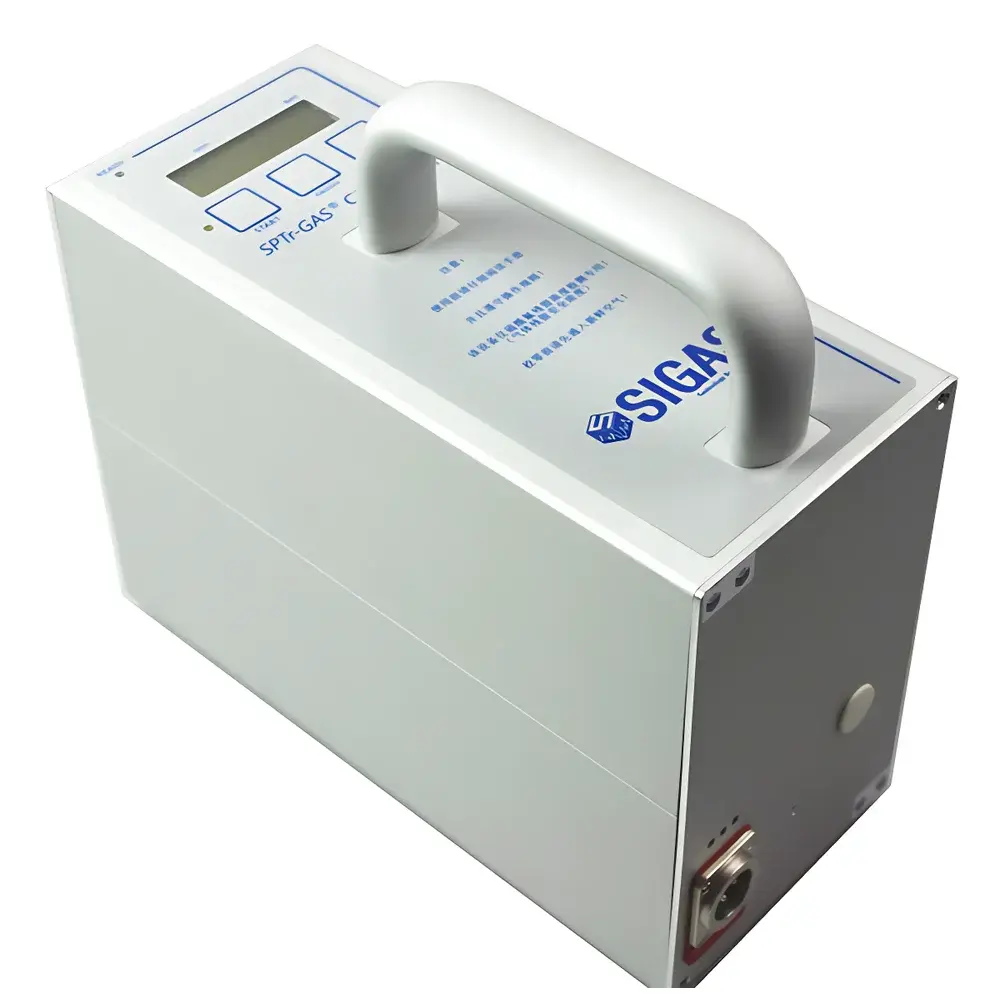
SIGAS SPTr-GAS® PORT 200 Portable Photoacoustic Spectroscopy Gas Analyzer
| Brand | SIGAS |
|---|---|
| Model | SPTr-GAS® PORT 200 |
| Detection Principle | Photoacoustic Spectroscopy (PAS) |
| Dimensions (H×W×D, incl. handle & ports) | 230 mm × 105 mm × 270 mm |
| Weight | ~4.3 kg |
| Power Supply | Internal NiMH battery (19.2 V, 4.5 Ah) |
| Operating Time | >4 h (fully charged) |
| Charging Time | ~3.5 h |
| Operating Temperature | +5 °C to +40 °C |
| Storage Temperature | −10 °C to +60 °C |
| Humidity Range | 0–95% RH (non-condensing) |
| Display | 1×8-character LCD with red backlight |
| Accuracy | ±0.5 ppm (0–10 ppm range) |
| Resolution | 0.5 ppm (residual gas) |
| Integrated Compensation | Active temperature stabilization (50 °C heated PAS cell), real-time humidity sensing, multi-gas interference rejection via spectral signal discrimination |
Overview
The SIGAS SPTr-GAS® PORT 200 is a field-deployable, battery-powered gas analyzer engineered for quantitative trace gas detection using photoacoustic spectroscopy (PAS). Unlike conventional non-dispersive infrared (NDIR) or electrochemical sensors, PAS relies on the physical photoacoustic effect: modulated infrared light—tuned to the fundamental absorption band of the target analyte—is absorbed by gas molecules, inducing localized thermal expansion and generating pressure waves (acoustic signals) within a sealed, resonant measurement cell. These ultralow-amplitude acoustic transients are detected by a high-sensitivity, low-noise MEMS microphone and converted into concentration values via digital lock-in amplification and calibrated signal processing algorithms. This principle eliminates optical path-length dependency, avoids optical window fouling, and delivers inherent immunity to particulate scattering and background light interference—making the SPTr-GAS® PORT 200 especially robust in uncontrolled field environments where dust, vibration, or variable ambient lighting would degrade performance of traditional optical systems.
Key Features
- Compact, ergonomic design optimized for one-handed operation: dimensions of 230 × 105 × 270 mm and mass of 4.3 kg enable extended use during mobile surveys and confined-space inspections.
- Integrated PAS cell with active thermal control: maintained at 50 °C to minimize condensation, suppress thermal drift, and stabilize baseline response across ambient temperature fluctuations (+5 °C to +40 °C operating range).
- Real-time humidity compensation: onboard high-accuracy capacitive hygrometer feeds dynamic correction coefficients into the concentration algorithm, mitigating water vapor cross-sensitivity without requiring external drying units.
- Three-button interface with monochrome red-backlit LCD: enables intuitive navigation through measurement modes, calibration status, battery level, and diagnostic menus—designed for glove-compatible operation in industrial settings.
- Automatic zero-point verification: performed periodically during idle cycles using internal reference pathways; no manual span gas or external zero-air supply required for routine field use.
- Robust power architecture: rechargeable NiMH battery (19.2 V / 4.5 Ah) supports >4 hours of continuous analysis; universal AC adapter (100–240 V, 47–64 Hz) enables global deployment without voltage conversion hardware.
Sample Compatibility & Compliance
The SPTr-GAS® PORT 200 is validated for direct sampling of ambient air, stack effluents, headspace vapors, and controlled atmospheres without pre-concentration or catalytic conversion—provided target gases exhibit IR-active vibrational transitions within the instrument’s tunable laser or broadband source range. It complies with general requirements for portable environmental monitoring equipment per ISO 16000-23 (indoor air—determination of formaldehyde and other carbonyls) and supports method development aligned with EPA Method TO-15 (determination of volatile organic compounds in ambient air) when used with appropriate sampling protocols. While not certified to ATEX or IECEx for hazardous locations, its low-power electronics and sealed optical cavity meet IP54 ingress protection standards for dust and water resistance. All firmware operations—including data logging timestamps, sensor diagnostics, and calibration history—are timestamped and stored in non-volatile memory to support GLP-compliant recordkeeping.
Software & Data Management
Data acquisition and reporting are managed via embedded firmware with configurable logging intervals (1 s to 60 min), automatic file rollover, and CSV export via USB-C interface. No proprietary desktop software is required: logged datasets include raw acoustic amplitude, compensated concentration, ambient temperature/humidity, battery voltage, and system health flags. The device supports audit-trail functionality—each zero-check event, user-initiated calibration, or parameter change is recorded with UTC timestamp and operator ID (if enabled via optional authentication module). For integration into centralized SCADA or LIMS platforms, ASCII-based serial output (RS-232/USB CDC) provides real-time streaming of concentration values with NMEA-style sentence framing, enabling compatibility with industry-standard data ingestion pipelines compliant with ISA-95 and ASTM E2500-18 guidelines.
Applications
- Industrial process monitoring: real-time detection of SF₆ decomposition products in GIS switchgear, NH₃ leaks in refrigeration circuits, or PH₃ in semiconductor fab exhaust streams.
- Environmental compliance verification: quantification of fumigants (e.g., phosphine, methyl bromide) in grain silos, soil emission flux studies, and landfill biogas composition screening.
- Emergency response & leak localization: rapid identification of VOCs, CO, NO₂, or H₂S during chemical spills, refinery incidents, or confined-space entry assessments.
- Research-grade field validation: ground-truthing of remote sensing data (e.g., DOAS, FTIR), calibration transfer between laboratory and ambient conditions, and method comparison studies under ISO/IEC 17025-accredited protocols.
- Regulatory emissions auditing: supporting periodic stack testing per EN 14181 (QAL2/QAL3 verification) when deployed as a reference analyzer in tandem with CEMS.
FAQ
Does the SPTr-GAS® PORT 200 require daily calibration with certified gas standards?
No. It performs autonomous zero-point verification using internal thermal referencing; span calibration is recommended every 30 days or after exposure to extreme contamination events, using traceable standard gases per ISO 6141.
Can it operate continuously while charging?
Yes—the analyzer supports hot-swap operation: AC power input maintains battery float charge while sustaining full measurement functionality without interruption.
Is spectral interference from CO₂ or H₂O fully compensated?
The PAS engine applies real-time humidity-coupled baseline correction and employs narrowband excitation wavelengths selected to avoid overlapping absorption features; residual cross-sensitivity is <2% of reading for typical ambient CO₂/H₂O levels.
What maintenance is required beyond battery replacement?
Annual inspection of the MEMS microphone sensitivity and optical window cleanliness is advised; no consumables (e.g., filters, electrolytes, or scrubbers) are used in normal operation.
How is measurement uncertainty quantified and documented?
Total expanded uncertainty (k=2) is calculated per GUM (JCGM 100:2008) incorporating contributions from signal noise, temperature/humidity compensation residuals, linearity deviation, and calibration gas certificate uncertainty—reported in the device’s electronic calibration certificate.







