
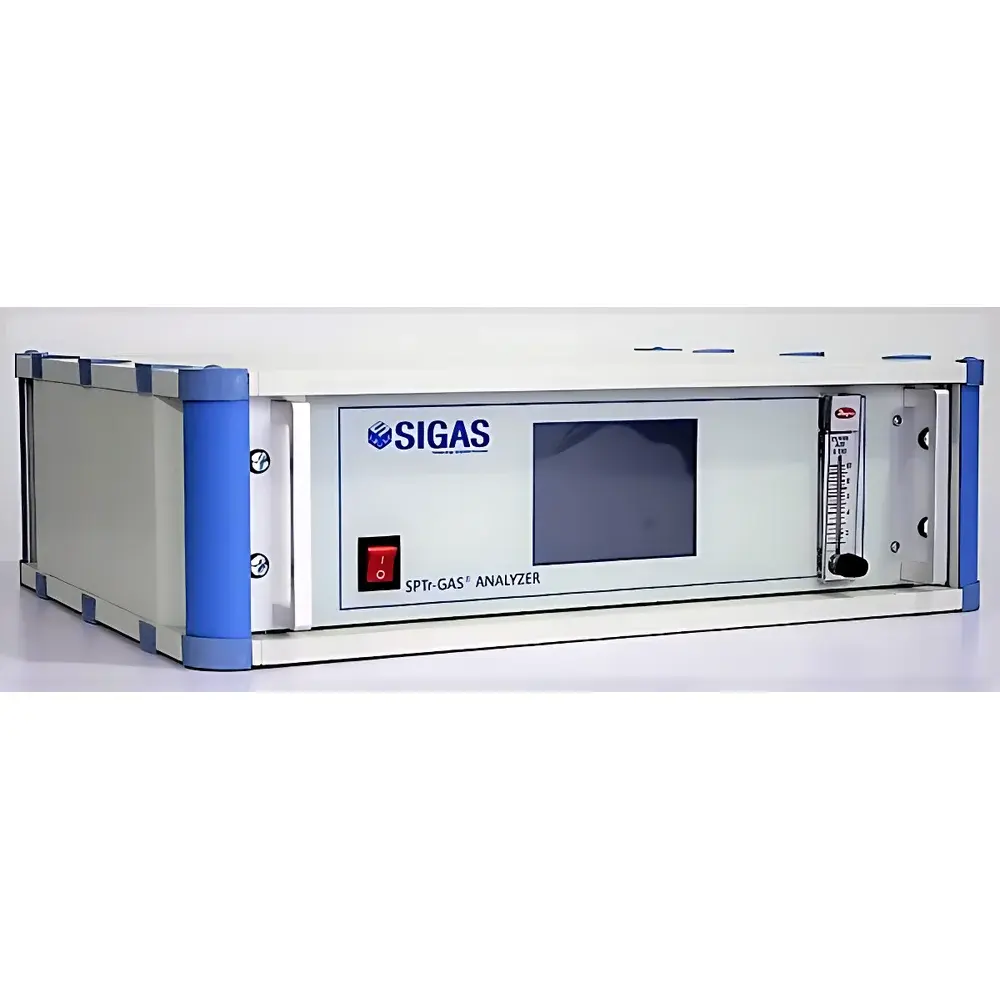
Schütz SPTr-GAS® Analyzer Photoacoustic Trace Gas Analyzer
| Brand | Schütz SIGAS |
|---|---|
| Origin | Jiangsu, China |
| Manufacturer Type | Authorized Distributor |
| Regional Category | Domestic (PRC) |
| Model | SPTr-GAS® ANALYZER |
| Instrument Type | Online Gas Analyzer |
| Detection Principle | Photoacoustic Spectroscopy (PAS) |
| Typical LOD | < 0.01 % FS |
| Response Time (T90) | < 20 s |
| Warm-up Time | ~15 min to 50 °C at 20 °C ambient |
| Display | 5.6" Touchscreen LCD |
| Analog Output | 4–20 mA (configurable range), 2 mA fault signal |
| Digital I/O | 6 relay outputs (programmable per channel) |
| Communication | RS232 (DB9-M), RS485 Modbus RTU |
| Power Supply | 198–242 V AC, 50/60 Hz, < 125 W |
| Enclosure Rating | IP41 (EN 60529) |
| Weight | ~10 kg (net), ~19 kg (packaged) |
| Sample Flow Rate | 0.2–1.2 L/min (±0.02 L/min stability required) |
| Inlet Temp | 5–35 °C |
| Inlet Pressure | ≤116 kPa |
| Inlet Humidity | Non-condensing |
| Particulate Load | ≤100 µg/m³, ≤1 µm |
| Zero Gas | 99.999% N₂ |
| Span Gas | 75–125% of full scale |
| Mid-point Calibration Gas | 37.5–62.5% of full scale |
Overview
The Schütz SPTr-GAS® Analyzer is an online photoacoustic trace gas analyzer engineered for high-sensitivity, interference-resistant quantification of volatile compounds in complex industrial and environmental matrices. It operates on the physical principle of photoacoustic spectroscopy (PAS), where modulated infrared light—tuned to absorption bands of target analytes—is absorbed by gas molecules, inducing localized thermal expansion and generating pressure waves (acoustic signals). These ultrasonic signals are detected by a low-noise, temperature-stabilized microphone housed within a resonant photoacoustic cell. Unlike conventional NDIR or FTIR systems, PAS eliminates optical path-length dependency and background scattering artifacts, delivering inherently high signal-to-noise ratio (SNR) for sub-ppm detection without optical windows or beam alignment. The instrument’s core architecture integrates active thermal stabilization (maintained at 50 °C), on-board humidity compensation via integrated IR hygrometry, and real-time baseline correction algorithms—enabling robust operation under fluctuating ambient conditions typical of stack emissions, semiconductor fab utilities, or landfill biogas streams.
Key Features
- Integrated photoacoustic cell with temperature-controlled (50 °C ±0.2 °C), vibration-damped acoustic chamber for long-term baseline stability
- On-chip infrared humidity sensing co-located inside the PAS cell—enabling dynamic water vapor interference correction without external dew-point chillers
- Multi-channel sampling architecture with internal diaphragm pump and three electrically actuated solenoid valves for automated sequential analysis across up to three independent inlet points
- Internal activated carbon pre-filter and replaceable particulate filters (≤1 µm cutoff) mounted directly at each sampling port to protect the optical-acoustic core from hydrocarbons and aerosols
- Auto-zero functionality using certified 99.999% nitrogen, configurable per channel; optional air-based zero calibration for field-deployed applications
- Modular firmware architecture supporting over 30 pre-characterized gases—including NH₃, SO₂, NO, SF₆, VOCs (e.g., acetone, isopropanol, styrene), fluorinated refrigerants (R11, R12, R134a, R125), and specialty process gases (NF₃, ProFume®)
- Compliance-ready analog and digital interfaces: isolated 4–20 mA output (user-scalable), six programmable relays with configurable alarm logic, and dual serial protocols (RS232 diagnostics + RS485 Modbus RTU for SCADA integration)
Sample Compatibility & Compliance
The SPTr-GAS® Analyzer accepts sample streams meeting ISO 8573-1 Class 4 particulate and Class 3 moisture specifications. Inlet gas must be non-condensing, with dew point controlled to 5 ±0.1 °C when measuring SO₂ or NO—ensuring minimal spectral overlap from H₂O rotational bands. The system complies with EN 61000-6-2 (immunity) and EN 61000-6-4 (emissions), and its enclosure meets IP41 per EN 60529. While not certified to EPA Method 205 or EN 14181, its measurement methodology aligns with the performance criteria defined in ISO 12039 (SO₂), ISO 10849 (NH₃), and ASTM D6348 (VOCs) for continuous emission monitoring system (CEMS) auxiliary analyzers. Data integrity features—including timestamped calibration logs, relay state history, and analog output diagnostic flags—support GLP/GMP-aligned operational documentation.
Software & Data Management
The embedded Linux-based firmware provides local data logging (≥30 days of 1-second resolution concentration values), configurable alarm thresholds (high/low, rate-of-change), and event-triggered snapshot capture. All calibrations—zero, span, and mid-point—are recorded with operator ID, gas certificate traceability, and deviation metrics. The RS485 Modbus interface supports read/write access to all configuration registers and real-time process variables (PV, SP, status bits), enabling seamless integration into DeltaV, Siemens Desigo, or Ignition SCADA platforms. Optional cloud telemetry module (via Ethernet/Wi-Fi) enables remote firmware updates, predictive maintenance alerts based on signal drift trends, and secure TLS-encrypted data export compliant with GDPR and ISO/IEC 27001 data handling requirements.
Applications
- Continuous emissions monitoring (CEM) of NH₃ slip in SCR deNOx systems and SO₂ in flue gas desulfurization units
- In-line purity verification of bulk electronic specialty gases (e.g., NF₃, C₂F₆, CHF₃) in semiconductor manufacturing tool cabinets
- Real-time tracking of VOC breakthrough in activated carbon beds during solvent recovery or odor control operations
- Process gas composition control in chemical synthesis reactors—particularly for reactions involving halogenated intermediates (e.g., chlorinated ethanes, fluorinated ketones)
- Landfill gas quality assurance (CH₄, H₂S, siloxanes) and biogas upgrading optimization
- Tunnel air quality surveillance for CO, NO₂, and NH₃ generated by diesel exhaust and de-icing agents
- TOC off-gas analysis in pharmaceutical wastewater treatment via catalytic oxidation followed by PAS detection of CO₂
FAQ
What is the minimum detectable concentration for ammonia (NH₃) in air?
For the 0–100 ppm NH₃ configuration, the limit of detection (LOD) is 0.1 ppm (3σ of zero-gas baseline noise), with linearity maintained to ±0.1% FS across the full scale.
Can the analyzer operate unattended for extended periods?
Yes—the system supports scheduled auto-zero cycles (user-defined interval), automatic relay-triggered span calibration, and built-in diagnostics that flag flow instability, temperature deviation, or microphone sensitivity drift before measurement integrity is compromised.
Is third-party calibration certification available?
Calibration certificates traceable to NIM (China National Institute of Metrology) or NIST standards can be provided upon request, including uncertainty budgets per ISO/IEC 17025 for individual gas channels.
How does the analyzer handle cross-interference from CO₂ or H₂O in humid samples?
The PAS cell’s narrow-band excitation and phase-sensitive lock-in detection reject broadband thermal noise; combined with co-located IR hygrometry and multi-wavelength referencing (where applicable), spectral interference from CO₂ and H₂O is mathematically compensated in real time.
What maintenance intervals are recommended?
Particulate filters should be replaced every 3–6 months depending on dust loading; activated carbon pre-filter every 12 months; microphone sensitivity verification annually using factory-provided reference gas pulses. No optical alignment or lamp replacement is required over the instrument’s service life.
Related Products







