
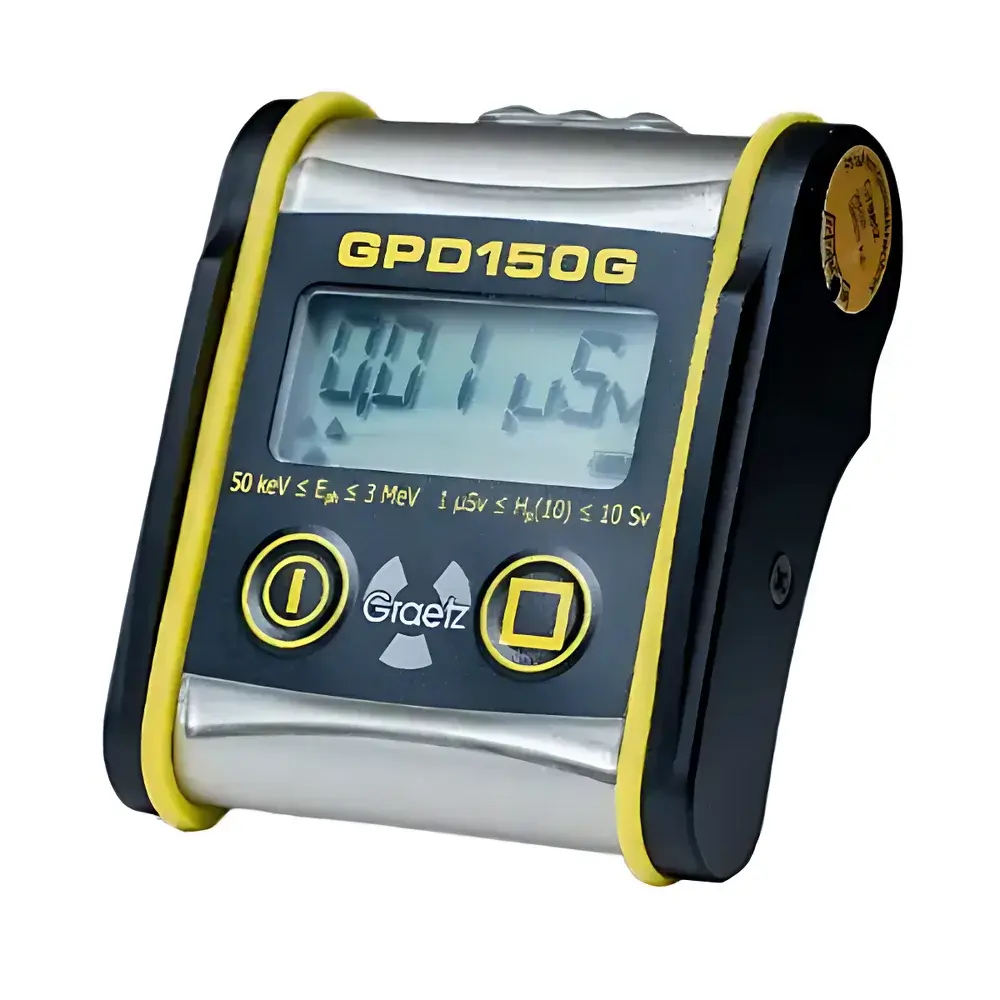
Schutz SIGAS GPD150G Electronic Personal Dosimeter
| Brand | Schutz SIGAS |
|---|---|
| Origin | Germany |
| Model | GPD150G |
| Instrument Type | Portable Dose/Dose Rate Meter |
| Detector Type | Energy-Compensated Geiger-Müller Tube |
| Measured Quantity | Hp(10) (Deep Personal Dose) |
| Radiation Type | Gamma and X-ray |
| Energy Range | 55 keV – 1.3 MeV |
| Dose Range | 1 µSv – 10 Sv |
| Protection Rating | IP54 |
| Battery Life | Up to 3 months (8 h/day) under ambient background radiation |
| Alarm Functions | Audible, visual, and vibration alerts for dose & dose rate thresholds |
| Predefined Warning Levels | Four user-selectable dose thresholds + one factory-set dose rate threshold |
| Data Retention | Persistent memory during battery replacement |
| Operating Mode | Single-pulse acoustic detection (switchable) |
| Accessories | Belt clip and protective holster |
| Compliance | Designed in accordance with IEC 61526:2010 and IEC 62387-1:2012 for personal dosimetry |
Overview
The Schutz SIGAS GPD150G is a CE-marked, battery-powered electronic personal dosimeter engineered for real-time monitoring of Hp(10) — the operational quantity for deep personal dose equivalent in external photon radiation fields. Based on energy-compensated Geiger-Müller (GM) tube detection technology, the GPD150G delivers traceable, reproducible measurements across a broad photon energy range (55 keV to 1.3 MeV), making it suitable for occupational exposure assessment in mixed gamma/X-ray environments. Its compact form factor, ruggedized housing, and IP54 ingress protection ensure reliable performance under demanding field conditions — including fire response, civil defense operations, nuclear medicine departments, industrial radiography, and academic research laboratories. Unlike passive dosimeters (e.g., TLD or OSL badges), the GPD150G provides immediate readout, configurable alarms, and continuous self-diagnostic capability — fulfilling functional requirements outlined in IEC 61526:2010 for active personal dosimeters used in routine and emergency monitoring.
Key Features
- Real-time Hp(10) measurement with dual alarm functionality: independent dose accumulation and dose rate thresholds
- Energy-compensated GM detector optimized for flat response across 55 keV–1.3 MeV — minimizing over-response at low energies per IEC 62387-1:2012
- Four programmable dose warning levels plus one fixed dose rate alarm threshold, configurable via front-panel interface
- Volatile-memory-free operation: all accumulated dose values and user settings retained during battery replacement
- Multi-modal alerting: simultaneous audible beep, LED flash, and optional vibration signal upon threshold exceedance
- Integrated self-test and continuous internal diagnostics — verifying detector integrity, electronics function, and battery status every 30 seconds
- Extended battery life: up to 90 days (based on 8 h/day usage) under typical environmental background radiation (≈0.1 µSv/h)
- Low-battery warning indicator activated when remaining capacity falls below 10% of nominal voltage
- Ergonomic design with integrated belt clip and impact-resistant protective holster for field durability
Sample Compatibility & Compliance
The GPD150G is calibrated and type-tested for Hp(10) evaluation in homogeneous photon fields, as defined in ISO 4037 and IEC 61526. It meets the performance criteria for Class M dosimeters per IEC 62387-1:2012, ensuring compliance with national radiation protection regulations in EU member states, the USA (NRC guidance), and Canada (CNSC REG-262). The device supports audit-ready documentation through its non-volatile event logging (dose/dose rate alarms, self-test failures, low-battery events) — facilitating GLP-aligned recordkeeping and regulatory reporting. While not intended for neutron or beta radiation monitoring, its energy compensation ensures minimal angular dependence (<±20% at ±60° incidence) and robustness against common electromagnetic interference sources encountered in industrial and emergency response settings.
Software & Data Management
The GPD150G operates autonomously without mandatory PC connectivity; however, optional infrared (IR) interface enables data download to the SIGAS Dosimetry Suite (Windows-compatible software). This application supports dose history export in CSV/Excel format, alarm event chronology, calibration certificate management, and batch reporting for multi-user deployments. All logged entries include timestamps, dose values, alarm types, and system status flags — satisfying traceability requirements under ISO/IEC 17025 and FDA 21 CFR Part 11 when configured with user authentication and electronic signature modules. No cloud storage or remote telemetry is embedded; data sovereignty remains fully under institutional control.
Applications
- Fire & rescue services: real-time situational awareness during radiological incident response
- Civil defense and emergency management: personnel monitoring during CBRN preparedness drills and deployment scenarios
- Nuclear medicine: staff dose tracking during PET/CT radiopharmaceutical handling and patient administration
- Industrial NDT: dose verification for radiographers performing gamma or X-ray weld inspections
- Research laboratories: educational tool for radiation safety training and experimental dosimetry validation
- Decommissioning projects: task-based exposure monitoring in legacy nuclear facilities
FAQ
What does Hp(10) represent, and why is it used for personal dosimetry?
Hp(10) is the personal dose equivalent at 10 mm depth in the ICRU sphere phantom, serving as the standardized operational quantity for assessing stochastic health risk from penetrating photon radiation. Regulatory frameworks worldwide mandate Hp(10) reporting for occupational monitoring.
Can the GPD150G measure neutron or beta radiation?
No. The energy-compensated GM tube is optimized exclusively for gamma and X-ray photons. Neutron or beta emitters require dedicated detectors (e.g., CR-39 for alpha/beta, He-3 tubes for thermal neutrons).
Is calibration traceable to national standards?
Yes. Each unit ships with a factory calibration certificate traceable to PTB (Physikalisch-Technische Bundesanstalt), Germany’s national metrology institute, in accordance with ISO/IEC 17025.
How frequently should the device be recalibrated?
Annual recalibration is recommended under normal use. More frequent verification may be required following mechanical shock, extreme temperature exposure, or after any firmware update.
Does the GPD150G support multi-user configuration?
While the device itself is single-user oriented, the Dosimetry Suite software enables centralized management of multiple units, including user assignment, group-based alarm templates, and consolidated regulatory reporting.







